
Test
Science 10 Unit 2 - Physics MEGA QUIZ
Este test tiene tipos de pregunta que se abren en el reproductor de siempre.
Preguntas del test (24)
1What is the Phlogiston Theory and when was it created?
- ASimilar to previous theory, but states that it doesn't have mass. It cannot be created nor destroyed. lt flows from warm to cold substances; late 1700s
- BHeat is a fluid known as phlogiston, flows between different objects as "heat". This was disproved because it would mean heat has mass, which it doesn't.; 1700s
- CHeat is a form of energy and can be converted to different forms (kinetic, chemical, etc.). Specific heat capacity was created at this time; 1800s
- DThe more particles move, the more thermal energy is created. Energy cannot be created nor destroyed and it comes in many forms; modern day
2What is the Caloric Theory and when was it created?
- ASimilar to previous theory, but states that it doesn't have mass. It cannot be created nor destroyed. lIt flows from warm to cold substances; late 1700s
- BHeat is a fluid known as phlogiston, flows between different objects as "heat". This was disproved because it would mean heat has mass, which it doesn't; 1700s
- CHeat is a form of energy and can be converted to different forms (kinetic, chemical, etc.). Specific heat capacity was created at this time; 1800s
- DThe more particles move, the more thermal energy is created. Energy cannot be created nor destroyed and it comes in many forms; modern day
3What did Count Rumford find out and when?
- AThe more particles move, the more thermal energy is created. Energy cannot be created nor destroyed and it comes in many forms; modern day
- BHeat is a fluid known as phlogiston, flows between different objects as "heat". This was disproved because it would mean heat has mass, which it doesn't; 1700s
- CSimilar to previous theory, but states that it doesn't have mass. It cannot be created nor destroyed. lIt flows from warm to cold substances; late 1700s
- DHeat is a form of energy and can be converted to different forms (kinetic, chemical, etc.). Specific heat capacity was created at this time; 1800s
4What is the Kinetic Molecular theory and when was it created?
- AHeat is a fluid known as phlogiston, flows between different objects as "heat". This was disproved because it would mean heat has mass, which it doesn't; 1700s
- BHeat is a form of energy and can be converted to different forms (kinetic, chemical, etc.). Specific heat capacity was created at this time; 1800s
- CSimilar to previous theory, but states that it doesn't have mass. It cannot be created nor destroyed. lIt flows from warm to cold substances; late 1700s
- DThe more particles move, the more thermal energy is created. Energy cannot be created nor destroyed and it comes in many forms; modern day
5Heat is the [blank_start]total[blank_end] kinetic energy of the particles. Temperature is the [blank_start]average[blank_end] kinetic energy of the particles.
- Atotal
- Baverage
- Cproduct of the
- Dsum of the
- Eaverage
- Ftotal
- Gsum of the
- Hproduct of the
6Check all the units that heat is measured in:
- AKilojoules
- BJoules
- CCelcius
- DFarenhiet
- EKelvin
7Check all of the units that temperature is measured in:
- AFarenhiet
- BCelcius
- CJoules
- DKilojoules
- EKelvin
8Someone moved an object. They applied a force of 12 N and it moved 800 cm. What was the work being done on the object?
- A9600 J
- B960 J
- C96 J
- D9.6 J
9It took 1300 J to move an object 3.2 m. What was the force applied?
- A2.4615 x 10(-3) N
- B406.25 N
- C4.0625 N
- D4160 N
10Someone is holding a suitcase above the ground and walking down the flat hallway. Work is being applied in this situation.
- AVerdadero
- BFalso
11Check all that are scalar quantities:
- ADistance
- BTime
- CSpeed
- DVelocity
- EAcceleration
- FDisplacement
12Check all that are vector quantities:
- ADisplacement
- BDistance
- CSpeed
- DAcceleration
- EVelocity
- FTime
13An object moved 500 m in 3 seconds, what is the object's speed?
- A167 m/s
- B1.66 m/s
- C0.6 m/s
- D0.006 m/s
14- Displacement is [blank_start]the shortest distance[blank_end] between two points
- Distance is [blank_start]any path[blank_end] between two points
- With vector quantities, North, East and Up are [blank_start]POSITIVE[blank_end] directions, while South, West and Down are [blank_start]NEGATIVE[blank_end] directions- Athe shortest distance
- Bthe longest path
- Cany path
- Dany path
- Ethe longest distance
- Fthe shortest distance
- Gpositive
- Hnegative
- Iscalar
- Jvector
- Knegative
- Lpositive
- Mvector
- Nscalar
15Point 1 is at 8.0 m[N] and point 2 is at 3.0 m [S]. I ride my bike and it takes 4.5 seconds to go from point 1 to point 2. What is my bike's velocity?
- A- 2.44 m/s
- B2.44 m/s
- C0.36 m/s
- D- 0.36 m/s
16I start speeding up on a highway. At first, I am going 40 km/h[E] and after 5 seconds I make it to 95 k/m[E]. What is my acceleration?
- A39855 km/h(2)
- B39855072 km/h(2)
- C39855 m/s(2)
- D39855072 m/s(2)
17Kinetic energy is the energy of [blank_start]MOVEMENT[blank_end]
Potential energy is [blank_start]STORED[blank_end] energy:
- [blank_start]Elastic[blank_end] potential energy is when an object is bend/compressed and has stored energy to return to its original shape
- [blank_start]Chemical[blank_end] potential energy is the stored energy in the bonds of chemicals
- [blank_start]Gravitational[blank_end] potential energy is the stored energy from the attraction between two objects
Mass is measured in [blank_start]kg[blank_end] and is the [blank_start]amount of space something takes up[blank_end]. Weight is the [blank_start]mass + gravity[blank_end].- Amovement
- Blight
- Cchemical bonds
- Dair waves
- Estored
- Fchemically bonded
- Ginvisible
- HElastic
- IChemical
- JGravitational
- KChemical
- LElastic
- MGravitational
- NGravitational
- OElastic
- PChemical
- Qkg
- RL
- SmL
- TN
- Uamount of space something takes up
- Vamount of space + gravity
- Wamount of energy something has
- Xamount of space + gravity
- Yamount of space something takes up
- Zamount of energy something has
18Some rules of energy:
- [blank_start]No[blank_end] machine is 100% efficient
- Energy [blank_start]cannot[blank_end] be [blank_start]created nor destroyed[blank_end], only [blank_start]transferred[blank_end]- ANo
- BSome
- CAll
- Dcannot
- Ecan
- Fcreated nor destroyed
- Gcreated
- Hdestroyed
- Iconverted
- Jtransferred
- Kcreated and destroyed
- Lcreated
- Mdestroyed
19What are the energy conversions in this situation?
A diver jumps off a spring board into the water below.- AChemical > Elastic > Gravitational > Kinetic
- BKinetic > Gravitational > Elastic > Chemical
- CGravitation > Chemical > Kinetic > Elastic
- DGravitational > Elastic > Kinetic > Chemical
20A 2kg ball is held above a table. It is 0.30 m above the table, and the table is 300 cm above the ground. What is the ball's gravitational potential energy relative to the ground?
- A64.746 J
- B7445.8 J
- C64746 J
- D7.4458 J
21A 4.2 kg ball was thrown and moved 0.7 m/s. What is the ball's kinetic energy?
- A2.058 J
- B1.029 J
- C2.940 J
- D1.470 J
22Label the Pendulum with the different forms of energy present.
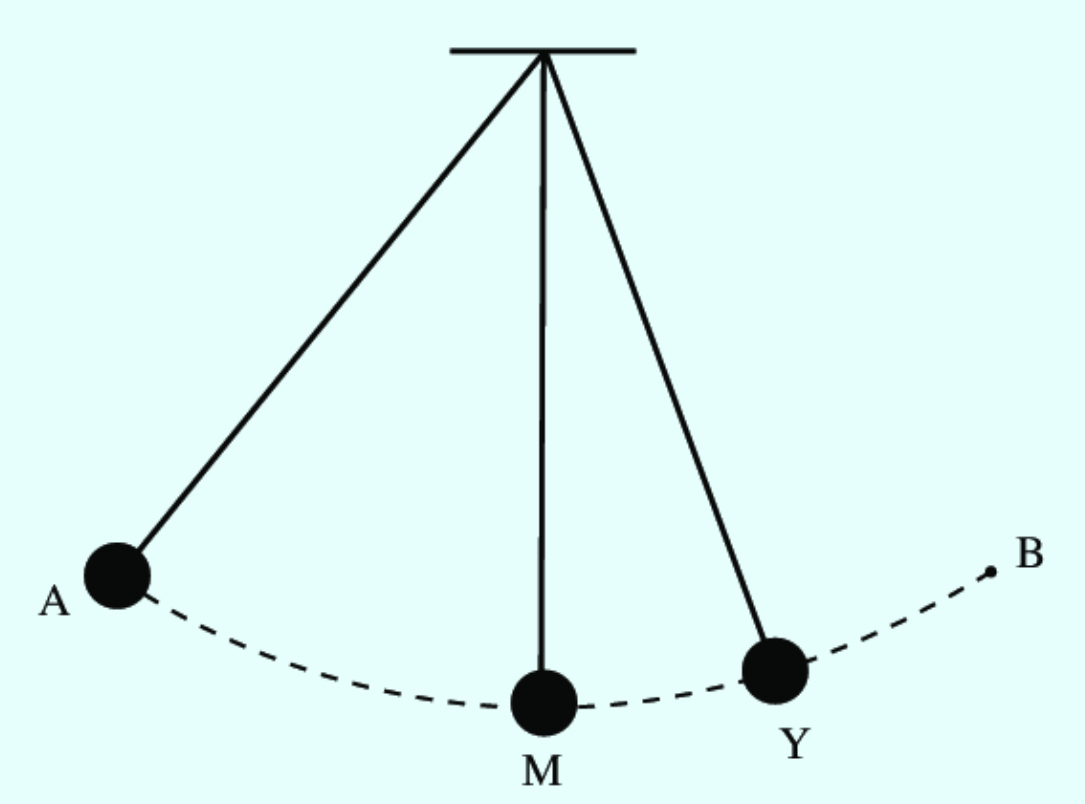
- AAll gravitational, no kinetic
- BAll kinetic, no gravitational
- C50/50 gravitational and kinetic
- D50/50 gravitational and kinetic
- EAll kinetic, no gravitational
- FAll gravitational, no kinetic
- G50/50 gravitational and kinetic
- HAll kinetic, no gravitational
- IAll gravitational, no kinetic
23A car takes in 12000 J of chemical energy to run. 8900 J is converted to kinetic energy to make the wheels turn. What is the efficiency of this machine?
- A0.742 %
- B74.2 %
- C7.42%
- D742%
24Someone drops a 23 kg rock down a cliff. The cliff is 400 m high. If the rock has 89,000 J of kinetic energy when breaking apart at the bottom, how much energy is converted to other forms?
- A0.986 %
- B98.6 %
- C1.38 %
- D0.014 %
Información
- Descripción
- Use this to study for exams.
- Autor
- Riley Babuik
- Idioma
- English
- Visitas
- 28
- Etiquetas
- Valoración
- Aún sin valoraciones Valora este test