
Test
Clinical Medicine: Pulmonary Vascular Disease
Preguntas del test (70)
1Mortality rates in the first 3 months following a PE dx are:
- A1.5%
- B5%
- C15%
- D30%
- E50%
2Emboli begin as thrombi which may consist of:
- Afat
- Bair
- Ctumor
- DOnly A & B
- EAll of the above
3Venous thromboembolism may originate from:
- ADVTs
- Bcatheters
- Cinfections
- DA & C only
- EAll of the above
4Which of the following are physiologic anticoagulants that oppose thrombosis?
- AAT-III
- BFibrin
- CProtein C
- DA & C only
- EAll of the above
5Which of the following are the most common sources for clinically important pulmonary emboli? (select all that apply)
- ASubclavian veins
- BRight Atrium/Ventricle
- CFemoral vein
- DIliac vein
- EPelvic vein
6Which of the following compose Virchow's Triad:
- AFactors in the vessel wall (e.g. tissue damage)
- BAbnormal blood flow (e.g. venous stasis)
- CAbnormal/Hypercoagulable states
- DAbnormal/Hypocoagulable states
- EAbnormal branching of vessels
7Which of the following may cause venous stasis?
- ASurgery
- BCongestive Heart Failure
- CPregnancy
- DOnly A & B
- EAll of the above
8Which of the following may cause hypercoagubility? (select all that apply)
- AOral contraceptives
- BHormone Replacement Therapy
- CPregnancy
- DMalignancy
- EExcesses of Proteins C or S
9Over 95% of pulmonary emboli are thromboemboli.
- AVerdadero
- BFalso
10Which of the following are NOT true regarding the natural history of a venous thomboembolism?
- ANon-extended distal DVTs rarely cause PE
- B80% of symptomatic DVTs have extended into the distal veins
- C60% of pts w/ symptomatic DVTs w/ will have a PE
- D70% of pts with symptomatic PE will have asymptomatic DVTs
- EDVTs most often start in the calf (distal) veins
11Of the following sxs, which are all associated w/ PE, which is the least common?
(choose one)- ADyspnea
- BCough
- CLeg Pain/Swelling
- DPleuritic chest pain
- EHemoptysis
- FWheezing
- GOrthopnea
12Which of the following is the most common sign associated with PE?
(found in approximately 54% of PE presentations)- ATachypnea
- BCalf swelling/tenderness
- CTachycardia
- DDecreased breath sounds
- ECrackles
13Which of the following is NOT part of the PERC clinical decision tool (i.e. HADCLOTS) used for diagnosing PE?
- ASurgery/trauma w/in past 28 days
- BCoughing blood
- CLower extremity swelling unilaterally
- DO2 Saturation <95%
- EAll of the above are associated with PERC
14Which of the following pairs would have the HIGHEST Wells score?
- A1) PE most likely dx (on ddx), 2) Hemoptysis
- B1) Clinical signs and sxs of DVT, 2) Immobilization for > 3 consecutive days or surgery in previous 4 weeks
- C1) Previous Dx of PE or DVT, 2) Cancer (tx w/in past 6 mo)
- D1) Tachycardia (>100bpm), 2) Immobilization for > 3 consecutive days or surgery in previous 4 weeks
- E1) PE most likely dx (on ddx), 2) Cancer (tx w/in past 6 mo)
15An EKG & Chest X-ray can be helpful tools in diagnosing a PE.
- AVerdadero
- BFalso
16Which of the following may be found on a chest x-ray of a pt w/ PE?
(note: these are neither sensitive nor specific findings)- ADecreased vascular markings in an area of lung (i.e. Westermark’s sign)
- BWedge-shaped infiltrate extending to the pleural surface (i.e. Hampton’s hump)
- CNormal (no abnormal findings)
- DOnly A & B
- EAll of the above
17Which of the following may be found on an EKG of a pt w/ PE?
(note: these are neither sensitive nor specific findings)- AVentricular arrhythmias
- BLeft bundle branch block
- CS1 Q3 T3 pattern
- DOnly A & C
- EAll of the above
18Which of the following clinical signs of PE is shown on this x-ray?
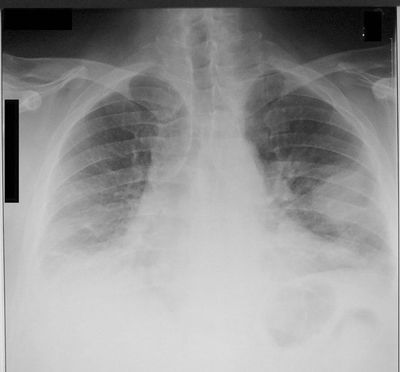
- AWestermark's sign
- BHampton's hump
19Which of the following clinical signs of PE is shown on this x-ray?
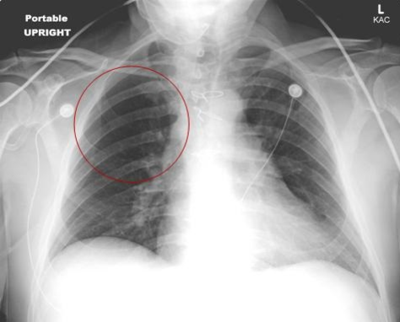
- AWestermark's sign
- BHampton's hump
20Which of the following is NOT true regarding use of CT angiography in dx of PE?
(select any that apply)- ABolus radiocontrast injection given intravenously.
- BHigh speed, multi-slice CT scanner takes thin section images.
- CExcellent definition of main and lobar.
- DMay detect central and peripheral emboli.
- EMay provide bonus information about the lungs and mediastinal structures.
21CT scanning has excellent (~90%) positive predictive values.
- AVerdadero
- BFalso
22Pulmonary angiography is considered the "gold standard" for dx of PE.
- AVerdadero
- BFalso
23Which of the following statements is/are NOT accurate regarding pulmonary angiography.
- AConsidered the "gold standard" in dx PE
- BAllows measurement of pulmonary artery pressures
- CIt is both invasive and expensive
- DFrequently used to confirm dx of PE
- ERequires administration of intravenous radiocontrast
24Which of the following is/are NOT true in regards to V/Q scanning in dx of PE:
(select any that apply)- Aperfusion scanning uses venous injection with radiolabeled- macroaggregated albumin (technetium 99)
- Bventilation scanning requires Iinhalation of a gas mixture containing a radiotracer (xenon 133)
- Cit is sensitive for decreased flow to areas of the pulmonary vascular bed, but not specific
- Da normal perfusion scan excludes the diagnosis of PE.
- Ein PE cases, areas of vascular obstruction should show decreased ventilation but preserved perfusion
25A "high probability" V/Q scan result, coupled with high clinical suspicion, gives a > 95% likelihood of PE.
- AVerdadero
- BFalso
26A negative (i.e. normal) D-Dimer result may be used to rule-out DVT and PE, regardless of clinical presentation and probability scores.
- AVerdadero
- BFalso
27Which of the following labs is LEAST helpful in the dx of PE?
- ACBC
- BABG
- CBNP
- DTroponin
- EINR, PTT
28Which of the following labs/results are NOT properly matched, in regards to dx PE.
- AABG: hypoxemia, widened alveolar-arterial gradient, and respiratory alkalosis
- BBNP: may be elevated due to right heart strain
- CTroponin: may be decreased in 30-50% of cases
- DPTT: needed for baseline when considering tx options
29A D-Dimer test could be positive in which of the following cases?
- APregnancy
- BInfection
- CPost-Op
- DTrauma
- EAll of the above
30According to the diagnostic algorithm for pulmonary embolism, if the pt's Wells score exceeds 4, what is the next step?
- AD-Dimer
- BCT angiography
- CPulmonary Angiography
- DUltrasound (serial venous doppler)
- EV/Q scan
31According to the diagnostic algorithm for pulmonary embolism, if the pt's Wells score is below 4, what is the next step?
- ANo treatment (PE dx excluded)
- BD-Dimer to confirm
- CChest X-ray to confirm
- DSerial Venous Doppler (US) to rule-out DVT
- ELabs to confirm (BNP, LFT, CBC, etc.)
32Small emboli discovered in the course of dx are relatively benign and do not require tx.
- AVerdadero
- BFalso
33Which three signs/sxs are most indicative of an acute PE?
- AHemodynamic instability (hypotension)
- BAMS
- CShock
- DHemoptysis
- ETachycardia
34Prompt use of heparin in pt's w/ a DVT helps to lyse the clot and reduce mortality.
- AVerdadero
- BFalso
35Mortality of PE after the initiation of heparin decreases to <5%
- AVerdadero
- BFalso
36Which of the following anticoagulants is the treatment of choice in pt's w/ a bleeding risk?
- ALow molecular weight heparin
- BUnfractionated heparin
- CHigh molecular weight heparin
- DFractionated heparin
- ENone of the above (Anticoagulants are contraindicated in pt's w/ bleeding risk)
37Which of the following statement is NOT accurate?
- AUnfractionated Heparin requires frequent lab monitoring
- BUnfractioned Heparin requires continuous infusion due to a short half-life
- CUnfractionated Heparin is reversible
- DLMW Heparin is administered via intramuscular injections
- ELMW Heparin does not require frequent monitoring and may be managed at home
38Which of the following is NOT true regarding Rivaroxaban & Dabigatran?
- Athey are oral medications approved by the FDA for the tx of PE
- Btheir risk of causing bleeding events is comparable or less than that of coumadin
- Cthey are both reversible
- Dneither require close monitoring
- Ethey are both thrombin inhibitors
39Thrombolytics are only indicated in hemodynamically stable patients.
- AVerdadero
- BFalso
40Thromolytic tx may cause an intracranial hemorrhage.
- AVerdadero
- BFalso
41Thrombolyics are typically administered by a vascular surgeon and/or radiologist.
- AVerdadero
- BFalso
42Which of the following might necessitate the use of an IVC ?
- APt. w/ bleeding problems
- BPt. allergic/intolerant to anticoagulants
- CPt. in need of acute stabilization
- DA & B only
- EAll of the above
43Which of the following are predictors of poor outcomes for pt's w/ hx of PE? (choose all that apply)
- AHypotension
- BHypoxemia
- CCoexisting DVT
- DDecreased lactate
- EDecreased WBC
44A resting pulmonary artery pressure of ________ is considered pulmonary hypertension.
- Amore than 25mmHg
- Bmore than 35mmHg
- Cmore than 45mmHg
- Dmore than 55mmHg
45Pulmonary hypertension may be:
- Afamilial
- Barise from areas affected by PE
- Crelated to drug toxicity
- Dsecondary to pulmonary venous congestion (e.g. left ventricular failure)
- EAll of the above
46Pulm. HTN is due to hypoxia and hypoxemia and may be seen in diseases such as COPD.
- AVerdadero
- BFalso
47An increase in blood flow, such as one experiences while exercising, will cause a proportional increase across the pulmonary vascular bed.
- AVerdadero
- BFalso
48Which of the following may cause pulm HTN (via chronic hypoxemia): (select all that apply)
- AChronic high altitude
- BCOPD
- CPulmonary fibrosis
- DObstructive sleep apnea
- EChronic Asthma
49Which of the following may also cause pulm HTN:
(select all that apply)- AParasitic infections
- BRecurrent/unresolved PE
- CCocaine use
- DHIV
- ESyphilis
- FLiver disease
- GAllergies
50Idiopathic pulm HTN is most common in women, ages 20-45 years old, and is due to medial hypertrophy and intimal proliferation and fibrosis.
- AVerdadero
- BFalso
51Common symptoms of Pulm HTN may include:
(choose all that apply)- ADyspnea
- BDysphagia
- CPeripheral edema
- DSyncope
- EChest pain
52Possible signs of pulm HTN may include:
- ACarvahlo's sign
(tricuspid murmur, regurg. w/ inspir.) - BProminent pulmonic component of second heart sound
- CRight ventricular (S3) gallop
- DJVD
- ETransient periods of tachycardia
- FDistended spleen
- GLeft ventricular hypertrophy
- HCorrigan's pulse
(alternates weak and bounding)
- ACarvahlo's sign
53All of the following are possible lab/diagnostic findings in Pulm HTN, EXCEPT:
- APolycythemia
- BDecreased PaO2
- CStenosis of main pulmonary (CXR)
- DCardiomegaly (CXR)
- EElevated Pulm Pressures (ECG & Echo)
54Which of the following are potential treatments for Pulm HTN: (select all that apply)
- ALong-term anticoagulation (even when not due to chronic PE)
- BVasodilators (especially for Primary Pulm HTN)
- CLung Transplantation
- DSupplemental O2
- ECardiopulmonary bypass
55Of the vasodilators used to tx pulm HTN, which is the most controversial?
- ACalcium channel blockers
- BProstacyclin
- CEndothelin receptor blockers
- DAll vasodilators are controversial in tx of Pulm HTN
56Which of the following statements is NOT accurate regarding Cor Pulmonale?
- ARight ventricular failure due to pulmonary disease
- BUsually accompanied by hypercapnia
- CMost commonly caused by pulm HTN, COPD, or pulm fibrosis
- DChronic and progressive
57Which are NOT common sxs associated with Cor Pulmonale:
- ACough
- BSwelling of face/neck
- CCyanosis
- DJVD
- EDysphagia
- FGallop S3 heart rhythm
58Common lab findings in Cor Pulmonale include:
- AWestermark sign on CXR
- BRAD, RVH on EKG
- CPolycythemia on CBC
- DB & C only
- EAll of the above
59All of the following are used to tx Cor Pulmonale EXCEPT:
- AACE Inhibitors/Angiotensin Receptor Blockers
- BDopamine/dobutamine
- CAnticoagulants
- DBeta-2 Agonists
60This is a rare autoimmune disease that affects the kidneys and lungs, causing necrosis of alveoli and loss of gas exchange.
- AGoodpasture's Syndrome
- BWegener's Granulomatosis
61While Goodpasture's may affect persons of all ages, it is found to be more common in younger males and older females.
- AVerdadero
- BFalso
62Signs/Sxs that might differentiate Goodpasture's from diseases such as PE and Pulmonary HTN, include:
(select all that apply)- AHematuria
- BPallor
- CWeight Loss
- DMyalgia
- EProteinuria
63Which of the following diagnostics are indicated in a work-up for Goodpasture's syndrome?
(Select all that apply)- AAnti-glomerular basement membrane test
- BABG
- CBUN
- DCXR
- ELFT
- FLung & Kidney Biopsy
- GMRI
64Goodpasture's Syndrome is treated with:
- APlasma exchange to remove antibodies
- BImmunosuppressants
- CSteroids
- DA & B only
- EAll of the above
65This rare disease causes "geograpahic" necrosis and granulomatous inflammation of the airways.
- AGoodpasture's
- BWegener's
66Wegener's granulomatous is believed to be caused by cellular immune processes and may present w/ respiratory and renal involvement.
- AVerdadero
- BFalso
67Which of the following statements concerning Wegener's granulomatous is FALSE ?
- AIt is a rare disease
- BEqually prevalent in men and women
- CTypically occurs in the 4th-5th decade of life
- DIs fatal within one year if not treated
- EAll of the above statements are TRUE
68This rare disease can cause recurrent sinusitis, chronic ear infections, and a variety of flu-like sxs.
- AWegener's
- BGoodpasture's
69The work-up for this disease includes a blood test for anti-neutrophil cytoplasmic antibodies.
- AWegener's
- BGoodpasture's
70While many survivors may be dependent on dialysis, the 5-year survival rate for Wegener's granulomatous is about 70%
- AVerdadero
- BFalso
Información
- Descripción
- Pulmonary Vascular Disease ppt
- Autor
- campbellpa2017
- Idioma
- English
- Visitas
- 36
- Etiquetas
- Valoración
- Aún sin valoraciones Valora este test