
Test
Econ 3.3.3 - Concentrated Markets
Este test tiene tipos de pregunta que se abren en el reproductor de siempre.
Preguntas del test (23)
1What are the sources of monopoly power?
- ABarriers of Entry
- BSNPs
- CPrice Discrimination
- DGovernment Licence
- EProduct Differentiation
- FAdvertising/ Branding
- GLack of price transparency
- HNo. of competitors
2Barriers to entry are the [blank_start]obstacles[blank_end] that prevent other firms from [blank_start]starting up[blank_end] and entering the industry. They protect [blank_start]monopolist power[blank_end], maintain [blank_start]market share[blank_end] and ensure SNPs. There are three main types of barriers, which are:
• Legal Barriers aka [blank_start]Statutory Barriers[blank_end]
This can include [blank_start]Intellectual property rights[blank_end] such as:
[blank_start]Patents[blank_end] – the right to be the sale provided for up to 25 years for new products and processes
[blank_start]Copyright[blank_end] – this is on literacy words – 70 years after death
[blank_start]Trademark[blank_end] – slogans, logos, fonts
It can also include Government Licence
The government provides a certain company/organisation the right to be the sole provider of something e.g. UCAS
• Structural Barriers aka [blank_start]Innocent Barriers[blank_end]
These are barriers simply due to the structure of the industry not due to any attempt e.g.
High Sunk Costs which is a clear [blank_start]deterrent[blank_end] making it harder to compete. This increases the minimum efficient scale which makes it very hard for small firms to compete.
EOS at high level of output as obtain significant EOS potential makes it harder for small firms to compete
Natural Monopolies which means that it is not [blank_start]cost effective[blank_end] to have many competing firms in some industries
Access to [blank_start]natural resources[blank_end] e.g. oil or climatic conditions
• Strategic Barriers
These are [blank_start]deliberate[blank_end] barriers to entry
USP
Using profits to sustain [blank_start]research and development[blank_end] to stay ahead of the competition
[blank_start]Predatory Pricing[blank_end] which involve selling products at a loss when threatened by [blank_start]new entrants[blank_end] in order to force them out of the industry and then raise prices later. This is illegal however it is hard to catch.
[blank_start]Brand Power[blank_end] and [blank_start]Sustained[blank_end] Marketing
Takeovers
Brand [blank_start]proliferation[blank_end]- Aproliferation
- BBrand Power
- CPredatory Pricing
- Dnew entrants
- Eresearch and development
- Fdeliberate
- Gnatural resources
- Hcost effective
- Iproductive
- Jefficient
- Kdeterrent
- Ldistraction
- MTrademark
- NCopyright
- OPatents
- PInnocent Barriers
- QStatutory Barriers
- RIntellectual property rights
- Smonopolist power
- Tmarket share
- Ustarting up
- Vobstacles
- Wdiversions
- Xblockages
- YSustained
3The ability/power to influence the price is dependent on the cross elasticity of the product
- AVerdadero
- BFalso
4There are many reasons for business to grow. These reasons include:
[blank_start]Profit Motive[blank_end] which means the firm wished to achieve [blank_start]higher profits[blank_end] and provide better returns/[blank_start]dividends[blank_end];
[blank_start]Cost Motive[blank_end] as by producing on a [blank_start]larger[blank_end] scale they can benefit from [blank_start]economies of scale[blank_end] which will increase their profit margins;
[blank_start]Market Power[blank_end] Motive as this allows [blank_start]dominance[blank_end], barriers to entry, buying power and [blank_start]pricing[blank_end] power;
[blank_start]Risk Motive[blank_end] which involves diversification and economies of [blank_start]scope[blank_end] and
[blank_start]Managerial[blank_end] Motive which means that this move is the managers objectives rather than the owners.- AProfit Motive
- BCost Motive
- CMarket Power
- DRisk Motive
- EManagerial
- Fhigher profits
- Gdividends
- Heconomies of scale
- Idominance
- Jpricing
- Kscope
- Llarger
5A monopoly can have the potential to exploit economies of scale
- AVerdadero
- BFalso
6Monopolies are always dynamically and statically efficient
- AVerdadero
- BFalso
7Disadvantages of a monopoly are that it damages consumer welfare, there is a lack of variety and some go out.
- AVerdadero
- BFalso
8In a monopoly market no customers can win
- AVerdadero
- BFalso
9Compare a perfect competitive market with a monopoly market
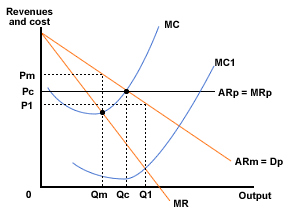
- AA = Long Run PC equilibrium
- BB = PM point for a selfish monopoly
- CC = Profit Max point of a good monopoly
10Market Entry can occur through:
- AIPR expiring
- BRegulation
- CGovernment Action
- DLoans
- EWell known brands/ international competitors
- FComplacency
- GLoss of differentiation
11How many degrees of differentiation are there?
- A4
- B2
- C3
12What can firms price discriminate on
- ATime
- BPlace
- CIncome
- DTime and Income
- EPlace and Time
- FIncome and Place
- GTime, Place and Income
13Price discrimination is done by firms in order to make more [blank_start]revenue[blank_end] and more [blank_start]profit[blank_end]. It allows them to exploit the higher [blank_start]willingness[blank_end] to pay as well as [blank_start]obtain[blank_end] demand and higher revenue during [blank_start]off peak[blank_end] times where they would otherwise see none/little demand. Furthermore it allows them to offload [blank_start]spare capacity[blank_end].
- Arevenue
- Bprofit
- Cwillingness
- Doff peak
- Espare capacity
- Fobtain
14In order to price discriminate do you need to have:
a) two or more groups with different PED and willingness to pay
b) Fair way of splitting these groups- AVerdadero
- BFalso
15Explain price discrimination
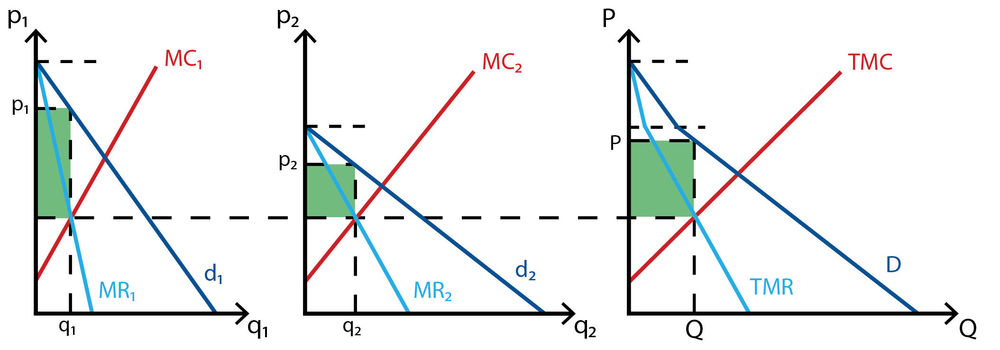
- ARevenue earnt from Market A
- BRevenue earnt from Market B
- CTotal Revenue earnt
- DOverall Average Costs
16Oligopolisitc markets are more [blank_start]realistic[blank_end] and examples can be seen today such as [blank_start]supermarkets[blank_end] and the gas industry. In these markets we assume that the market is [blank_start]dominated[blank_end] by a few large firms who control most of the market which means there is a [blank_start]high concentration[blank_end] ratio. However there are other small firms in the market. We also assume that the firms are [blank_start]interdependent[blank_end], that barriers to entry exists, they are all profit maximisers and that they produce [blank_start]differentiated[blank_end] products.
- Arealistic
- Bsupermarkets
- Cdominated
- Dhigh concentration
- Einterdependent
- Fdifferentiated
17Does the kinked demand curve show the ineffective of price as a weapon?
- AVerdadero
- BFalso
18In order to collude what are the preferred conditions?
- ALarge no. of firms
- BSmall no. of firms
- CDeterrent to cheat
- DLow barriers to exit
- EHigh barriers to entry
- FLarge customer base
- GOutput is difficult to measure
- HInelastic and Fixed Demand
- IEasily monitored output
- JHard to give price discounts
19Firms can face difficulties when colluding this is because [blank_start]game theory[blank_end] predicts someone will cheat. Furthermore [blank_start]price fixing[blank_end] is illegal, [blank_start]overproduction[blank_end] can occur and new firms can still enter the market.
- Agame theory
- BAnsoff
- CKeynesian
- Dprice fixing
- Ecolluding
- Fpredatory pricing
- Goverproduction
- Hovertrading
20Firms can be anti-competitive through:
1. [blank_start]Price fixing[blank_end]
This is an agreement on set prices which is illegal and if a firm is caught and found guilty it can be fined 10% of all revenue over a 3 year period. Manufacturers are allowed to have a ‘RRP’ but they cannot insist that this is the price the firm sell for.
2. [blank_start]Reusing[blank_end] to sell to certain retailers.
A manufacturer can’t ensure retailers will sell at the right price then they can choose not to sell to specific retailers that would [blank_start]buy in bulk[blank_end] but sell off cheaply e.g. high-end perfume sold only to Selfridges rather than Boots.
3. [blank_start]Predatory Pricing[blank_end]
This is when an existing firm [blank_start]deliberately[blank_end] lowers prices often [blank_start]selling at a loss[blank_end] and often occurs when they are [blank_start]threatened[blank_end] by a [blank_start]new entrant[blank_end]. The existing firm can afford to lose money for longer and will raise prices again once the other firm has been forced out of the market and this is [blank_start]illegal[blank_end].
4. [blank_start]Discriminating[blank_end] pricing policies
Giving bulk buying/regular trade discounts is good business sense, but it makes it harder for small firms to compete. This is why individual grocers/bakers cannot survive easily against supermarkets like Tesco.
5. Tying in related goods and services
When firms only sell a product if consumers also pay for [blank_start]other related[blank_end] products e.g. only buy a game console if games are bought as well, insurance packages.
6. Refusing the competition [blank_start]access[blank_end] to or use of essential facilities
Walls and Coke provided fridge and freezers free of charge to small retailers on the condition that they sell their products. Some airports have agreements with some airlines allowing them only access to land on that airport.- APrice fixing
- BRefusing
- Cbuy in bulk
- DPredatory Pricing
- Edeliberately
- Fselling at a loss
- Gthreatened
- Hpleased
- Iangered
- Jnew entrant
- Kcompetition
- Lillegal
- Mlegal
- Nfrowned upon
- ODiscriminating
- Pother related
- Qsubstitute
- Raccess
21All markets have the potential to be contestable
- AVerdadero
- BFalso
22What does market contestability depend on?
- ANature of costs and degree of consumer loyalty
- BProduct differentiation and the elasticity of demand
- CType of barriers to entry and the market structure
- DAll combinations
23What are the conditions necessary for a market to be contestable?
- ALow barriers to entry/exit
- BAccess to available technology
- CEntrants willing and ready to entrant
- DHigh customer churn
- EAll options
Información
- Descripción
- A Levels (Micro) Economics Test sobre Econ 3.3.3 - Concentrated Markets, creado por Krystal Smith el 15/02/2016.
- Autor
- Krystal Smith
- Idioma
- English
- Visitas
- 163
- Historial
- Creado el 15 feb 2016 · actualizado el 28 ago 2017
- Etiquetas
- Valoración
- 5,0 de 5 · 1 valoración Valora este test