
Test
Spirometry
Este test tiene tipos de pregunta que se abren en el reproductor de siempre.
Preguntas del test (27)
1Physical Description
1. Age
2. Height or [blank_start]Arm[blank_end] Span. Without [blank_start]shoes[blank_end]. Multiply by [blank_start]2.54[blank_end] to get cm
3. Gender
4. Weight
5. Race
3.- AArm
- Bshoes
- C2.54
2[blank_start]Occupational[blank_end] History
Inquire about:
Mine / [blank_start]Quarry[blank_end] work
Mill [blank_start]Work[blank_end]
Farming
Gas / Fume exposure
Dusty [blank_start]Environment[blank_end]- AEnvironment
- BWork
- CQuarry
- DOccupational
3Smoking History
Differentiate between cigars, pipes and [blank_start]cigarettes[blank_end]
Pack [blank_start]years[blank_end]
Does pt still [blank_start]smoke[blank_end]- Asmoke
- Byears
- Ccigarettes
4Medical / Surgical History
Disease: [blank_start]Asthma[blank_end], TB, Chronic [blank_start]Bronchitis[blank_end], Recurrent Colds, pneumonia, infections
Record presence of: Hay [blank_start]fever[blank_end] / allergies- AAsthma
- BBronchitis
- Cfever
5Withholding Medications
SABA: [blank_start]4[blank_end] hrs
LABA: [blank_start]12[blank_end] hrs
Methylxanthines: [blank_start]12[blank_end] hrs
Slow Release Methylxanthines: [blank_start]24[blank_end] hrs
Anticholinergics: [blank_start]8[blank_end] hrs
Cromolyn Sodium: [blank_start]8[blank_end] - [blank_start]12[blank_end] hrs
Other Meds: Inquire about Inhaled steroids, cardiac meds, antibiotics, beta blockers- A4
- B12
- C12
- D24
- E8
- F8
- G12
6Vital Signs
RR: [blank_start]10[blank_end] - [blank_start]20[blank_end]
HR: [blank_start]60[blank_end] - [blank_start]100[blank_end]
BP: 120/80
Sensorium: Alert, oriented and able to follow [blank_start]commands[blank_end]- A10
- B20
- C60
- D100
- Ecommands
7Other Respiratory Modalities:
Evaluate O2 [blank_start]therapy[blank_end], aerosol [blank_start]therapy[blank_end], pulmonary [blank_start]rehab[blank_end]
Contraindications:
[blank_start]Hemoptysis[blank_end] within 24 hrs, unstable [blank_start]vitals[blank_end], unable to [blank_start]cooperate[blank_end]
Prohibited activities
No alcohol within [blank_start]4[blank_end] hrs, no exercise within [blank_start]30[blank_end] minutes, don't wear [blank_start]tight[blank_end] clothing, don't eat large meal within [blank_start]2[blank_end] hours.
Other considerations:
Room [blank_start]temperature,[blank_end] barometric [blank_start]pressure[blank_end], dentures stay in unless they are [blank_start]loose[blank_end], wear nose clips, sitting position- Atherapy
- Btherapy
- Crehab
- DHemoptysis
- Evitals
- Fcooperate
- G4
- H30
- Itight
- J2
- Ktemperature,
- Lpressure
- Mloose
8Testing:
Slow Vital Capacity (SVC):
Max [blank_start]expiration[blank_end] after a [blank_start]full[blank_end] inspiration
L or mL corrected to [blank_start]BTPS[blank_end]
ATPS x [blank_start]factor[blank_end] = BTPS
BTPS is based on: ambient [blank_start]temperature[blank_end], Barometric [blank_start]Pressure[blank_end], Humidity
Measures:
Vital [blank_start]Capacity[blank_end]
[blank_start]Tidal[blank_end] Volume
Inspiratory [blank_start]Reserve[blank_end] Volume
Expiratory [blank_start]Reserve[blank_end] Volume- Aexpiration
- Bfull
- CBTPS
- Dfactor
- Etemperature
- FPressure
- GCapacity
- HTidal
- IReserve
- JReserve
9Slow Vital Capacity ATS Standards
End Level of [blank_start]3[blank_end] breaths before SVC must not vary more than [blank_start]100[blank_end] mL
Large Variances may indicate a [blank_start]leak[blank_end]
At least 2 acceptable maneuvers within [blank_start]5[blank_end]% or [blank_start].15[blank_end] L
SVC should be within [blank_start]5[blank_end]% of best FVC
SVC higher than FVC indicates [blank_start]obstructive[blank_end] disease, but evaluate pt effort- A3
- B100
- Cleak
- D5
- E.15
- F5
- Gobstructive
10Vital Capacity (VC)
Max [blank_start]inspiration[blank_end] then max [blank_start]expiration[blank_end]
Typical Value: 4800 mL
decreased with restrictive disease
VC = [blank_start]IRV[blank_end] + Vt + ERV
VC = IC +[blank_start]ERV[blank_end]
VC = TLC - [blank_start]RV[blank_end]
Tidal Volume (Vt)
Normal resting breathing voume
Typical value: 500 mL
Decreased with restrictive disease
Vt x RR = [blank_start]Minute Volume[blank_end]
Vt - [blank_start]IC[blank_end] - IRV
Vt = VC - IRV - [blank_start]ERV[blank_end]
Vt = TLC - [blank_start]IRV[blank_end] - ERV - RV
Inspiratory Reserve Volume (IRV)
Largest volume of air that can be inspired above VT
Typical Value 3100 mL
Decreased with restrictive disease
IRV = IC - [blank_start]Vt[blank_end]
IRV = VC - [blank_start]ERV[blank_end] - Vt
Expiratory Reserve Volume (ERV)
Largest volume of air that can be expired from [blank_start]resiting[blank_end] end level
Typical Value: 1200 mL
Decreased with restrictive diseases
ERV = [blank_start]VC[blank_end] - IC
ERV = FRC - [blank_start]RV[blank_end]- Ainspiration
- Bexpiration
- CIRV
- DERV
- ERV
- FMinute Volume
- GIC
- HERV
- IIRV
- JVt
- KERV
- Lresiting
- MVC
- NRV
11Inspiratory Capacity (IC)
Largest Volume of air that can be inspired from resting end level [blank_start]expiratory[blank_end].
Typical Value [blank_start]3600[blank_end] mL
Decreased with restrictive disease
IC = [blank_start]IRV[blank_end] + Vt
IC = VC - [blank_start]ERV[blank_end]
IC = [blank_start]TLC[blank_end] - FRC- Aexpiratory
- B3600
- CIRV
- DERV
- ETLC
12Forced Vital Capacity (FVC):
Max inspiration followed by a [blank_start]forced[blank_end] expiration
If SVC [blank_start]>[blank_end] FVC suspect obstructive disease
If SVC [blank_start]<[blank_end] FVC question pt effort
Exhale until a volume pleateau OR [blank_start]15[blank_end] seconds
Modified maneuver: After [blank_start]4[blank_end] seconds, relax and exhale gently.- Aforced
- B<
- C>
- D15
- E4
13FVC Measurements:
Peak Expiratory Flowrate (PEFR)
Maximum [blank_start]flowrate[blank_end] achieved during FVC
10 L/s
Nonspecific in significance because it is very dependent on [blank_start]patient[blank_end] effort
Measured in L/s ATPS corrected to BTPS
Forced Expiratory Flow 200-1200
Average flowrate that occurs during FVC after the first [blank_start]200[blank_end]mL has been expired
Typical: 6 L/s
Significance: Measures airflow in [blank_start]big[blank_end] airways. Decreased with mechanical airway problems and [blank_start]obstructive[blank_end] disease, can be decreased d/t poor effort
Forced Expiratory Flow 25%-75%
Average flowrate during the [blank_start]middle[blank_end] half of FVC
Typical: 4-5 L/s ATPS corrected to BTPS
Significance: Measures flow in the [blank_start]small[blank_end] airways, is [blank_start]decreased[blank_end] in obstructive disease. Most sensitive to detect [blank_start]small[blank_end] airway disease. Can appear erroneously [blank_start]decreased[blank_end] if FVC and FEV1 are greatly increased in post bronchodilator studies.
Forced Expiratory Volume/Time (FEVtime)
Volume Expired of time interval
Common: FEV.5, FEV1, FEV2, FEV3, FEV6
ATPS corrected to BTPS
Significance: Decreased flows indicate obstructive disease, FEV1 used to assess improvement in post BD studies, allow 10-15 minutes in between pre/post tests.
FEVT / FVC%
Forced expiratory volume for time interval expressed as a percentage of total FVC
Minimum acceptable values:
FEV.5/FVC = [blank_start]60[blank_end]%
FEV1/FVC = [blank_start]70[blank_end]%
FEV2/FVC = [blank_start]94[blank_end]%
FEV3/FVC = [blank_start]97[blank_end]%
FEV6/FVC = [blank_start]99[blank_end]%
Significance: [blank_start]decreased[blank_end] with obstructive disease, [blank_start]normal[blank_end] with restrictive.- Aflowrate
- Bpatient
- C200
- Dbig
- Eobstructive
- Fmiddle
- Gsmall
- Hdecreased
- Ismall
- Jdecreased
- K60
- L70
- M94
- N97
- O99
- Pdecreased
- Qnormal
14FVC to Generate Flow-Volume Loop
A forced expiratory maneuver followed by forced inspiratory maneuver
Recorder plots flow ([blank_start]vertical[blank_end]) and volume ([blank_start]horizontal[blank_end]) for inspiration and expiration
Expiration is [blank_start]above[blank_end] baseline, inspiration [blank_start]below[blank_end] baseline
Important to coach max effort without [blank_start]coughing[blank_end]
PEF is measured with pt at [blank_start]TLC[blank_end]
PIF is measured with pt at [blank_start]RV[blank_end]
Forced Expiratory Flow at 25%, 50%, and 75% of VC
% is amount of [blank_start]FVC[blank_end] that has been exhaled
Decreases in FEF50% and FEF75% indicate [blank_start]obstructive[blank_end] disease
These values can be more sensitive in detecting small airway obstruction than FEV1.
Forced Inspiratory Flow at 25%, 50% and 75% of Inspiratory Vital Capacity
Measured on inspiratory side of loop
useful when compared to expiratory Values for determining a site of large [blank_start]obstruction[blank_end] - particularly the [blank_start]50[blank_end]% value
Maximum Forced Expiratory Flow (FEFmax)
Highest flow achieved on expiratory curve
Analagous to [blank_start]PEF[blank_end]
FEFmax used to determine [blank_start]effort[blank_end]- Avertical
- Bhorizontal
- Cabove
- Dbelow
- Ecoughing
- FTLC
- GRV
- HFVC
- Iobstructive
- Jobstruction
- K50
- Leffort
- MPEF
15Flow Volume Studies:
FEF50%/FIF50%
Ratio of forced expiratory flow to forced inspiratory flow at 50% of VC
Helpful in evaluating [blank_start]upper airway[blank_end] obstruction
Normal: [blank_start].8[blank_end] - [blank_start]1.2[blank_end]
Variable Extrathoracic Obstruction [blank_start]increases[blank_end] ratio > [blank_start]1.2[blank_end]
Variable intrathoracic obstruction [blank_start]decreases[blank_end] ratio < [blank_start].8[blank_end]
Fixed airway obstruction would cause equally reduced flows
Formula: FEF50% / FIF50%- Aupper airway
- B.8
- C1.2
- Dincreases
- E1.2
- Fdecreases
- G.8
16Fixed Airway Obstruction:
Appears as decreased FEF50% and decreased FIF50% with values approximately [blank_start]equal[blank_end].
Example: Tracheal [blank_start]Stenosis[blank_end]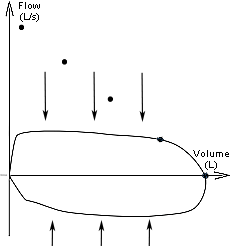
- AStenosis
- Bequal
17Variable Extrathoracic Obstruction:
Appears as [blank_start]normal[blank_end] expiratory flows with [blank_start]decreased[blank_end] inspiratory flows
FEF50% / FIF50% is [blank_start]increased[blank_end] > [blank_start]1.2[blank_end]
Example: [blank_start]Vocal Cord[blank_end] paralysis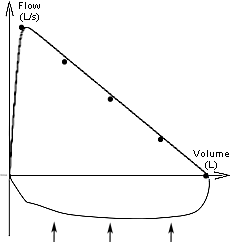
- AVocal Cord
- B1.2
- Cincreased
- Dnormal
- Edecreased
18Variable Intrathoracic Obstruction
[blank_start]Normal[blank_end] inspiratory flows with [blank_start]decreased[blank_end] expiratory flows
FEF50% / FIF50% is [blank_start]decreased[blank_end] < [blank_start].8[blank_end]
Ex: Tumor near the carina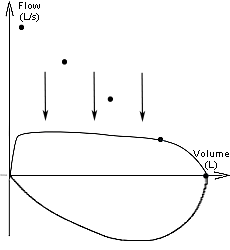
- Adecreased
- BNormal
- C.8
- Ddecreased
19Flow Vol. Loops
Restriction:
Decreased lung [blank_start]volumes[blank_end] with [blank_start]normal[blank_end] flows
Loop is [blank_start]tall[blank_end] and [blank_start]skinny[blank_end]
Asthma:
Increase in resistance in [blank_start]small[blank_end] airways causes a [blank_start]decrease[blank_end] in expiratory flows
[blank_start]Scooped[blank_end] out portion on expiratory loop
Emphysema:
Increased small airways [blank_start]resistance[blank_end] along with loss of [blank_start]elastic recoil[blank_end] = a reduction of expiratory flows more pronounced than asthma- Atall
- Bskinny
- Cnormal
- Dvolumes
- Esmall
- Fdecrease
- GScooped
- Helastic recoil
- Iresistance
20Pre/Post Bronchodilator testing:
Determines degree of [blank_start]reversible[blank_end] obstruction
Indications:
FEV1 <[blank_start]80[blank_end]%, cough of unknown [blank_start]etiology[blank_end], asthma, suspected hyperresponsiveness
Loops can be superimposed to readily detect improvement
SABA is given via MDI, SVN, or IPPB
FEV1 must improve by at least [blank_start]12[blank_end]% and [blank_start].2[blank_end] L to be considered reversible.
Forumla: (post FEV1 - pre FEV1) / pre FEV1 = % change
If FVC increases in post, it is suggestive of [blank_start]air trapping[blank_end]- Areversible
- B80
- Cetiology
- D12
- E.2
- Fair trapping
21Spirometry Evaluation:
2 Major characteristics that Spirometry measures: Lung [blank_start]Volumes[blank_end] & [blank_start]Flows[blank_end]
Decreased [blank_start]Flows[blank_end] indicate obstructive disorder.
CBABE: [blank_start]Cystic Fibrosis[blank_end], [blank_start]Bronchitis[blank_end], [blank_start]Asthma[blank_end], [blank_start]Emphysema[blank_end]
Decreased [blank_start]Volumes[blank_end] indicates restrictive disorder
Neuromuscular: Myasthenia Gravis, Gullian Barre, Muscular Dystrophy
Cardiovascular: CHF
Pulmonary: pneumonia, atelectasis, pulmonary fibrosis
Trauma: head trauma, rib fractures, flail chest- AVolumes
- BFlows
- CFlows
- DCystic Fibrosis
- EBronchitis
- FAsthma
- GEmphysema
- HVolumes
22Interpretation:
>= [blank_start]80[blank_end]% Predicted : Normal
<[blank_start]80[blank_end]% Predicted: Mild dysfunction
<[blank_start]70[blank_end]% Predicted: Moderate dysfunction
<[blank_start]60[blank_end]% predicted: Moderate/severe dyfunction
<[blank_start]50[blank_end]% Predicted: Severe Dysfunction
<[blank_start]35[blank_end]% predicted: Very Severe Dysfunction- A80
- B80
- C70
- D60
- E50
- F35
23FVC: ATS Standards
Maximal effort and smooth curve
Minimum of [blank_start]6[blank_end] seconds effort or [blank_start]2[blank_end] second plateau
Start of test needs to be [blank_start]abrupt[blank_end] with no hesitation
3 acceptable tests
Best Test has the highest [blank_start]FVC[blank_end] + [blank_start]FEV1[blank_end]
Adults should stand or sit
Coughing shows as an upward deflection
Early termination is a short horizontal line at end of expiration
Back extrapolation % = (back extrapolated vol / FVC) x 100
Spirogram acceptability:
Free from artifact: No [blank_start]cough[blank_end] or glottis closure in 1st seond. No early [blank_start]termination[blank_end]. No variable effort. No leak. no obstructed mouthpiece.
Good Start: Extrapolated volume of <[blank_start]5[blank_end]% of FVC OR time to PEF less than [blank_start]120[blank_end] ms
Satisfactory Exhalation: 6 seconds and or volume plateau, reasonable duration or plateau, OR subject cannot continue to exhale.- A6
- B2
- Cabrupt
- DFVC
- EFEV1
- Fcough
- Gtermination
- H5
- I120
24Maximum Voluntary Ventilation
Largest Volume of Air inhaled and exhaled over a [blank_start]12[blank_end] second period
Value is extrapolated to 1 minute and reported in L/min corrected to BTPS
Typical : [blank_start]170[blank_end] L/m
Provides info about: status of [blank_start]respiratory[blank_end] muscles, compliance of [blank_start]lungs[blank_end] and [blank_start]thorax[blank_end], airway [blank_start]resistance[blank_end]
Pt Breathes as DEEPLY and as RAPIDLY as possible for 12 seconds
Significance: Large reductions = sever obstruction.
Effort dependent: If FEV1 x [blank_start]35[blank_end] > MVV - question pt effort- A12
- B170
- Crespiratory
- Dlungs
- Ethorax
- Fresistance
- G35
25Obstructive Spiro Results: [blank_start]Normal[blank_end] FVC, [blank_start]decreased[blank_end] FEV1/FVC
Restrictive Spiro Results: [blank_start]Decreased[blank_end] FVC, [blank_start]normal[blank_end] FEV1/FVC- ANormal
- Bdecreased
- CDecreased
- Dnormal
26Pediatric Spirometry
Same equipment
[blank_start]5[blank_end] years an older can usually perform acceptable spirometry
Loops that meet criteria for good start of test and are free from artifact in the first second are considered [blank_start]usable[blank_end].
If kid stops inhaling when flow is within [blank_start]10[blank_end]% of PEF it is early termination and [blank_start]unusable[blank_end].- A5
- Busable
- Cunusable
- D10
27Spirometry ATS Standards
After [blank_start]3[blank_end] [blank_start]acceptable[blank_end] tests:
Check that the 2 largest FVC are within .[blank_start]15[blank_end] liters
Check that the 2 largest FEV1 are withink .[blank_start]15[blank_end] liters
Save best 3 maneuvers- A15
- B15
- C3
- Dacceptable
Información
- Descripción
- El usuario ha eliminado su información de asignaturas Test sobre Spirometry, creado por Usuario eliminado el 19/08/2016.
- Autor
- Usuario eliminado
- Idioma
- English
- Visitas
- 39
- Etiquetas