
Test
QA Interview Qiuz
Este test tiene tipos de pregunta que se abren en el reproductor de siempre.
Preguntas del test (50)
1What is a Module?
- AA software component that has a specific task. It can be a ‘link’ which can go inside to its component detail.
- BA document that describes step by step process how to test the application. A Test Case includes Test Case ID, Steps Description, Expected Output, Actual Output, Pass/Fail, Remarks.
- CA meeting to disseminate his findings or to share his queries to other tester or leads of the company working on the same application
2Are Test Plan and Test Strategy same type of document?
- AVerdadero
- BFalso
3 As a QA person, I have written Test Plans, [blank_start]Test Cases[blank_end], attended [blank_start]walkthrough[blank_end] meetings with the Business Analysts, Project Managers, Business Managers and QA Leads. Attended [blank_start]requirement review[blank_end] meetings and provided feedback to the Business Analysts. I have worked in different [blank_start]databases[blank_end] like Oracle and DB2, wrote [blank_start]SQL queries[blank_end] to retrieve data from the database.
As far as different types of testing is concerned, I have performed S[blank_start]moke Testing[blank_end], F[blank_start]unctional[blank_end] Testing, B[blank_start]ackend[blank_end] Testing, B[blank_start]lackBox[blank_end] Testing, In[blank_start]tegration[blank_end] Testing, R[blank_start]egression[blank_end] Testing and UAT (User Acceptance Testing) Testing. I have participated in L[blank_start]oad[blank_end] Testing and S[blank_start]tress[blank_end] Testing.- ATest Cases
- Bwalkthrough
- Crequirement review
- Ddatabases
- ESQL queries
- Fmoke Testing
- Gunctional
- Hackend
- IlackBox
- Jtegration
- Kegression
- Load
- Mtress
4A Test Case is a document that describes [blank_start]step by step process[blank_end] how to test the application. A Test Case includes Test [blank_start]Case ID[blank_end], [blank_start]Steps Description[blank_end], Expected Output, [blank_start]Actual Output[blank_end], Pass[blank_start]/Fail, Remarks[blank_end].
- Astep by step process
- Bhow to test
- Ca test plan
- Dregression
- ECase ID
- Fuse case
- GSteps Description
- HPest Description
- IActual Output
- JFactual Output
- K/Fail, Remarks
- L/Rail,Remarks
- M/Sail,Remarks
5 The Scope, resource and schedule for test activities, acceptance criteria, test environment, test tools, test priorities, test planning, executing a test pass and types of test to be performed. Refers to?
- ATest Strategy
- BStrategy testing
- CTest Plan
6 A test to check the code whether it is properly working or not as per the requirement. It is done by the developers (Not testers).
- ASmoke testing
- BUnit testing
- CSystem testing
- DPerformance testing
7An initial set of tests to check whether the major functionalities are working or not and also to check the major breakdowns in the application. It is the preliminary test carried out by the SQA tester.
- AFunctional Testing
- BUnit Testing
- CSmoke testing
- DShakeout Testing
8It is a test to check whether each and every functionality of that application is working as per the requirement. It is major test where 80% of the tests are done. In this test, the Test Cases are ‘executed’.
- ASystem testing
- BRegression testing
- CFunctional testing
9 It is a test to check whether all the modules are combined together or not and working successfully as specified in the requirement document.
- ARegression testing
- BIntegration testing
- CPerformance testing
- DAlpha testing
10[blank_start]Black box testing[blank_end] is test where a tester performs testing without looking into the code. OR A testing method where the application under test is viewed as a black box and the internal behavior of the program is completely ignored. Testing occurs based upon the external specifications. Also known as behavioral testing, since only the external behavior of the program is evaluated and analyzed.
- AWhite box testing
- BBlack box testing
11Testing the system or application using [blank_start]negative data[blank_end] is called negative testing, for example, testing password entering 6 characters where it should be 8 characters should display a message.
- Anegative data
12Basically Load, Stress and [blank_start]Performance Testing[blank_end] are the same. However, [blank_start]Load testing[blank_end] is the test to check the users’ response time of number of users of any [blank_start]one scenario[blank_end] of the application whereas Performance Testing is the test to check the user response time for [blank_start]multiple[blank_end] scenario of the same application.
- APerformance Testing
- BLoad testing
- Cone scenario
- Dmultiple
13SQL stands for [blank_start]Structured Query Language[blank_end]. SQL is an ANSI (American National Standards Institute) standard computer language for [blank_start]accessing and manipulating[blank_end] database systems. SQL statements are used to retrieve and update data in a [blank_start]database[blank_end]. SQL works with database programs like MS Access, DB2, Informix, MS SQL Server, Oracle, Sybase, etc.
- AStructured Query Language
- BSimple query language
- CSudden quest language
- Dobstructing and manhandling
- Eaccessing and manipulating
- Faccessing and obstructing
- Gretrieve and update
- Hdatabank
- Idatabase
- Jdatalace
14[blank_start]Backend testing[blank_end] is a test to check whether the data displayed in the [blank_start]GUI front end[blank_end] report format matches with the particular data in the [blank_start]original database[blank_end].
- ABackend testing
- BGUI front end
- Coriginal database
15 Have you used Automation tools?
I have used [blank_start]TestDirector[blank_end] and [blank_start]ClearQuest[blank_end] as [blank_start]defect tracking tools[blank_end]. (Your answer is based on whether you have used automation tools specially for functional and load testing. If you have NOT used, but read about these tools, then you may be better off saying, “I know about the tools. I was involved in some of the testing using these tools, but would need some brush up in order to work independently.” I am saying this because these tools are difficult to tackle in the interview and have to know in depth. In order to pass the interview on functional automation tools, it may not be easy unless you really know the stuff. But, since there is not much to learn in ClearQuest and TestDirector, you only have to know what different types of fields are there in the defect logging window when writing a defect.)- ATestDirector
- BClearQuest
- Cdefect tracking tools
16When you log a defect using TestDirector (or ClearQuest) what fields do you see?
Answer: When we log a defect, we see [blank_start]Defect ID[blank_end] (it shows later in TestDirector), [blank_start]Summary[blank_end] (where we write short [blank_start]description[blank_end] of the defect), [blank_start]Description[blank_end] (long description of the defect), [blank_start]Detected by[blank_end] (Person who found the defect, (it’s you), [blank_start]Severity[blank_end] (meaning-is the defect [blank_start]critical[blank_end]? High? [blank_start]Medium[blank_end]? Or Low?), [blank_start]Date[blank_end], Detected in [blank_start]Version[blank_end], Priority, Project, [blank_start]Status[blank_end], [blank_start]Assigned to[blank_end] and so on.- ADefect ID
- Bdescription
- CDescription
- DSummary
- EDetected by
- FSeverity
- GDate
- Hcritical
- IMedium
- JVersion
- KAssigned to
- LStatus
17Do you have any situations in the past where you have some arguments with your team members?
- AVerdadero
- BFalso
18Why do you like this job?
Answer: I like this job, because it is [blank_start]process oriented[blank_end]. Meaning that I get an opportunity to work from [blank_start]analyzing[blank_end] the requirement documents to [blank_start]writing[blank_end] test plans, test cases, testing the application, [blank_start]logging defects[blank_end], retesting, preparing [blank_start]reports[blank_end] and finally testing in [blank_start]production[blank_end] as well. Therefore, I am [blank_start]involved[blank_end] from the very [blank_start]beginning[blank_end] to the end of the software development life cycle ([blank_start]SDLC[blank_end]) process. I like this.
Another reason is I like to find defects. I enjoy [blank_start]logging defects[blank_end]. The more [blank_start]defects I find[blank_end], the happier I am.- Aprocess oriented
- Banalyzing
- Cwriting
- Dlogging defects
- Ereports
- Fproduction
- Ginvolved
- Hbeginning
- ISDLC
- Jlogging defects
- Kdefects I find
19How do you determine what to test in an application?
Answer: First of all we have the [blank_start]test cases[blank_end] (or test scripts) that are written [blank_start]based on[blank_end] the [blank_start]requirement[blank_end] document. This pretty much covers what [blank_start]functionalities[blank_end] to test. Therefore, looking at the [blank_start]test cases[blank_end] tells us what to test in the [blank_start]application[blank_end].- Atest cases
- Bbased on
- Crequirement
- Dfunctionalities
- Etest cases
- Fapplication
20If you have no documentation about the product, how do you test an application? Describe the process.
Answer: Well, this is a situation where I have come across several times. Some of the companies in my previous projects did not have any documents. In this case, I went to the [blank_start]Business Analyst[blank_end] and some times to [blank_start]developers[blank_end] to find out how exactly the [blank_start]functionalities[blank_end] work, how to [blank_start]navigate[blank_end] from one page to another page and so on. After getting a clear vision, I write test cases based on the [blank_start]conversation[blank_end] (which is a step by step procedure to test an application) and get ready for testing.- ABusiness Analyst
- Bdevelopers
- Cfunctionalities
- Dnavigate
- Econversation
21What do you do once you find a defect?
Once you find a defect, this is what we need to do:
1. [blank_start]Recreate the Defect[blank_end]: Once you find a defect, we must try to [blank_start]recreate[blank_end] (meaning that we should be able to reproduce it) at least [blank_start]3[blank_end] times so that we are sure that it is a defect. Some times, once we find it log it without recreating, may put us in a false situation (because sometimes the application does not behave in the same way). Therefore, it is important to [blank_start]recreate[blank_end] the same defect [blank_start]several[blank_end] times.
2. Attach the [blank_start]Screen Shot[blank_end] (supporting document): Once we [blank_start]confirm[blank_end] that it is a defect, and then it is a good idea to attach supporting documents when we log (write) a defect. For example, screen shot, requirement document etc. For instance, let us say that instead of “Continue” button on a page, there is a typo “Contiinuee”. Now, we will make a [blank_start]screen shot[blank_end] of this page (To make screen shot, press “Print Screen” button on the keyboard, and open a Word document, and Click Edit on the Word document and “Past” it. You will see the screen now) Now, a tester needs to write defects in easy and [blank_start]clear[blank_end] language to make all the [blank_start]developers[blank_end] to understand easily.
3. [blank_start]Log the Defect[blank_end]: Now, the next step is, we need to [blank_start]log it[blank_end]. Depending on the [blank_start]company[blank_end] what kind of tools they are using (for example, some companies use [blank_start]TestDirector[blank_end] to log defects, some companies use Rational ClearQuest, some use PVC Tracker and so on). If the company is small and cannot afford these expensive tools, then they may simply use [blank_start]Excel[blank_end] sheet to log defects. We log the defect.- ALog the Defect
- BRecreate the Defect
- Crecreate
- D3
- Erecreate
- Fseveral
- Gconfirm
- Hscreen shot
- Iclear
- Jdevelopers
- Klog it
- Lcompany
- MExcel
- NTestDirector
- OScreen Shot
22A show stopper is a defect or bug that [blank_start]stops the user[blank_end] for further action (testing). It has no [blank_start]work around[blank_end]. In other words, it [blank_start]stops[blank_end] everything and the user cannot go any futher. This is called show stopper in software industry languague. (This is not an interview questions, but you have to know this terminology)
- Astops the user
- Bwork around
- Cstops
23What did you learn from your previous companies?
Answer: I learned a lot from the previous companies wherever I have worked. Wherever I have worked, I found out the there is always something to [blank_start]learn[blank_end]. Different companies have different ways of working. The environment and technology always differ from one company to another company. I have never found one company’s environment matching with another company. For example, if one company is using documents called [blank_start]requirement[blank_end] documents, then the other company might be using U[blank_start]se[blank_end] Cases and some companies might be using D[blank_start]esign[blank_end] Document and so on. Therefore, in my experience, there are always [blank_start]new things[blank_end] to learn in every company and we can always [blank_start]contribute[blank_end] these thing in the next company if they help to be more [blank_start]productive[blank_end].- Alearn
- Bnew things
- Ccontribute
- Dproductive
- Eesign
- Fse
- Grequirement
24What is this?
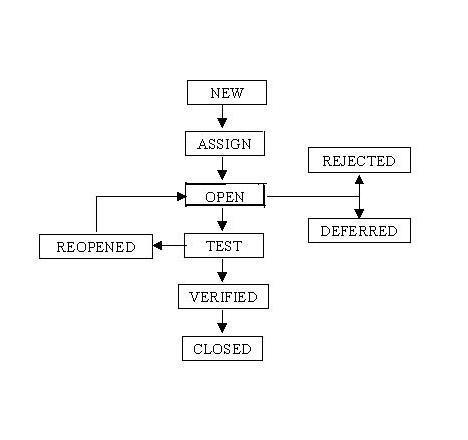
- ABug Lifecycle
25XML stands for [blank_start]EXtensible Markup Language.[blank_end]
- AEXtensible Markup Language.
26On the first day, normally, we will be given a [blank_start]computer[blank_end] and support people will set up the U[blank_start]ser[blank_end] Name and [blank_start]Password[blank_end] for the computer. If that is done already, then the QA Lead or QA Manager will give me a brief [blank_start]walk[blank_end] through of the documents (which documents are where), introduce to different team members (normally to the ones you will be working with). Then your boss will ask you to step into work what needs to be done. However, the first thing normally is, they will ask you to [blank_start]read[blank_end] the documents available for that project.
- Acomputer
- BPassword
- Cwalk
- Dread
- Eser
27let’s say you did not understand something while reading documents. Who are you going to ask? Answer-[blank_start]Business[blank_end] Analysts who [blank_start]wrote[blank_end] this document
- ABusiness
- Bwrote
28Software Development Lifecycle
1. [blank_start]Requirement phase[blank_end]
2. Design phase
3. Coding (programming)
4. Testing
5. Release (Production)
6. Maintenance (Support)- ATesting phase
- BDesign phase
- Crequirement phase
- Drelease
- EMaintenance (Support)
- FCoding (programming)
291. Requirement phase
2. Design phase
3. Coding (programming)
4. Testing
5. Release (Production)
6. Maintenance (Support)
Are all part of which cycle?- ADefect life cycle
- BSoftware development lifecycle
- CSoftware Testing Life Cycle
30What is Business (BRD)
- ABirds resting document
- BBusiness Requirement Document
- CBusiness right Document
311. Requirement Study
2. Test Planning
3. Writing Test Cases
4. Review the Test Cases
5. Executing the Test Cases
6. Bug logging and tracking
7. Close or Reopen bugs
What cycle is this- ABug lifecycle
- BTesting Lifecycle (STLC)
- CSoftware development lifecycle
32A ‘Module’ is a software component that has a specific [blank_start]task[blank_end]. It can be a ‘[blank_start]link[blank_end]’ which can go inside to its c[blank_start]omponent[blank_end] detail.
- Alink
- Btask
- Component
33A test to check the user’s response time of number of users using any one scenario (single business process) of the same application at the same time.
- ALoad testing
- BStress testing
34 In this type of testing the application is tested against heavy load such as complex numerical values, large number of inputs, large number of queries etc. which checks for the stress/load the applications can withstand.
- AStress testing
- BLoad testing
- CPerformance testing
35 A test to check the application's response time to a number of users using multiple scenarios (multiple business process) of the same application at the same time.
- AUser acceptance testing
- BPerformance testing
- CLoad testing
36In this type of testing, the users are invited at the development center where they use the application and the developers note every particular input or action carried out by the user. Any type of abnormal behavior of the system is noted and rectified by the developers.
- ABeta testing
- BAlpha testing
37 In this type of testing, the software is distributed as a beta version to the users and users test the application at their sites. As the users explore the software, in case if any exception/defect occurs that is reported to the developers.
- ABeta testing
- BAlpha testing
38It is a document that describes the [blank_start]additional[blank_end] functionalities that are [blank_start]added[blank_end] after the Business Requirement Document is signed off. It can be updated in the old business requirement document or it can be a [blank_start]separate[blank_end] document.
- Aadditional
- Badded
- Cseparate
39What are the basic elements you put in a defect?
Answer: Basic elements we put in a defect are: S[blank_start]EVERITY[blank_end], P[blank_start]RIORIT[blank_end]Y, C[blank_start]REATED[blank_end] BY, V[blank_start]ERSION[blank_end] NO, HEADER, D[blank_start]ESCRIPTION[blank_end] OF THE DEFECT where we write how to recreate a defect, in what m[blank_start]odule[blank_end] the defect is found, S[blank_start]tatus[blank_end], and so on.- AEVERITY
- BRIORIT
- CREATED
- DERSION
- EESCRIPTION
- Fodule
- Gtatus
40When should testing start in a project? Why?
Answer: We should start testing as soon as the following things are ready:
-[blank_start]Test Data[blank_end] are ready
-[blank_start]Build[blank_end] (all the developers have coded their code and merged them
[blank_start]together[blank_end])
[blank_start]Test Environmen[blank_end]t (servers, network etc) is set up and ready
-When the manager asks us to go ahead and [blank_start]start[blank_end] testing.- ATest Data
- BBuild
- Ctogether
- DTest Environmen
- Estart
41Let us say you have a web application to test. How do you go about testing it? What is the process?
Answer: First of all, I will look at the [blank_start]requirement[blank_end] documents (or [blank_start]design[blank_end] document in some companies). The requirement document will tell us what the [blank_start]functionalities[blank_end] in the application (software) are. Once I analyze the requirement documents (one module=one requirement document). After that, I will write test [blank_start]plans[blank_end] for each [blank_start]module[blank_end] (one module =one test plan). Then after the test plan is complete, I will write test [blank_start]cases[blank_end] (One module can have hundreds, even thousands test cases). Once the test cases are ready and the application is ready (or once the build is ready), then I will start testing. Before I start testing, however, I will make sure the test environments, test data and [blank_start]defect[blank_end] logging tools are in place. This is how I will go about testing an application.- Arequirement
- Bdesign
- Cfunctionalities
- Dplans
- Emodule
- Fcases
- Gdefect
42LIST ALL THE REPORT YOU HAVE IN A PROJECT REPORT AND THE IMPORTANCE OF THOSE REPORT.
1. WEEKLY OR MONTHLY [blank_start]TEST PROGRESS[blank_end] REPORT
2. [blank_start]DEFECT[blank_end] REPORT
3. R[blank_start]EQUEST FOR[blank_end] CHANGE REPORT- ATEST PROGRESS
- BDEFECT
- CEQUEST FOR
43WHAT TYPICALLY WOULD YOU FIND IN THE TEST ENVIRONMENT.
[blank_start]TESTING TOOLS[blank_end]
[blank_start]SERVERS[blank_end]
TESTING ITEMS EG [blank_start]LAPTOPS[blank_end], SERVERS.- ATESTING TOOLS
- Bresting tools
- Cmodules
- Dlight bulb
- Eservers
- Ftest environment
- GLAPTOPS
- Hcofee
44CAN YOU EXPLAIN THE SEVERITY AND PRIORITY, WHAT IS THE DIFFERENT BETWEEN THE TWO AND WHO USES EACH OF THEM.
SEVERITY IS THE MEASURE OF [blank_start]HOW BAD[blank_end] A DEFECT IS FROM [blank_start]TESTING PERSPECTIVE[blank_end] i.e SHOW STOPPER AND IT IS SELECTED BY TESTER WHILE PRIORITY IS DETERMINED BY THE [blank_start]DEVELOPERS[blank_end]. PRIORITY IS THE MEASURE OF WHICH DEFECT WILL BE FIXED [blank_start]FIRST[blank_end].- AHOW BAD
- BHOW GOOD
- CTESTING PERSPECTIVE
- DRESTING PERSPECTIVE
- EDEVELOPERS
- FTESTERS
- GFIRST
- HLAST
45WHAT IS TRACEABILITY MATRIX. WILL YOU ENCOURAGE IT?
IT IS TRACING REQUIREMENTS TO [blank_start]TEST[blank_end] AND TRACING [blank_start]TEST[blank_end] TO REQUIREMENTS. I WILL ENCOURAGE IT IF THERE IS ENOUGH [blank_start]TIME[blank_end] FOR THE PROJECT- ATEST
- BTEST
- CTIME
46HOW WILL YOU KNOW WHAT LEVEL OF SEVERITY TO GIVE OR TO PLACE A DEFECT?
AS A SENIOR TESTER I PREPARED A TEMPLATE FOR MY TEST TEAM AND THIS TEMPLATE CONTAINS THE SEVERITY THAT WILL GO INTO DEFECT CLASSIFICATION.
FOR EXAMPLE
SHOW STOPPER DEFECT WILL INCLUDE PROCESS THAT CAUSES THE APPLICATION TO [blank_start]CRASH[blank_end]. A SHOW STOPPER CAN ALSO BE VALUES THAT ARE NOT GOING BACK TO THE [blank_start]SERVER[blank_end].
VERY [blank_start]HIGH[blank_end] OR HIGH SEVERITY WILL INCLUDE THE BACK BUTTON NAVIGATING TO THE WRONG SCREEN, MANDATORY FIELD BEEN OPTIONAL, VALUE GOING BACK GO TO THE [blank_start]WRONG[blank_end] TABLES IN DATABASE e.t.c.
LOW OR MEDIUM SEVERITY WILL INCLUDE [blank_start]SPELLING[blank_end] MISTAKES, A BOX THAT DOES HAVE A LABEL NAME, ETC- ACRASH
- BSERVER
- CHIGH
- DWRONG
- ESPELLING
47HOW WILL YOU LOG A DEFECT?
I WILL LOG A DEFECT FROM A DEFECT [blank_start]MODULE[blank_end], TEST PLAN MODULE OR TEST LAB MODULE. WHEN A DEFECT IS DISCOVERED I WILL CLICK ON THE DEFECT [blank_start]TAB[blank_end] AND IT WILL LUNCH A NEW DEFECT WINDOW THEN I WILL PUT A S[blank_start]UMMARY[blank_end] OF THE DEFECT IN A CLEAR, PRECISE AND TIMELY MANNER.
AFTER THAT I WILL ASSIGN A [blank_start]SEVERITY[blank_end] TO THE DEFECT, I WILL ASSIGN A [blank_start]DEVELOPER[blank_end] THAT WILL [blank_start]FIX[blank_end] THE DEFECT, INCLUDE A [blank_start]VERSION[blank_end], NAME OF THE PROJECT AND CLICK OK. IT AUTOMATICALLY LOG AGAINST THE ASSIGNED DEVELOPERS.- ASEVERITY
- BDEVELOPER
- CFIX
- DVERSION
- EMODULE
- FTAB
- GUMMARY
48IT HELPS TO FIND BUGS AND DEFECTS [blank_start]FASTER[blank_end]. IT ALSO ELIMINATES THE NEED FOR [blank_start]MANY[blank_end] USERS PERFORMING TASKS.
- AFASTER
- BSLOWER
- CFEW
- DMANY
49WHAT MAKES A GOOD SOFTWARE QA ENGINEER?
- ATHEY MUST BE ABLE TO UNDERSTAND THE ENTIRE SOFTWARE DEVELOPMENT PROCESS AND HOW IT CAN FIT INTO THE BUSINESS APPROACH AND GOALS OF THE ORGANIZATION.
- BJUDGMENT SKILLS ARE NEEDED TO ASSESS HIGH-RISK AREAS OF AN APPLICATION ON WHICH TO FOCUS TESTING EFFORTS WHEN TIME IS LIMITED.
50HOW CAN IT BE KNOWN WHEN TO STOP TESTING?
- ABUG RATE FALLS BELOW A CERTAIN LEVEL
- BBETA OR ALPHA TESTING PERIOD STARTS
Información
- Descripción
- Test sobre QA Interview Qiuz, creado por Bridget Jones el 12/10/2016.
- Autor
- Bridget Jones
- Idioma
- English
- Visitas
- 7
- Etiquetas
- Valoración
- Aún sin valoraciones Valora este test