
Test
Econ 10A - Final
Preguntas del test (57)
1Over time the U.S. economy has had
- Afluctuations in growth and unemployment
- Bfull employment without serious inflation
- Ccontinuous growth in output per person
- Dsteadily increasing unemployment
2Economics is best defined as the study of how
- Ato clarify resources used to produce final goods and services
- Bresources are apportioned to satisfy human wants
- Cmodern businesses have grown and prospered
- Dtechnology can be used to change scarce resources into free resources
- Epure capitalism has become the best system for satisfying basic human wants
3Economists generally classify economic resources into the following three categories
- Amen, money, and machines
- Bsavings, spending, and investment
- Cland, labor, and capital
- Dphysical, human, and technological
- Eemployed, unemployed, and free
4Society's pool of knowledge concerning the industrial arts is called
- Alabor
- Bland
- Ccapital
- Dopportunity cost
- Etechnology
5The purpose of an economic model is to
- Abe a complex, exact replica of reality
- Bdemonstrate which values and beliefs are best for the economy
- Cmake predictions about the real world
- Dmanage the economy like an automatic pilot
- Eset the prices in a price system
6When Adam Smith described the invisible hand, he was talking about
- AThe price system
- Bcentral planning
- Copportunity cost
- Dthe division of labor
- Edisguised unemployment
7For this economy to produce 5 million units of consumer goods and 3 million units of defense goods,
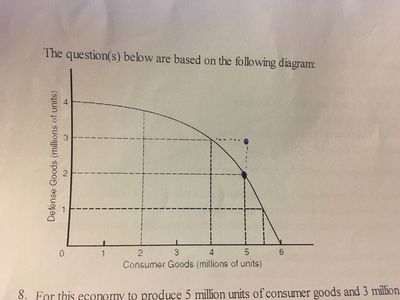
- Aresources must be used inefficiently
- Bthe production possibilities curve must be pushed outward
- Cunemployment must grow
- Dincome inequality must increase
- Esociety's resources must shrink
8The U.S economy may be best characterized as an example of
- AMarket socialism
- Bopportunistic imperialism
- Cmilitaristic capitalism
- Dpure capitalism
- EMixed capitalism
9A market demand curve
- AShifts as the price falls
- Bslopes outward from left to right
- Cis unaffected by changes in consumers' tastes and incomes
- Dmeasures the rate of growth of per-capita output
- Eshows the amount buyers would like to purchase at various prices
10A decrease in demand
- AResults from a decrease in supply
- Bmeans that the demand curve has shifted to the left
- Cincreases the quantity sold in the market
- Dreflects an increasing consumer preference for the item
- Ecauses the equilibrium price to rise
11In general, supply curves slope outward to the right because
- Aincreases in the price of a commodity lead to right outward shifts of the supply curve
- Brising prices motivate producers to offer more units for sale
- Ctechnology progresses over time, increasing the ability of firms to produce more at existing prices
- Dof increases in input prices as production is increased
- Eempirical studies almost always show that the is the case
12For a maket to exhibit excess demand
- Asupply must exceed demand
- Bthe equilibrium price must be too high to clear the market
- Cthe actual price must be below the equilibrium price
- Dthe demand curve must slope outward
- Ethe market must be growing
13The equilibrium price is
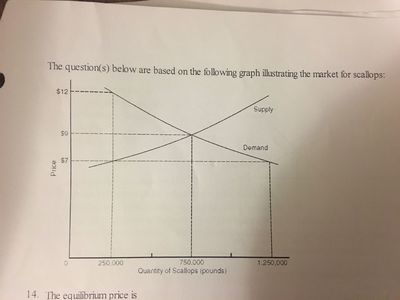
- Amore than $12 per pound
- B$12 per pound
- C$9 per pound
- D$7 per pound
- Eless than $7 per pound
14In a free market, actual price will
- Aremain unchanged as equilibrium price changes
- Bmove toward equilibrium price
- Ccause demand and supply curves to shift direction
- Dalways exceed equilibrium price
- Ebe very difficult to calculate
15If farmers currently produce 800 bushels
- Athe actual price is $2
- Bthe market is in equilibrium
- Cactual price is below equilibrium price and will tend to rise
- DOnly increases in demand would encourage the rise above 80 units
- EThe market exhibits to surplus
16Gross domestic product:
- Aequals the total wages paid in a year
- Bis a measure of government output
- Cequals the total value of final goods and services produced in a year
- Dis the sum of all goods, both final and intermediate
- Eis an obsolete economic indicator of inflation
17When measuring GDP, we double count if we include the value of:
- AGovernment expenditures
- BIntermediate goods
- CNonmarket transactions
- Dnonproductive transactions
- Enet exports
18GDP expressed in constant dollars is called:
- Acapital accumulation
- Bthe net national product
- Cpermanent income
- Dreal GDP
- Ea price index
19To deflate, one must:
- Amultiply the price ratio by 100
- Bdivide the current dollar values by the price index
- Csubtract the constant dollar values from current dollar values
- Dadd the price index in the current year to the price index in the base year
- Efind the difference between the values of two different sets of goods in a given year
20(Data) According to the data in the table, from 2002 to 2003, GDP in constant dollars rose by:
- A6.5 percent
- B5.7 percent
- C4.8 percent
- D3.1 percent
- E1.7 percent
21The best example of consumer nondurable counted in this year's GDP is a:
- AHair cut
- BRefrigerator
- CPizza
- DConcert
- EUsed car
22(Data) GDP is:
- AA. $1240 billion
- B$1250 billion
- C$1340 billion
- D$1640 billion
- E$2590 billion
23In this economy
- Athe stock of capital goods fell during the year
- Bthe government balanced its budget
- Cvalue-added exceeded the income
- Doutput exceeded GDP
- Eimports exceeded exports
24The level of real national output purchased at each price level is called:
- AA market basket
- BA market demand curve
- CAn aggregate demand curve
- DA derived demand curve
- EA consumption of possibilities curve
25If the money supply is fixed, increases in the price level reduce:
- AInterest rate
- BImports
- CThe rate of inflation
- DTotal real output purchased
- EThe average money cost of each transaction
26When the economy is at equilibrium in the horizontal range of the short run aggregate supply curve,:
- AThere is little upward pressure on prices because of widespread unemployment
- BThe aggregate demand curve must be horizontal as well
- CEconomic conditions similar to those experienced during world war II prevail
- DReal output is equal to potential output
- EA change in aggregate demand causes price levels to fall
27People temporarily out of work because they are changing jobs or looking for their first jobs are examples of
- Africtional unemployment
- Bstructural unemployment
- Ccyclical unemployment
- Dinflationary unemployment
- Eresidual unemployment
28People actively looking for work who cannot find jobs because of an insufficiency of aggregate demand are examples of:
- AFrictional unemployment
- BStructural unemployment
- CCyclical unemployment
- DInflationary unemployment
- EResidual unemployment
29During a period when total spending is too high relative to potential output, the economy experiences:
- AExcessive unemployment
- BFailing average prices
- CA glut
- DA great crash
- EInflation
30The phase of the business cycle in which output is highest relative to its potential level is the:
- APeak
- BTrough
- CRecession
- DExpansion
- ETrend
31In general, a business cycle goes through its phases in the following sequence:
- ATrough, peak, expansion, recession
- BRecession, trough, expansion, peak
- CTrough, recession, expansion, peak
- DTrough, expansion, recession, peak
- EExpansion, recession, trough, peak
32If Carolyn's consumption rises by $5,000 as her income from $26,000 to $32,000 per year, her marginal propensity to consume is
- A0.16
- B19
- C0.83
- D1.20
- Eimpossible to determine from the data
33The average propensity to consume equals the
- AChange in personal consumption expenditures divided by the current level of consumption expenditures
- Bamount spent on consumption divided by the amount of disposable income
- Cchange in personal consumption expenditures divided by the amount of disposable income
- Dpersonal consumption expenditures divided by personal saving
- Esum of personal consumption expenditures and disposable income divided by two
34An MPS of .32 implies that the MPC is
- A1.32
- B0.74
- C0.68
- D0.36
- Eimpossible to calculate unless the change in income is specified
35If the interest rate is 7%, the number of projects undertaken would be
- A1
- B2
- C3
- D4
- E5
36The relationship between household spending and disposable income is known as the
- Ainvestment function
- Bmultiplier
- Cgross domestic product
- Dconsumption function
- Esaving function
37If disposable income raises by $100 billion and personal consumption expenditure rises by $60 billion, what is the marginal propensity to consume?
- A0.60
- B0.40
- C1.60
- D1.66
- E2.50
38If disposable income is $1,800 billion, the average propensity to consume is
- A.8
- B.84
- C.92
- D1.0
- E1.08
39If disposable income is $1,900 billion, saving is
- A$16 billion
- B$20 billion
- C$144 billion
- D$160 billion
- E$180 billion
40If the multiplier is 3, a $1 billion decrease in government spending will
- Alower equilibrium GDP by 1/3
- BLower equilibrium GDP by 3
- CRaise equilibrium GDP by 1/3
- Draise equilibrium GDP by 3
- Eleave equilibrium GDP unchanged but change intended spending by 1/3
41One reason not to wait for wage rates and other input prices to fall and shift the short-run aggregate supply curve to the right in an economy experiencing a recessionary gap is that
- Asuch attention will result in inflation
- Bunemployment would fall too fast for a complex adjustment
- Ca government budget deficit would be created
- Dit would take too long because wages and prices tend to be sticky
- Efalling prices would reduce exports
42Aggregate demand shifts to the right when
- Agovernment spending is reduced
- Btax rates are reduced
- Cequilibrium GDP is reduced
- Dtotal intended spending is reduced
- Ethe inflator gap is reduced
43When the equilibrium level of out put in an economy is above its potential output
- Athe government should raise its spending
- Bthere is an inflationary gap
- Cthe long-run aggregate supply curve is horizontal
- Dunemployment rates are high
- Ewages and prices must rapidly falling
44In an economy experiencing a high unemployment rate, appropriate fiscal policy would attempt to
- Await for wages and other input prices to fall
- Bdiscourage firms from investing
- Cincrease personal tax rates
- Dreduce welfare payments to households
- Eshift the aggregate demand curve to the right
45When inflation constitutes a major economic problem, government policy may attempt to
- Ashift the aggregate demand curve to the left
- Bshift the aggregate supply curve to the ;eft
- Cencourage and augment spending
- Draise the equilibrium price level
- Eraise the minimum wage to reduce the effective price level
46Government anti-inflationary fiscal policy
- Ais intended to shift the short-run aggregate supply curve to the left
- Btypically leads to an increase in total real output and a rise in the price level
- Cleads to reduction in total real output when the short-run aggregate supply curve is positively sloped
- Dshifts the aggregate demand curve to the right
- Eis undertaken when the economy is in the horizontal
47the value of money
- Arises during periods of inflation
- Bis inversely related to the price level
- Cis unaffected by creeping inflation
- Dhas remained relatively constant in the United States over the past 25 years
- Efalls as real income rises
48Inflation
- Ameans demand is falling and supply is rising
- Bincreases the value of the money supply
- Crarely affects the distribution of income or wealth
- Dis generally highest when there is plenty of excess capacity and unemployed resources
- Eis a general upward movement in the average level of prices
49In the base year, a price index has a value of
- A-1
- Bzero
- C1/100
- D100x100
- E100
50Inflation
- Ahurts people living on fixed incomes
- Binevitably tends to die out
- Chas been the experience of this country since its founding
- Ddoes not tend to redistribute income
- Einevitably leads to deflation
51During periods of high inflation, investors tend to buy real estate, art, and commodities like gold because
- Aduring inflation there are the only items that are not in short supply
- Bsuch items tend to grow in value at a rate higher than the inflation rate
- Creal estate and commodities are very cheap during periods of inflation
- Dbanks and other lenders are very eager to support such investments
- Ethe purchasing power of money trises during inflationary periods
52Demand-side inflation is most likely to occur when the economy
- Ahas substantial excess capacity
- Bis approaching or operating at full employment
- Chas an aggregate demand curve shifting to the left
- Dhas a horizontal aggregate supply curve
- Ehas labor productivity rising faster than wages
53Demand-side and supply-side inflations differ in that, in one case,
- Atotal real output rises, and in other, it falls
- Bthe price level rises, and in other, it falls
- Cborrowers benefit and, in other, savers benefit
- Dbusinesses benefit, and in other, householders benefit,
- Einflation is temporary, and in other, inflation is permanent
54In part, supply-side inflation
- Ais at the heart of demand-side inflation
- Bis an example of too little money chasing too may goods
- Cis an outgrow of a perfectly competitive market structure
- Dresults from significant price increases of important resources
- Eoccurs when labor productivity rises faster than wage rates
55Currency in the United States is
- Aconvertible into gold at fixed rates
- Bfiat money
- Cissued by commercial banks based on their deposits
- Danother name for checking deposits and NOW accounts
- Eany interest bearing government note
- Fbruh
- GAll of them
56Fiat money is any money that
- Aexist in the form of coin or currency
- Bis issued by the Federal Reserve
- Chas a greater face value than its purchasing power
- Dis money because the government says so and the people accept it
- Eearns interest when deposited in banks
57Assets a government says are money and are accepted by the public as money are called
- Anear money
- Bfunny money
- Csophisticated money
- Dnominal money
- Efiat money
Información
- Descripción
- Principles of Macroeconomic Theory - Final Study Guide
- Autor
- Ricardo Villeda
- Idioma
- English
- Visitas
- 50
- Historial
- Creado el 26 ene 2017 · actualizado el 26 ene 2017
- Etiquetas
- Valoración
- Aún sin valoraciones Valora este test