
Test
Capacitance Pre-Knowledge Quiz
Crea una cuenta gratis para terminar este test
Guarda tu progreso y consulta tu resultado final.
¿Ya tienes cuenta? Inicia sesión
Preguntas del test (8)
1A balloon is rubbed quickly across a rug.
The balloon is then brought to touch a smooth wall.
When released it sticks to the wall.
Which of the following explains why the balloon sticks to the wall?- AThe balloon removes protons from the rug and the extra protons are attracted to the electrons in the wall.
- BThe balloon removes electrons from the rug and those extra electrons from the rug are attracted to the protons in the wall.
- CThe balloon removes protons from the rug and the extra protons are attracted to the protons in the wall.
- DThe balloon removes electrons from the rug and the extra electrons are attracted to the electrons in the wall.
2A positively charged conducting sphere sits on an insulated stand.
A second insulated neutral conducting sphere is brought near the first but does not touch it.
Which statement below best describes the resulting charge distribution?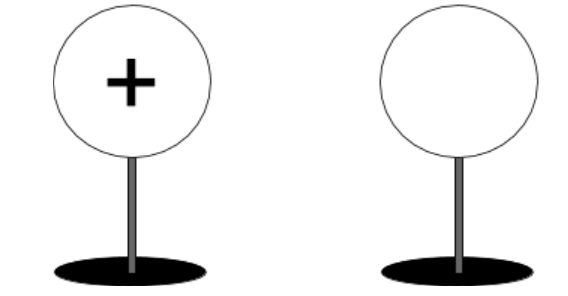
- ALoosely held electrons on the neutral sphere are attracted toward the positively charged sphere. The left side of the neutral sphere becomes more negative than the right side as the sphere is polarized.
- BLoosely held protons on the neutral sphere are repelled away from the positively charged sphere. The left side of the neutral sphere becomes more negative than the right side as the sphere is polarized.
- CElectrons in each atom of the neutral sphere are pulled closer to the positively charged sphere while the positive atomic nuclei are pushed away slightly. This results in polarization of atoms but not the sphere itself.
- DProtons jump from the positive sphere onto the neutral sphere, giving both spheres an equal positive charge that is about half of the positive charge that was originally on the left-hand sphere.
3A scientist has a neutral conducting sphere on a non-conducting stand, a positively charged conducting rod, and a ground wire (which allows the sphere to be grounded to the Earth).
How can the scientist use these to place a charge on the sphere? Select two.- AConnect the sphere to the ground wire, bring the rod close to the sphere, disconnect the ground wire, and move the rod away from the sphere. The result is a negatively-charged sphere.
- BConnect the sphere to the ground wire, bring the rod close to the sphere, move the rod away from the sphere, and disconnect the ground wire. The result is a negatively-charged sphere.
- CTouch the sphere with the rod without using the ground wire and then move the rod away from the sphere. The result is a positively charged sphere.
- DConnect the sphere to the ground wire, touch the sphere with the rod, disconnect the ground wire, and then move the rod away from the sphere. The result is a positively charged sphere.
4The diagram above shows a circuit with an open switch, a 3 V ideal battery, and a light bulb.
Which of the following best represents the magnitude of the potential difference across various elements of this circuit when the switch is open?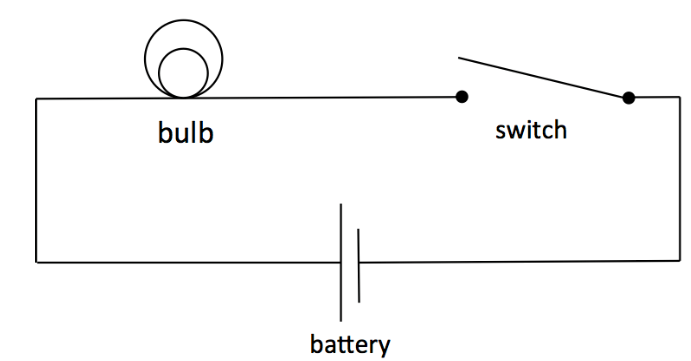
- AIt is zero across the switch, bulb, and battery.
- BIt is zero across the switch and bulb, and 3 V across the battery.
- CIt is zero across the bulb, and 3 V across the switch and battery.
- DIt is 3V across the switch, bulb, and battery.
5The circuit diagram above shows a closed switch, an ideal battery, and two light bulbs in series. Use this diagram to answer the next two questions.
Choose the statement below which correctly describes current in the circuit.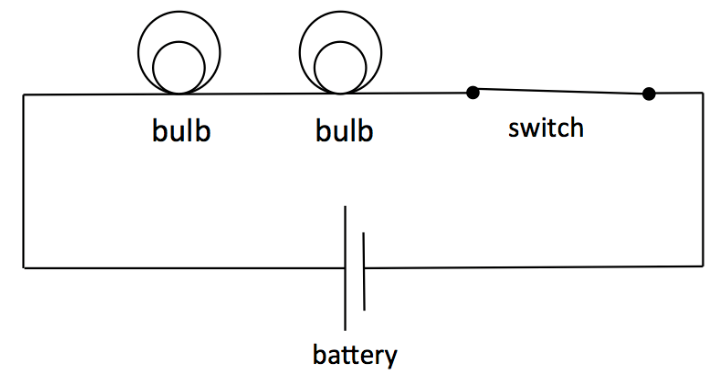
- AThe current leaving the battery is the greatest. It decreases after passing through the first bulb and is zero once it has passed the second bulb.
- BThe current is used up in each light bulb as the charges make the bulbs glow.
- CThe current is the same through all elements of the circuit.
- DThe current through each light bulb is half of that which flows through the battery.
6One of the bulbs in the circuit is considerably brighter than the other.
Choose the TWO statements below which explain this observation.- AThe current through both bulbs is the same, so the bulb with the greater resistance will have the greatest potential difference across it and be the brightest.
- BThe potential difference across the two bulbs is the same, so the bulb with the least resistance will have the greatest current through it and be the brightest.
- CThe bulb closest to the positive side of the battery will receive the most current and be the brightest.
- DThe brightest bulb uses the most power as that is a measure of energy output per unit time.
7The four cylindrical resistors shown above are made from an alloy of nichrome and have uniform resistivity ρ.
If A is the cross-sectional area and L is the length of Resistor A, choose which of the four resistors will have the greatest resistance to electrical current.- AResistor A
- BResistor B
- CResistor C
- DResistor D
8A circuit is constructed with two resistors, R1 and R2, in parallel with each other as shown above.
The resistance of R2 is greater than the resistance R1.
Choose the correct statements from the choices below. There are TWO correct statements.- AThe potential difference across R2 is the same as the potential difference across R1.
- BEach electron passing through R2 results in a greater dissipation of energy than each electron passing through R1.
- CThe current is less through R2 than it is through R1.
- DThe power dissipated through R2 is greater than the power dissipated through R1.
Información
- Descripción
- Prior knowledge quiz on capacitance for A Level Physics.
- Autor
- Jeffrey Piggott
- Idioma
- English
- Visitas
- 77
- Etiquetas
- Valoración
- Aún sin valoraciones Valora este test