
Test
Arousal, Anxiety and Performance
Este test tiene tipos de pregunta que se abren en el reproductor de siempre.
Preguntas del test (19)
1[blank_start]Social Facilitation theory[blank_end] aims to explain how the presence of others influences performance. By predicating the [blank_start]presence[blank_end] of others [blank_start]increases[blank_end] arousal.
- ASocial Facilitation theory
- Bpresence
- Cincreases
2Martens (1975) reviewed [blank_start]24[blank_end] studies to find audiences [blank_start]increased[blank_end] the performance of [blank_start]well learned[blank_end] skills however [blank_start]novel[blank_end] skills were [blank_start]impaired[blank_end].
- A24
- Bincreased
- Cwell learned
- Dnovel
- Eimpaired
3MacCraken and Stadulis (1985) used the [blank_start]balance beam test[blank_end] to see how an [blank_start]audience[blank_end] effected [blank_start]performance[blank_end]. The study included a [blank_start]pre-test[blank_end] to separate [blank_start]high[blank_end] and [blank_start]low[blank_end] balancing skill levels in the participants. The participants then performed the test with and without and audience. Finding the [blank_start]high skill level[blank_end] participants performed [blank_start]well[blank_end] in front of spectators but the [blank_start]low skill[blank_end] group didn't.
- Abalance beam test
- Baudience
- Cperformance
- Dpre-test
- Ehigh
- Flow
- Ghigh skill level
- Hwell
- Ilow skill
4What are the problems with social facilitation theory?
- AToo simplistic
- BValid
- CUnreliable
5Inverted U Theory predicts performance decreases with arousal.
- AVerdadero
- BFalso
6Lowe (1971) measured heart rate in baseball little league performers. Finding heart rate increased depending on the importance of the situation.
- AVerdadero
- BFalso
7What does this graph show?
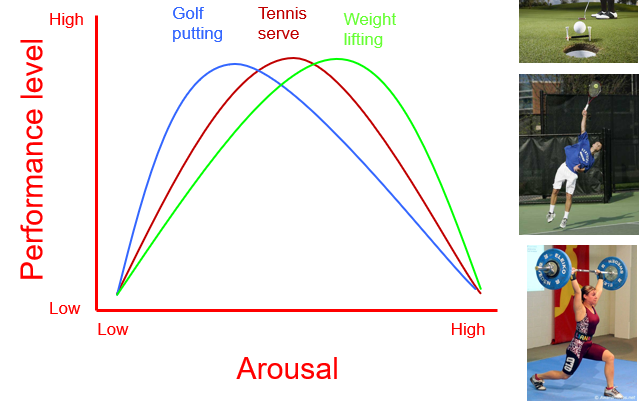
- AVarying optimual arousal points
8What are the problems with the inverted U theory?
- ALacks precision and is too simplistic
- BReductionist
- CInvalid
9The catastrophe model shows...
- APerformance, arousal and anxiety
- BPerformance, emotions and moods
- Canxiety, stress and arousal
10Low arousal...
- Aincreases performance with anxiety
- Bdecreases perfromance with anxiety
11High arousal...
- Aincreases perfromance with anxiety
- Bdecreases perrformance as anxiety increases
12Low anxiety...
- Adecreases arousal as performance increases
- Bincreases perfromance until optimual arousal
13High anxiety will create...
- Aincrease performance until optimal arousal
- Bincreased performance but decreased arousal
14The problems with the [blank_start]catastrophe model[blank_end] are that is only have [blank_start]limited[blank_end] research and [blank_start]fails[blank_end] to describe [blank_start]how[blank_end] this happens to performance.
- Acatastrophe model
- Blimited
- Cfails
- Dhow
15What is processing efficiency theory?
- AIncreased resources used decreases efficiency processing
- BIncreased resources used increases efficiency processing
16The functions of anxiety are to [blank_start]consume[blank_end] attentional resources and increase [blank_start]effort[blank_end] during performance.
- Aconsume
- Beffort
17Why is too much anxiety bad?
- AReduces attentional resources devoted to a task
- BCreates feelings of worry which distracts the player
- CCauses panic attacks
18Williams, Vickers and Rodrigus (2002) used [blank_start]10[blank_end] table tennis players. The players ahd [blank_start]6[blank_end] shots towards a target under 2 conditions.
1. [blank_start]Practice[blank_end]
2. £200 prize
Attention was measured using a [blank_start]probe reaction time[blank_end], were participants had to shout yes to a tone that was played. The researchers found that comp [blank_start]increased[blank_end] anxiety as their reaction time was longer.- A10
- B6
- C20
- D30
- E5
- F12
- GPractice
- H£200 prize
- IAudience present
- Jprobe reaction time
- KMental Readiness Form
- LEEG - brain waves
- Mincreased
- Ndecreased
19Hardy and Hutchinson (2007) studied [blank_start]10[blank_end] climbers under 2 climbs - one climb was high anxiety (hard) and the other was low anxiety (easy). The researchers found difficulty [blank_start]increased[blank_end] anxiety but this also [blank_start]increase[blank_end] effort, therefore performance increased with anxiety.
- A10
- B13
- C7
- Dincreased
- Edecreased
- Fincrease
- Gdidnt effect
Información
- Descripción
- Studying how arousal and anxiety can effect performance.
- Autor
- Georgina Bradshaw
- Idioma
- English
- Visitas
- 117
- Etiquetas
- Valoración
- Aún sin valoraciones Valora este test