
Test
Key Concept 3.2 Continuity and Innovation of State Forms and Their Interactions
Este test tiene tipos de pregunta que se abren en el reproductor de siempre.
Preguntas del test (20)
1"State formation in this era [blank_start]demonstrated[blank_end] remarkable continuity, innovation and [blank_start]diversity[blank_end] in various regions. In Afro-Eurasia, some states attempted, with differing degrees of success, to preserve or revive [blank_start]imperial structures[blank_end], while smaller, less [blank_start]centralized[blank_end] states continued to develop. The expansion of [blank_start]Islam[blank_end] introduced a new concept — the [blank_start]Caliphate[blank_end] — to Afro-Eurasian statecraft. Pastoral peoples in Eurasia built powerful and distinctive empires that integrated [blank_start]people[blank_end] and [blank_start]institutions[blank_end] from both the [blank_start]pastoral and agrarian[blank_end] worlds. In the Americas, powerful states developed in both [blank_start]Mesoamerica[blank_end] and the [blank_start]Andean[blank_end] region." [1]
I. Empires collapsed and were reconstituted; in some regions new state forms emerged.
A. States that reformed during this time period built upon the [blank_start]foundations[blank_end] of the classical ages; they found traditional sources of [blank_start]authority[blank_end] and legitimacy as reliable ground for the [blank_start]reconstitution[blank_end] of their civilizations. In such cases, these states had to combine these revived [blank_start]traditions[blank_end] with innovations in order to adapt to new circumstances. This process formed unique combinations of the [blank_start]old and new[blank_end].- Ademonstrated
- Bdiversity
- Cimperial structures
- Dcentralized
- EIslam
- FCaliphate
- Gpeople
- Hinstitutions
- Ipastoral and agrarian
- JMesoamerica
- KAndean
- Lfoundations
- Mauthority
- Nreconstitution
- Otraditions
- Pold and new
2CHINA
During the classical age, the [blank_start]Han[blank_end] Dynasty found that a [blank_start]bureaucracy[blank_end] of merit made of [blank_start]Confucian[blank_end] scholars was more conducive to running a [blank_start]centralized[blank_end] state than relying on local [blank_start]aristocrats[blank_end] to implement [blank_start]imperial[blank_end] rule. In the post classical age the [blank_start]Tang[blank_end] Dynasty reinstated this tradition of using a Confucian bureaucracy in China's [blank_start]political system[blank_end]. The Confucian [blank_start]civil service exams[blank_end] were brought back, and candidates studied Confucian classics with the hope of meriting an esteemed post in the Chinese government. One [blank_start]effect[blank_end] of reestablishing the civil service bureaucracy was that the cultural content of Confucianism continued to [blank_start]influence[blank_end] Chinese civilizations. For example, [blank_start]patriarchy[blank_end] continued to be a feature of Chinese society during the Tang Dynasty and traditional social [blank_start]hierarchies[blank_end] were reinforced.
The Tang did not simply copy the [blank_start]accomplishments[blank_end] of the Han. Onto these borrowed [blank_start]traditions[blank_end] they grafted their own innovations. One such innovation resulted from the Tang's attempt to address a problem that [blank_start]crippled[blank_end] the Han during the last centuries of its rule: the unequal distribution of [blank_start]land[blank_end] across society. The Tang developed the equal field system to prevent peasant land from falling into the hands of the [blank_start]aristocracy[blank_end], which happens so often during hard economic times. In this system, the government owned all the land but periodically [blank_start]redistributed[blank_end] it to families according to their need. This provided for a fairer distribution of land and a more [blank_start]equitable[blank_end] method of [blank_start]taxation[blank_end] (although the basis for calculating the tax was an issue of intense debate during the Tang.) [2]- AHan
- Bbureaucracy
- CConfucian
- Dcentralized
- Earistocrats
- Fimperial
- GTang
- Hpolitical system
- Icivil service exams
- Jeffect
- Kinfluence
- Lpatriarchy
- Mhierarchies
- Naccomplishments
- Otraditions
- Pcrippled
- Qland
- Raristocracy
- Sredistributed
- Tequitable
- Utaxation
3Another innovation of the Tang Dynasty was its policy of establishing [blank_start]tributary[blank_end] states. Although earlier Chinese dynasties collected tribute, the practice became more complex and standardized under the Tang. The Chinese tributary system was based on their belief that Chinese civilization was [blank_start]superior[blank_end] to others, but barbarian and [blank_start]non-Chinese[blank_end] people could have access to Chinese ways providing they ceremonially recognized the [blank_start]supremacy[blank_end] of China and [blank_start]paid tribute[blank_end] to the emperor. [3] Thus China could "radiate" its superior civilization to [blank_start]barbarian[blank_end] people around it. In reality, the tributary system was a means for [blank_start]China[blank_end] to control conquered lands that often proved difficult to rule. Chinese dynasties had long tried to project their control over the [blank_start]Korean peninsula[blank_end]; indeed, its long costly war with Korea did much to discredit the [blank_start]Sui[blank_end] Dynasty, the Tang's predecessor. The Tang Dynasty gave its support the the Silla family of Korea to ensure their rule over the entire Korean peninsula, but it cost the Silla their [blank_start]independence[blank_end]. The price China demanded for helping the Silla was that they become a [blank_start]tributary state[blank_end] of the Tang emperor. Each year representatives from [blank_start]Korea[blank_end] traveled to the Chinese capital to purchase their rule with payments of tribute. They returned with Chinese customs, [blank_start]fads[blank_end], Buddhist writings, clothing fashions, and literature. Through this tributary relationship much Chinese [blank_start]influence[blank_end] made its way into Korea.[4]
In summary, the recovery of [blank_start]Chinese civilization[blank_end] in the post classical era was made possible by building on [blank_start]classical traditions[blank_end], such as the Confucian civil service [blank_start]bureaucracy[blank_end], and fusing them with new administrative practices such as the equal field system and the creation of tributary states.- Atributary
- Bsuperior
- Cnon-Chinese
- Dsupremacy
- Epaid tribute
- Fbarbarian
- GChina
- HKorean peninsula
- ISui
- Jindependence
- Ktributary state
- LKorea
- Mfads
- Ninfluence
- OChinese civilization
- Pclassical traditions
- Qbureaucracy
4THE BYZANTINE EMPIRE
The Byzantine Empire thought of itself as the continuation of [blank_start]Roman[blank_end] civilization, so it was only natural that it would continue and build upon the foundations of classical Rome. One of Rome's most enduring legacies was its system of [blank_start]law[blank_end]. Indeed, even the [blank_start]barbarians[blank_end] who brought down the western half of the empire in the 5th century adopted the system of Roman law to regulate their civilizations. In the surviving eastern half of the Roman Empire the task to update laws and make them relevant to the new situation of Byzantine civilization fell to the emperor [blank_start]Justinian[blank_end]. Although he technically lived before the post classical age (482-565 CE) his [blank_start]code of laws[blank_end] profoundly influenced the Byzantine empire and constitute the greatest example of the Byzantine Empire building on a tradition of Rome.
As the classical age drew to a close, many of the previous Roman laws were rendered [blank_start]obsolete[blank_end] by changing conditions of the empire. Confusing and [blank_start]contradictory[blank_end] laws hindered the functioning of courts. Moreover, Roman civil law often conflicted with the eastern empire's adopted religion of [blank_start]Christianity[blank_end].[5] In response to this situation, Justinian commissioned the formation of several bodies of law which are collectively referred to as the [blank_start]Code of Justinian[blank_end].
Like classical Roman Law, the Code of Justinian gave [blank_start]order and security[blank_end] to a collection of diverse peoples across the breadth of the empire. It punished dishonest [blank_start]tax collectors[blank_end] and encouraged [blank_start]honest trade[blank_end]. "Rape was punished by death and confiscation of property, and the proceeds were given to the injured woman." [6] What was entirely new about the Code was its enactment of [blank_start]Christianity morality[blank_end] into [blank_start]Roman civil law[blank_end]. It enforced the Church's views on divorce, adultery and homosexuality, and the Church's property was protected as a [blank_start]permanent holding[blank_end]. Death, torture and mutilation were common [blank_start]punishments[blank_end]. The Code of Justinian was an innovation but one built upon one of Rome's most successful traditions: law.- ARoman
- Blaw
- Cbarbarians
- DJustinian
- Ecode of laws
- Fobsolete
- Gcontradictory
- HChristianity
- ICode of Justinian
- Jorder and security
- Ktax collectors
- Lhonest trade
- MChristianity morality
- NRoman civil law
- Opermanent holding
- Ppunishments
5Another of the Byzantine Empire's [blank_start]innovations[blank_end] was prompted by a pressing security issue: the advance of [blank_start]Islam[blank_end] on its eastern frontier. Protecting its borders against barbarian incursions was a significant problem for the [blank_start]late Roman Empire[blank_end], but Islam represented a much more organized front. To counter this [blank_start]threat[blank_end] the Byzantine Empire developed a system of [blank_start]imperial[blank_end] organization called the theme system. Each [blank_start]theme[blank_end], or province, was placed under the leadership of a general who organized its administration and defense. Each general was responsible directly to the [blank_start]emperor[blank_end] and he recruited his armies from the [blank_start]free peasants[blank_end]. In return for military service, the peasants were given [blank_start]land[blank_end]. The theme system provided [blank_start]incentives[blank_end] for increased [blank_start]grain[blank_end] production and gave the empire [blank_start]effective and loyal[blank_end] soldiers. Under this system the empire protected its [blank_start]eastern borders[blank_end] and captured additional land in [blank_start]Anatolia[blank_end] and present day [blank_start]Syria[blank_end].[7]
Unlike most of the era of Western Rome, the Byzantine Empire had an official religion, [blank_start]Orthodox Christianity[blank_end]. To adapt to this circumstance the Empire developed a new [blank_start]model of authority[blank_end]. Beginning with Constantine and extending to the end of the empire, they operated under an ideology called [blank_start]Caesaropapism[blank_end], the vesting of political and religious authority under a [blank_start]single figure[blank_end]. Thus the emperor, the political head of state, simultaneously acted as the head of the [blank_start]organized Church[blank_end]. Again, Byzantine civilization innovated to meet the circumstances of the empire's [blank_start]realities[blank_end].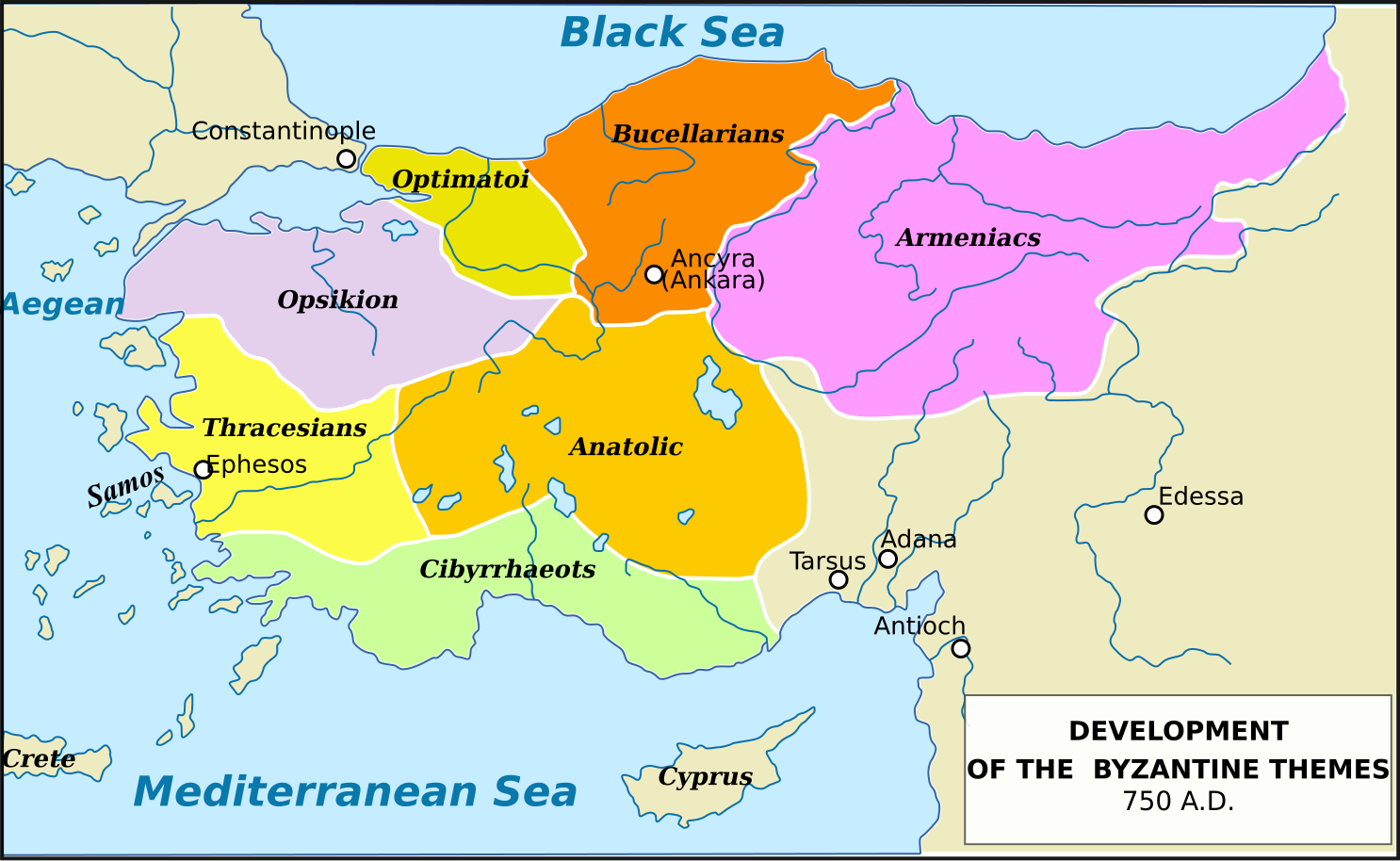
- Ainnovations
- BIslam
- Clate Roman Empire
- Dthreat
- Eimperial
- Ftheme
- Gemperor
- Hfree peasants
- Iland
- Jincentives
- Kgrain
- Leffective and loyal
- Meastern borders
- NAnatolia
- OSyria
- POrthodox Christianity
- Qmodel of authority
- RCaesaropapism
- Ssingle figure
- Torganized Church
- Urealities
6B. Not all states in this era were reconstituted from the classical period. Some were new and built themselves from limited connections to the past.
THE ISLAMIC STATES
A distinctive feature of the post classical period is the [blank_start]rapid[blank_end] rise of [blank_start]Islamic[blank_end] civilization, or the [blank_start]Dar al-Islam[blank_end]. A [blank_start]unified[blank_end] civilization seemed an unlikely prospect for the area in which Islam was born. The [blank_start]nomads[blank_end] of the Arabian peninsula (Bedouins) were [blank_start]polytheistic[blank_end] and organized by powerful [blank_start]tribal identities[blank_end]. Conversion to the [blank_start]monotheistic[blank_end] teachings of [blank_start]Muhammad[blank_end] meant that these issues were less likely to hinder [blank_start]cooperation[blank_end] between tribes. One’s ancestral bloodline—once the unifying bond within a tribe—gave way to a new loyalty based on a common faith in one god that brought individuals together regardless of their [blank_start]tribe[blank_end]. As a result, Islam facilitated the rise of empires in areas once characterized by bands of feuding nomadic tribes.
Soon after the death of [blank_start]Mohammed[blank_end] a dispute erupted over who should be the [blank_start]leader[blank_end] of this new religion. Since the idea of another prophet was inconceivable, a "deputy" or [blank_start]Caliph[blank_end] was chosen to lead the Muslim community. Disagreement over the [blank_start]qualifications[blank_end] of the Caliph led to the split of Muslims into [blank_start]Shia and Sunni[blank_end] factions. Nevertheless, the Caliph--a leader who presides over the political, religious and military affairs of the Dar al-Islam--became a [blank_start]central feature[blank_end] of Islamic civilization for the majority of Muslims. By bringing these separate components of civilization under a single leader, the Caliphate (the office of the Caliph) had a [blank_start]unifying[blank_end] effect on Islamic civilization.- Arapid
- BIslamic
- CDar al-Islam
- Dunified
- Enomads
- Fpolytheistic
- Gtribal identities
- Hmonotheistic
- IMuhammad
- Jcooperation
- Ktribe
- LMohammed
- Mleader
- NCaliph
- Oqualifications
- PShia and Sunni
- Qcentral feature
- Runifying
7The [blank_start]Umayyad Caliphate[blank_end] (661-750) pushed the boundaries of Islam far outside the [blank_start]Arabian[blank_end] peninsula. Umayyad armies conquered the [blank_start]Middle East[blank_end], spread across [blank_start]North Africa[blank_end], and into [blank_start]Iberia[blank_end]. Their conquests in Europe were limited to Spain by the [blank_start]Battle of Tours[blank_end] (732) in which the Franks routed the Muslim armies and turned them back across the Pyrenees Mountains. Under the Umayyads the [blank_start]Dar al-Islam[blank_end] was dominated by Arab [blank_start]military[blank_end] elites, and their [blank_start]preferential treatment[blank_end] of [blank_start]Arab Muslims[blank_end] brought them into [blank_start]conflict[blank_end] with the growing [blank_start]non-Arab[blank_end] population of [blank_start]Islamic[blank_end] civilization.[8]
In 750 the Umayyads were overthrown by the [blank_start]Abbasids[blank_end] and a new [blank_start]Caliphate[blank_end] was established. Under the Abbasid Caliphate (750-1258) a [blank_start]wider[blank_end] variety of cultural influences made their way into Islamic civilization, the most prominent of which was [blank_start]Persian[blank_end]. From the Abbasid capital of [blank_start]Baghdad[blank_end], the Caliph ruled with [blank_start]absolute authority[blank_end] which he claimed to have received directly from [blank_start]God[blank_end].[9] Rather than depend on a [blank_start]Arab military aristocracy[blank_end] like the Umayyads, the Abbasids used a [blank_start]salaried bureaucracy[blank_end]; bureaucrats could be [blank_start]promoted or dismissed[blank_end] at the whim of the caliph. They ended the [blank_start]racial policies[blank_end] of the Umayyads; Arabs were no longer [blank_start]favored[blank_end] in the administration of the caliphate and the Arab [blank_start]militias[blank_end] were replaced by a [blank_start]professional[blank_end] Abbasid army of [blank_start]paid soldiers[blank_end]. The nature of the caliph itself was dramatically transformed during the reign of the Abbasids. Rather than the "[blank_start]warrior[blank_end]" caliph of the Umayyads, the Abbasid Caliph lived in [blank_start]splendor[blank_end] and surrounded himself with wealth and [blank_start]elaborate ceremonies[blank_end]. He was an [blank_start]absolute[blank_end] ruler presiding over a [blank_start]centralized bureaucratic state[blank_end] and supported by [blank_start]military force[blank_end].[10]- AUmayyad Caliphate
- BArabian
- CMiddle East
- DNorth Africa
- EIberia
- FBattle of Tours
- GDar al-Islam
- Hmilitary
- Ipreferential treatment
- JArab Muslims
- Kconflict
- Lnon-Arab
- MIslamic
- NAbbasids
- OCaliphate
- Pwider
- QPersian
- RBaghdad
- Sabsolute authority
- TGod
- UArab military aristocracy
- Vsalaried bureaucracy
- Wpromoted or dismissed
- Xracial policies
- Yfavored
- Zmilitias
- AAprofessional
- ABpaid soldiers
- ACwarrior
- ADsplendor
- AEelaborate ceremonies
- AFabsolute
- AGcentralized bureaucratic state
- AHmilitary force
8THE MONGOL KHANATES
The Mongols built the [blank_start]largest[blank_end] land empire in the world, a remarkable feat considering they were [blank_start]pastoral nomads[blank_end]. Like the Muslims, Mongols had to overcome deep [blank_start]tribal[blank_end] divisions before they could be integrated into a [blank_start]large empire[blank_end]. In the culture of the Central Asian steppes, loyalties of [blank_start]kinship[blank_end] were so strong that they prevented any broad [blank_start]cooperation[blank_end] between people of [blank_start]different bloodlines[blank_end]. Like the [blank_start]Bedouins of Arabia[blank_end], [blank_start]Central Asia nomads[blank_end] seemed locked into constant [blank_start]tribal rivalries[blank_end] and warfare. [blank_start]Genghis Khan[blank_end] (1162-1227) was the man responsible for uniting these warring tribes into an empire. One of his tactics was to blur the lines between tribes by [blank_start]intermarriage[blank_end]. For example, after his defeat of the Tartars Genghis took two daughters of prominent [blank_start]Tartar aristocrats[blank_end] as his wives, and encouraged other Mongols to do the same.[11] He thus blended the Tartar bloodline with his own making [blank_start]tribal distinctions[blank_end] less relevant. So widespread was his practice of cross-contaminating tribal [blank_start]purity[blank_end] through marriage and fathering children across bloodlines that recent DNA research suggests that 16 million people today are descended from Genghis Khan.[12]
A more important method of breaking [blank_start]tribal loyalties[blank_end] was through [blank_start]military[blank_end] organization. The most basic unit of the Mongol army was a unit of 10 men called an arban. To break the power of tribal identity, the men in each [blank_start]arban[blank_end] were purposely chosen from different [blank_start]bloodlines[blank_end]. They lived together, trained together, and fought together. In battle, members of an arban could never leave [blank_start]one of their own[blank_end] behind as missing or a captive. Seniority in the arban was determined by [blank_start]age[blank_end], just as it was in tribes; indeed, the strong bonds of [blank_start]loyalty[blank_end] that formed among members of the arban rendered the military unit a [blank_start]surrogate[blank_end] for one's tribe, the identity of which became increasingly [blank_start]irrelevant[blank_end].- Alargest
- Bpastoral nomads
- Ctribal
- Dlarge empire
- Ekinship
- Fcooperation
- Gdifferent bloodlines
- HBedouins of Arabia
- Itribal rivalries
- JCentral Asia nomads
- KGenghis Khan
- Lintermarriage
- MTartar aristocrats
- Ntribal distinctions
- Opurity
- Ptribal loyalties
- Qmilitary
- Rarban
- Sbloodlines
- Tone of their own
- Uage
- Vloyalty
- Wsurrogate
- Xirrelevant
9The organization of the [blank_start]arban[blank_end] was projected across the entire army in multiples of [blank_start]10[blank_end]. A group of ten arbans formed an unit of 100 called a zagun, and ten of these formed mingan, or battalion, of one thousand troops; ten of these was a tumen of ten thousand soldiers. [13] [blank_start]Promotion[blank_end] up the ranks was based on [blank_start]loyalty and performance[blank_end] with no consideration of the prestige of one's [blank_start]tribe[blank_end]. [blank_start]Communication[blank_end] across the empire depended on a [blank_start]postal service[blank_end] made up of [blank_start]arrow messengers[blank_end]. These fast riders delivered communications between stations set up approximately 20 miles apart, at which point another rider would take the message to the next station until it reached its intended destination.[14]
An [blank_start]efficient[blank_end] communication network was not the only thing that benefited from the Mongols' mastery of their [blank_start]horses[blank_end]. Their equestrian skills were most effective on the [blank_start]battle field[blank_end]. The Mongol army, which could travel up to 100 miles in a day, had a level of [blank_start]mobility[blank_end] unparalleled until modern times. [15] A Mongol soldier spent much of his day on his [blank_start]horse[blank_end], trained on his horse, used it for food, and could deliver arrows with deadly accuracy from the horse.
[blank_start]Genghis Khan's[blank_end] armies first united the Mongol people, then began to incorporate other [blank_start]Asian[blank_end] tribes and [blank_start]Turks[blank_end] into his empire. He imposed law, called the [blank_start]Yassa[blank_end], which codified most aspects of [blank_start]politics[blank_end] and the [blank_start]daily life[blank_end] of the empire. This law granted [blank_start]religious toleration[blank_end] and [blank_start]protected trade[blank_end]. The breadth of the Empire encompassed the [blank_start]Silk Roads[blank_end] and trade began to flow again. The Mongols sacked Baghdad and ended the [blank_start]Islamic Caliphate[blank_end]. They destroyed the Seljuk Turks and paved the way for the rise of the [blank_start]Ottomans[blank_end]. They ruled Russia as a [blank_start]tributary state[blank_end]. After taking the [blank_start]Song[blank_end] Dynasty, Genghis Khan's grandson [blank_start]Kublai Khan[blank_end] established the Yuan Dynasty and ruled China directly. The Mongol Empire had a profound impact of the development of world history.- Aarban
- B10
- CPromotion
- Dloyalty and performance
- Etribe
- FCommunication
- Gpostal service
- Harrow messengers
- Iefficient
- Jhorses
- Kbattle field
- Lmobility
- Mhorse
- NGenghis Khan's
- OAsian
- PTurks
- QYassa
- Rpolitics
- Sdaily life
- Treligious toleration
- Uprotected trade
- VSilk Roads
- WIslamic Caliphate
- XOttomans
- Ytributary state
- ZSong
- AAKublai Khan
10SWAHILI COAST CITY-STATES
Not all the new political developments of this era produced [blank_start]centralized states[blank_end]. On the eastern coast of [blank_start]Africa[blank_end], trade and [blank_start]Islam[blank_end] gave rise to [blank_start]powerful[blank_end] but independent city-states that thrived on [blank_start]Indian Ocean[blank_end] commerce. Something of this region's history can be seen from its name alone: [blank_start]Swahili[blank_end] is a language that formed through the blending of [blank_start]Bantu and Arabic[blank_end]. These African city-states were profoundly affected by [blank_start]Arab merchants[blank_end] who brought Islam to east Africa thus pulling them into the activity of Indian Ocean trade.
[blank_start]Sustained[blank_end] contact with Muslim merchants of [blank_start]Arabia[blank_end] kept the practice of Islam in these city-states relatively [blank_start]pure[blank_end]. This is in contrast to the [blank_start]syncretic[blank_end] practices found inland, which looked more like African [blank_start]traditional beliefs[blank_end] the farther one moved [blank_start]inland[blank_end] from the eastern coast. Despite the strong [blank_start]Islamic character[blank_end] of the Swahili city-states, they were [blank_start]highly tolerant[blank_end] and [blank_start]cosmopolitan[blank_end]. Because of the seasonal monsoons, at any given time these cities were occupied by many [blank_start]merchants[blank_end] of many [blank_start]faiths[blank_end] waiting for the winds to favor their departure. Thus Christian, Hindu, Confucian, Jewish and Buddhist merchants were in these cities at the same time. [blank_start]Tolerance[blank_end] was [blank_start]good[blank_end] for [blank_start]business[blank_end].
The Swahili city-states were important points for connecting [blank_start]inland trade[blank_end] into the vast Indian Ocean network. Especially important was the city of [blank_start]Kilwa[blank_end], which was the farthest down the coast a merchant ship could sail in a typical monsoon season. For this reason it attracted [blank_start]trade[blank_end] from the southernmost part of Africa. With this outlet for [blank_start]gold and ivory[blank_end], the powerful [blank_start]Great Zimbabwe[blank_end] formed in southern Africa. Great Zimbabwe stands as a good example of an African state that developed along [blank_start]Bantu[blank_end] lines; it was out of the reach of [blank_start]Islam's influence[blank_end], unlike Ghana, Mali and Songhai to the north.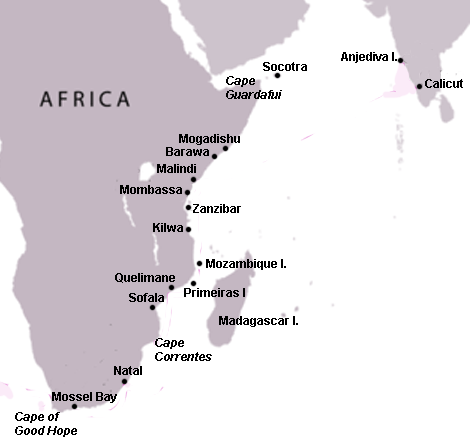
- Acentralized states
- BAfrica
- CIslam
- Dpowerful
- EIndian Ocean
- FBantu and Arabic
- GSwahili
- HArab merchants
- ISustained
- JArabia
- Kpure
- Lsyncretic
- Mtraditional beliefs
- Ninland
- OIslamic character
- Phighly tolerant
- Qcosmopolitan
- Rmerchants
- Sfaiths
- TTolerance
- Ugood
- Vbusiness
- Winland trade
- XKilwa
- Ytrade
- Zgold and ivory
- AAGreat Zimbabwe
- ABBantu
- ACIslam's influence
11FEUDALISM
Another example of political [blank_start]decentralization[blank_end] in this time period is the rise of [blank_start]feudalism[blank_end] in Western Europe and Japan. Since the fall of the [blank_start]Western Roman Empire[blank_end] in 476, nothing had really formed to replace the [blank_start]security[blank_end] provided by Roman civilization. The need for security was made clear when invaders such as [blank_start]Vikings[blank_end] from Scandinavia or [blank_start]Magyars[blank_end] from central Europe began to [blank_start]pillage[blank_end] settlements in the former Roman Empire. People looked to local [blank_start]landowners[blank_end] to provide them with [blank_start]protection[blank_end] and they in turn gave their [blank_start]labor[blank_end] to the landlord. These [blank_start]reciprocal bonds of obligation[blank_end] were the core of feudalism. In [blank_start]Europe[blank_end] these bonds were sealed by [blank_start]legal contracts[blank_end] between vassals and those above them. To fulfill his obligation of protection the lord supported a [blank_start]military class[blank_end] known as [blank_start]knights[blank_end]. The labor of the serfs was a form of [blank_start]tax[blank_end] to the lord and they often were [blank_start]obligated[blank_end] to form [blank_start]small armies[blank_end] of foot soldiers as well. Thus Europe was organized into a highly [blank_start]decentralized[blank_end] social and economic system in which most all considerations of existence was [blank_start]local[blank_end].
When [blank_start]Japan[blank_end] was not able to maintain a [blank_start]centralized[blank_end] rule, they too fell into a similar situation with [blank_start]samurai warriors[blank_end] comprising the military caste. One important difference, however, was the [blank_start]absence[blank_end] of negotiated [blank_start]contracts[blank_end] between vassals and their superiors. It was [blank_start]honor[blank_end] and the [blank_start]fear of shame[blank_end] that held the bonds of [blank_start]obligation[blank_end] in the Japanese form of feudalism.- Adecentralization
- Bfeudalism
- CWestern Roman Empire
- Dsecurity
- EVikings
- FMagyars
- Gpillage
- Hlandowners
- Iprotection
- Jlabor
- Kreciprocal bonds of obligation
- LEurope
- Mlegal contracts
- Nmilitary class
- Oknights
- Ptax
- Qobligated
- Rsmall armies
- Sdecentralized
- Tlocal
- UJapan
- Vcentralized
- Wsamurai warriors
- Xabsence
- Ycontracts
- Zhonor
- AAfear of shame
- ABobligation
12C. There were some states in this time period that blended traditions with previous or neighboring civilizations to form [blank_start]synthesized states[blank_end]. For example, the [blank_start]Abbasid Caliphate[blank_end] was heavily influenced by [blank_start]Persian traditions[blank_end]. [blank_start]Islam[blank_end] advanced into the territory of the crumbling [blank_start]Sassanid Empire[blank_end], and the Abbasids later selected [blank_start]Baghdad[blank_end] as its administrative center. Islamic civilization readily adopted [blank_start]Persian cultural[blank_end] and political influences. The practice of [blank_start]veiling[blank_end] women was [blank_start]not[blank_end] an original Muslim practice, but rather a Persian one with roots deep in [blank_start]Mesopotamian culture[blank_end]. Islamic women began to [blank_start]wear veils[blank_end], a practice that showed the increasing [blank_start]patriarchy[blank_end] of Muslim society. [16] The Abbasids also borrowed the "[blank_start]cult of the king[blank_end]" notion from Persia. The [blank_start]caliph[blank_end] was transformed into an [blank_start]absolute ruler[blank_end] who could only be approached through an elaborate regimen of court rituals. Rather than being a leader who commanded an army on the field, the Abbasid Caliph's [blank_start]authority[blank_end] was reinforced by a large [blank_start]standing army[blank_end]. The source of the caliph's power, and the influence of Persia, can be seen in his new title, the "Shadow of God on Earth." [17]
Another synthesized state in this era was [blank_start]Japan[blank_end]. The Japanese could not help but notice the [blank_start]successes and power[blank_end] of their Tang neighbors. Unlike [blank_start]Korea[blank_end] and Vietnam who acquired Chinese influences through [blank_start]invasions[blank_end], the Japanese chose to [blank_start]emulate[blank_end] the Chinese. The government embarked on a course of transformation known as the [blank_start]Taika Reforms[blank_end] in which they copied many of China's successes. They attempted to [blank_start]centralize[blank_end] their state by means of a Confucian based [blank_start]bureaucracy[blank_end]. Chinese written language entered Japan, and the Japanese borrowed the Chinese equal field system of [blank_start]agriculture[blank_end]. Through Japan's connection to China, [blank_start]Buddhism[blank_end] poured into China, as it did in Korea and Vietnam.- Asynthesized states
- BAbbasid Caliphate
- CPersian traditions
- DIslam
- ESassanid Empire
- FBaghdad
- GPersian cultural
- Hveiling
- Inot
- JMesopotamian culture
- Kwear veils
- Lpatriarchy
- Mcult of the king
- Ncaliph
- Oabsolute ruler
- Pauthority
- Qstanding army
- RJapan
- Ssuccesses and power
- TKorea
- Uinvasions
- Vemulate
- WTaika Reforms
- Xcentralize
- Ybureaucracy
- Zagriculture
- AABuddhism
13D. In addition to the great [blank_start]River Valley[blank_end] Civilizations that emerged in [blank_start]Afro-eurasia[blank_end], societies in [blank_start]Mesoamerican[blank_end] and the [blank_start]Andes[blank_end] region forged large complex civilizations. The most successful to arise during this period were the Mayan, the Aztecs, and the Incas. These civilizations, as with their counterparts on the other side of the world, were made possible by massive agricultural [blank_start]surpluses[blank_end] that supported [blank_start]hierarchical[blank_end] and complex societies. In Mesoamerica, the most important crop was [blank_start]maize[blank_end]. In the Andes it was [blank_start]potatoes[blank_end]. All three had to develop highly sophisticated [blank_start]irrigation and agricultural[blank_end] techniques to farm the harsh forests, lowlands, and mountains of their terrain. So critical was the need to manage [blank_start]water[blank_end] in these civilizations that one prominent historian has labeled them "[blank_start]hydraulic[blank_end]" civilizations. [18] They did all this without the benefit of [blank_start]wheeled[blank_end] vehicles, metal [blank_start]tools[blank_end], or large pack [blank_start]animals[blank_end]. Notwithstanding these limitations, each developed complex hierarchical [blank_start]societies[blank_end], advanced knowledge of [blank_start]astronomy[blank_end] and calendars, and formulated religious ideologies of [blank_start]military conquest[blank_end].
- ARiver Valley
- BAfro-eurasia
- CMesoamerican
- DAndes
- Esurpluses
- Fhierarchical
- Gmaize
- Hpotatoes
- Iirrigation and agricultural
- Jwater
- Khydraulic
- Lwheeled
- Mtools
- Nanimals
- Osocieties
- Pastronomy
- Qmilitary conquest
14The Mayan
Borrowing heavily from their parent civilization, the [blank_start]Olmecs[blank_end], the Mayans reached their first peak of civilization between 250 to 900 C.E., then again between 1200 and 1450 C.E. One of the [blank_start]most impressive[blank_end] aspects about their ascendancy is how they [blank_start]overcame[blank_end] "extraordinary ecological challenges to create a very sophisticated and productive agriculture that was the key to their development." [19] They learned to trap [blank_start]rich river silt[blank_end] with [blank_start]terraces[blank_end] to replenish the fertility of the thin, poorly drained topsoil of southern Mexico. [20] The increased agriculture allowed the Mayan civilization to greatly [blank_start]expand[blank_end], driving them to find increasingly creative means of collecting and storing [blank_start]water[blank_end] during the dry seasons and as insurance against unpredictable summer rains. [21] Politically, the Mayan were not a [blank_start]centralized[blank_end] empire, but rather were organized into over fifty small [blank_start]city-kingdoms[blank_end] often [blank_start]competing[blank_end] against each other. As in ancient Greece, cities sometimes formed [blank_start]opposing[blank_end] military alliances which shifted and reformed as circumstances changed. [blank_start]Tikal[blank_end], the most powerful of these city-kingdoms, lasted eight centuries. About fifty years before the [blank_start]Spanish[blank_end] showed up in the Americas, the Mayan civilization fell apart, probably due to [blank_start]civil wars[blank_end] between the city-states.- AOlmecs
- Bmost impressive
- Covercame
- Drich river silt
- Eterraces
- Fexpand
- Gwater
- Hcentralized
- Icity-kingdoms
- Jcompeting
- Kopposing
- LTikal
- MSpanish
- Ncivil wars
15The Aztecs
After the demise of the [blank_start]Toltec[blank_end] empire around 1200 C.E., an ethnic group called the [blank_start]Mexica[blank_end] migrated southeast and eventually settled on an island in the marshy areas of [blank_start]Lake Texcoco[blank_end]. There they built the settlement that would later become the great Aztec capital [blank_start]Tenochtitlan[blank_end] (the Mexica people came to be called Aztecs, a reference to the home of their ancestors.) By raking the muck of the lake into small islands above the surface of the water (called chinampas), they were able to produce [blank_start]abundant agriculture[blank_end] to support a thriving civilization. By the early 1400s the Mexica had defeated their neighbors and demanded [blank_start]tribute[blank_end] from them. Thus was born the [blank_start]Aztec[blank_end] empire. At times, the empire was actually a [blank_start]triple alliance[blank_end] of three major cities who combined to project their rule over most of Mesoamerica, about 12 million people. [22] The Aztec Empire was a [blank_start]loose[blank_end] collection of [blank_start]conquered[blank_end] areas from which the core at Tenochtitlan collected heavy tribute. Every year Aztec rulers demanded massive amounts of [blank_start]clothing, jewelry, food, animals[blank_end], and other materials from locations across their vast domain. Throughout the empire there was a significant market for [blank_start]craft goods[blank_end] and most all cities and villages had thriving [blank_start]markets[blank_end]. The expansion of the empire was motivated in part by its religious belief. The Aztec believed that their gods were engaged in an ongoing struggle against the stars. The keep the fight going, and keep the sun moving across the sky, the gods needed [blank_start]human blood[blank_end] that was provided by an elaborate ritual of [blank_start]mass human sacrifice[blank_end].- AToltec
- BMexica
- CLake Texcoco
- DTenochtitlan
- Eabundant agriculture
- Ftribute
- GAztec
- Htriple alliance
- Iconquered
- Jloose
- Kclothing, jewelry, food, animals
- Lcraft goods
- Mmarkets
- Nhuman blood
- Omass human sacrifice
16The Inca
In the 14th and 15th centuries, the Incas built the most [blank_start]centralized[blank_end] empire in the Americas during this time. Building on the base of the [blank_start]Chavin and Moche[blank_end] civilizations, they spread their civilization along the 2500 mile spine of the [blank_start]Andes[blank_end] Mountains on the western side of South America. Extensive [blank_start]terracing[blank_end] allowed them to practice agriculture in these [blank_start]high altitude[blank_end] and mountainous regions where they grew [blank_start]potatoes, maize, beans and peppers[blank_end]. There was a small merchant class, but trade was controlled by the [blank_start]government[blank_end]. Unlike the diverse societies of the [blank_start]Mayan and Aztec[blank_end] civilizations, the Incas practiced cultural [blank_start]imperialism[blank_end], forcing their [blank_start]language and religion[blank_end] on [blank_start]conquered[blank_end] people. The Incas centralized their rule through a complex [blank_start]bureaucracy[blank_end] and an extensive network of roads and bridges. [23] Their [blank_start]ruler[blank_end] (originally called the "Inca") was believed to be a god. A large [blank_start]professional army[blank_end] was supported by peasants who owed [blank_start]compulsory[blank_end] labor to the state.- Acentralized
- BChavin and Moche
- CAndes
- Dterracing
- Ehigh altitude
- Fpotatoes, maize, beans and peppers
- Ggovernment
- HMayan and Aztec
- Iimperialism
- Jlanguage and religion
- Kconquered
- Lbureaucracy
- Mruler
- Nprofessional army
- Ocompulsory
17II. Interregional contacts and conflicts between states and empires encouraged significant technological and cultural transfers.
Tang China and the Abbasids
As Tang China expanded [blank_start]westward[blank_end] they came in contact with the [blank_start]Dar al Islam[blank_end]. Tang and Abbasid armies fought near the [blank_start]Talas River[blank_end] in what became known as the Battle of Talas in 751. The Muslim Armies routed the Chinese and ended their westward advancement into Central Asia. The major cultural result of this battle is that Central Asia would be primarily [blank_start]Islamic[blank_end]; Buddhism would [blank_start]decline[blank_end]. Another significant result was the transferal of [blank_start]technology[blank_end] from the [blank_start]Chinese[blank_end] to the [blank_start]Muslims[blank_end]. According to legends, knowledgeable Chinese [blank_start]prisoners of war[blank_end] were forced to teach the [blank_start]Muslim Abbasids[blank_end] the secrets of [blank_start]paper-making[blank_end]. Within a few decades, the Abbasid capital of [blank_start]Baghdad[blank_end] was producing quality paper. This led to an increase in [blank_start]education[blank_end], the transferal of knowledge, more efficient [blank_start]accounting[blank_end], and the [blank_start]preservation[blank_end] of religion. The Muslims tried to prevent [blank_start]Christian[blank_end] Europe from gaining this technology for as long as they could.- Awestward
- BDar al Islam
- CTalas River
- DIslamic
- Edecline
- Ftechnology
- GChinese
- HMuslims
- Iprisoners of war
- JMuslim Abbasids
- Kpaper-making
- LBaghdad
- Meducation
- Naccounting
- Opreservation
- PChristian
18Across the Mongol Empires
The Mongol Empire was the [blank_start]largest[blank_end] land-based empire in history and brought together the breadth of most of Eurasia under a [blank_start]single rule[blank_end]. This facilitated substantial [blank_start]technological and cultural[blank_end] exchange through the medium of [blank_start]trade[blank_end]. Through the Mongols, Islamic [blank_start]mathematics and astronomy[blank_end] spread from the [blank_start]Dar la Islam[blank_end] into [blank_start]China[blank_end] where they found a receptive audience. [blank_start]Kublai Khan[blank_end] was very interested in mathematics, such as algebra, which the Muslims had developed in Baghdad. Accurate readings of the heavens were very important to [blank_start]Daoism and Shamanism[blank_end], both of which depended on astrological readings to plan [blank_start]weddings, feasts and agriculture[blank_end]. The Chinese made advanced [blank_start]calculations[blank_end] in these areas which then made their way back to the Muslim world. Other areas of [blank_start]exchange[blank_end] were knowledge of [blank_start]geography and cartography[blank_end]. Most instrumental in this exchange was Rashid al-Din, the scholarly connection between the great Mongol courts in [blank_start]Iran and China[blank_end]. Scholars combined geographic information from China to the Middle East into the most accurate [blank_start]maps[blank_end] in the world at that time thus enabling the later [blank_start]Ming Dynasty[blank_end] to initiate its famous explorations (Zeng He and Ma Huan). In the world of food and agriculture, the [blank_start]Pax Mongolia[blank_end] allowed for the transfer of [blank_start]grapes and fruit[blank_end] trees to China. In return, luxury items of Chinese cuisine, such as [blank_start]pepper, cinnamon and tea[blank_end], were introduced into the Muslim world. Perhaps the most important technological transfers during the Pax Mongolia were [blank_start]block printing and gunpowder[blank_end]. Through the Mongols, block printing, which had developed during China's Song Dynasty, was transferred to the Muslim world. Copying the Song Dynasty, the Mongol Ilkhanate in Persia even issued [blank_start]paper money[blank_end] for a brief time. The best known technological exchange facilitated by the Mongols was [blank_start]gunpowder[blank_end]. Developed in China as early as the Han Dynasty, gunpowder would transform [blank_start]warfare[blank_end] and realign the centers of power in the world. With it Europeans would develop advanced [blank_start]firearms[blank_end] and dominate the [blank_start]Americas[blank_end], the [blank_start]Byzantine Empire[blank_end] would fall to the [blank_start]Ottoman Turks[blank_end], and Mongol rule over China, ironically, would come to an end. [24]- Alargest
- Bsingle rule
- Ctechnological and cultural
- Dtrade
- Emathematics and astronomy
- FDar la Islam
- GChina
- HKublai Khan
- IDaoism and Shamanism
- Jweddings, feasts and agriculture
- Kcalculations
- Lexchange
- Mgeography and cartography
- NIran and China
- Omaps
- PMing Dynasty
- QPax Mongolia
- Rgrapes and fruit
- Spepper, cinnamon and tea
- Tblock printing and gunpowder
- Upaper money
- Vgunpowder
- Wwarfare
- Xfirearms
- YAmericas
- ZByzantine Empire
- AAOttoman Turks
19The Crusades
The Crusades were a series of [blank_start]religious wars[blank_end] launched initially to route Muslims from the [blank_start]Holy Land[blank_end] (Jerusalem). Although militarily [blank_start]unsuccessful[blank_end] in the long run, they introduced Europeans to [blank_start]new and exotic[blank_end] lands and initiated a [blank_start]cultural and technological exchange[blank_end]. This exchange was almost exclusively a [blank_start]one-way[blank_end] transfer from the Dar al Islam to Western Europe. Muslim [blank_start]science and medicine[blank_end] was shown to be superior to that in Europe. Always looking for better ways to make war, Europeans borrowed the practice of making [blank_start]damascene swords[blank_end] from the Muslims. European monarchs improved their methods of building military [blank_start]fortifications[blank_end] based on Muslim techniques, as can be seen in [blank_start]castles[blank_end] built by William the Conqueror in Normandy. [25] An important cultural transfer were [blank_start]Arabic numerals[blank_end] and the [blank_start]decimal system[blank_end] which helped Europeans develop advanced mathematics and more efficient [blank_start]accounting systems[blank_end] for trade. The game of [blank_start]chess[blank_end] as well as foods such as [blank_start]yogurt, coffee, sugar and dates[blank_end] were introduced in Europe because of the Crusades. Europeans gained a [blank_start]desire[blank_end] for items of trade such as Persian carpets, silk, and cotton textiles. Europeans were also introduced to their own [blank_start]cultural and intellectual past[blank_end]. Classical writers such as [blank_start]Aristotle[blank_end], lost to Europeans during the invasions after the fall of Rome, had been preserved in [blank_start]Muslim schools[blank_end]. Contacts with Muslims through the Crusades and in [blank_start]Spain[blank_end], reintroduced Europe to its own intellectual and cultural heritage. This renewed interest in its classical past would culminate in the late 15th century as the [blank_start]Renaissance[blank_end], a cultural flowering that would not have been possible without contact with the Dar al Islam.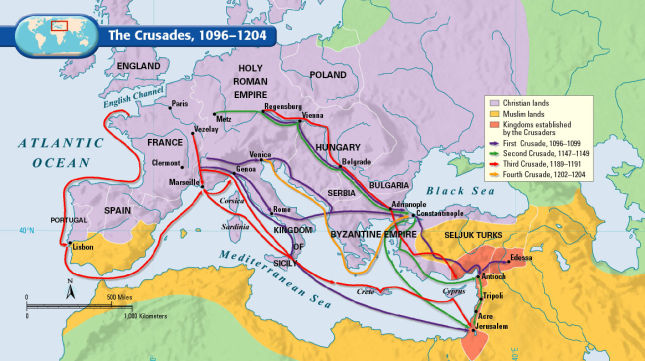
- Areligious wars
- BHoly Land
- Cunsuccessful
- Dnew and exotic
- Ecultural and technological exchange
- Fone-way
- Gscience and medicine
- Hdamascene swords
- Ifortifications
- Jcastles
- KArabic numerals
- Ldecimal system
- Maccounting systems
- Nchess
- Oyogurt, coffee, sugar and dates
- Pdesire
- Qcultural and intellectual past
- RAristotle
- SMuslim schools
- TSpain
- URenaissance
20Zheng He
The Voyages of Admiral Zheng He
The most extravagant maritime outreach early in this period was that of the [blank_start]Chinese[blank_end]. After the [blank_start]peasant revolt[blank_end] that threw out the [blank_start]Mongols[blank_end] and established the Ming Dynasty, the Chinese commissioned 7 major [blank_start]voyages[blank_end] under the leadership of admiral Zheng He. With an estimated 317 ships and a staff of 27,000 men, [26] Zheng He set out to establish the reputation of the Ming in the [blank_start]Indian Ocean[blank_end]. He sailed initially to [blank_start]southeast Asia[blank_end] and India but his final three voyages reached as far as the [blank_start]Swahili[blank_end] coast of east Africa. Unlike the [blank_start]European[blank_end] voyages that began a few decades later, these Chinese expeditions were not driven by attempts to [blank_start]conquer[blank_end] or win [blank_start]converts[blank_end]. They were [blank_start]diplomatic[blank_end] in nature, intended to impress upon others the [blank_start]prestige, wealth and superiority[blank_end] of Chinese civilization. Once other societies saw this, they would be willing to pay [blank_start]tribute[blank_end] to China for the right to purchase costly Chinese [blank_start]luxury products[blank_end] such as [blank_start]silk and porcelain[blank_end]. On his two year voyage of 1431-1433 alone, Zheng He established for China 20 tributary and diplomatic relations across the rim of the Indian Ocean. [27]
The Chinese strategy in the Indian Ocean could not have been farther from that of the [blank_start]Portuguese[blank_end] a few decades later. In 1911 a stele, shown on the left, was discovered in Galle, south of India (present day Sri Lanka). It is inscribed not only in Chinese, but in [blank_start]Tamil and Persian[blank_end], the primary languages of the inhabitants of that area. This stele was placed by Zheng He in 1409 as a gift to the people of Galle; its inscriptions list the extravagant gifts made by Zheng He in honor of the inhabitants' [blank_start]gods[blank_end], in their own languages, to demonstrate China's good will. This is to be contrasted with [blank_start]Vasco da Gama[blank_end], who cut apart the bodies of captured [blank_start]merchants and fishermen[blank_end] and sent their heads to the leader of [blank_start]Calcutta[blank_end] to show he meant business. [28]
Unfortunately for Zheng He, a [blank_start]change of power[blank_end] in imperial China brought these voyages to an end. A new emperor, under the influence of powerful [blank_start]Confucians[blank_end] long suspicious of these voyages, withdrew funds for these diplomatic missions. The official records of Zheng's voyages were destroyed and the large treasure ships of the Chinese were banned. China began to focus instead on establishing [blank_start]internal stability[blank_end] over reaching out to the world.- AChinese
- Bpeasant revolt
- CMongols
- Dvoyages
- EIndian Ocean
- Fsoutheast Asia
- GSwahili
- HEuropean
- Iconquer
- Jconverts
- Kdiplomatic
- Lprestige, wealth and superiority
- Mtribute
- Nluxury products
- Osilk and porcelain
- PPortuguese
- QTamil and Persian
- Rgods
- SVasco da Gama
- Tmerchants and fishermen
- UCalcutta
- Vchange of power
- WConfucians
- Xinternal stability
Información
- Descripción
- AP AP World History Semster 1 Test sobre Key Concept 3.2 Continuity and Innovation of State Forms and Their Interactions, creado por Ana Hale el 15/12/2017.
- Autor
- Ana Hale
- Idioma
- English
- Visitas
- 42
- Etiquetas
- Valoración
- Aún sin valoraciones Valora este test