
Test
Neuromuscular Blockade
Este test tiene tiempo límite, así que se abre en el reproductor de siempre.
Preguntas del test (16)
1Use of succinylcholine to facilitate endotracheal intubation would be acceptable (“safe”) in which one of the following situations:
- A80 y.o. female patient 2 days after 40% body surface area burn
- B18 y. o. male one week after spinal cord transection injury
- C12 y.o. with Duchene’s muscular dystrophy
- D22 y. o. with evolving respiratory failure secondary to Guillian-Barre’
- E27 y. o. female with myasthenia gravis
2A patient taking which of the following drugs would most commonly be associated with resistance to (nondepolarizing) NMB drugs:
- AQuinidine
- BPhenytoin
- CCyclophosphamide
- DAminoglycosides
- EMagnesium
3The MOST important parameter that determines the speed of onset for NMB drugs is:
- APotency
- BLipophilicity
- CIonization
- DPlasma clearance
- EE. Receptor affinity
4A characteristic common to current aminosteroid-based NMB drugs such as vecuronium or rocuronium is:
- ASignificant histamine release after a bolus injection
- BVagolysis producing tachycardia
- CHofmann elimination
- DDeacetylation in the liver
- EProduction of laudanosine as the primary metabolite
5Clinical data support that when the TOFR exceeds [blank_start]__[blank_end],
anesthesia providers have trouble assessing the presence
of fade- A0.4
- B0.2
- C0.7
- D0.9
6TOF count of 3 would equate to a twitch suppression of [blank_start]__[blank_end]%
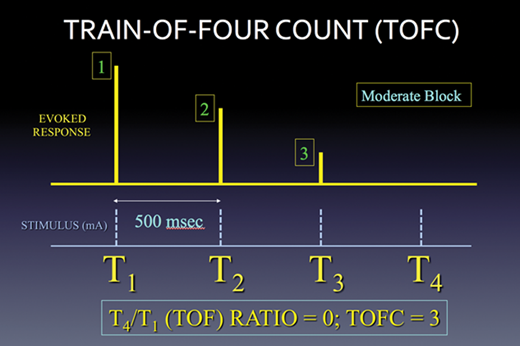
- A55
- B75
- C85
- D90
7Once the TOF ratio exceeds [blank_start]0.60[blank_end], fade to DBS generally cannot be detected subjectively
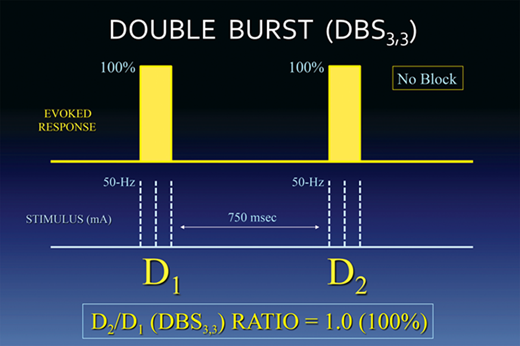
- A0.60
- B0.40
- C0.70
- D0.85
8What is true about Tetanic stimulation (TET)?
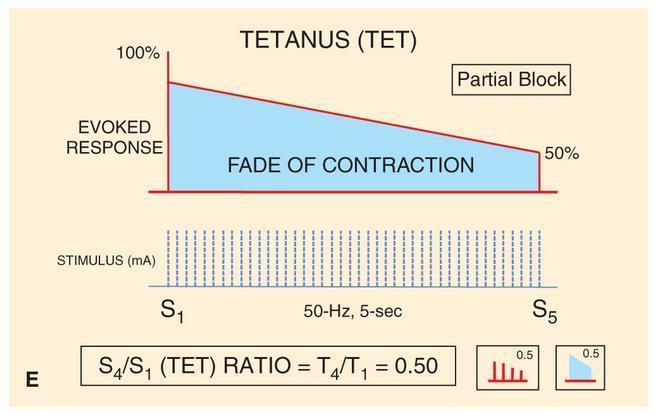
- ADuring partial depolarizing block, fade is not observed in response to tetanic stimulation
- BTetanic stimulation is not painful
- CMuscular fatigue usually develop at a stimulation frequency of 50 Hz
- DFade is thought to be an effect of a depolarizing agent on the presynaptic nerve membrane
9Which statement about posttetanic count is NOT correct?
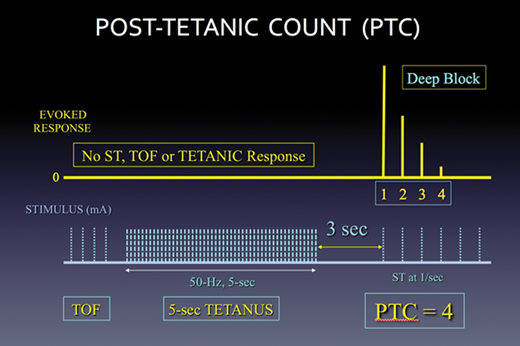
- AThe number of posttetanic count twitches is inversely related to time until the first regular TOF twitch returns
- BPosttetanic count used when TOF or DBS is absent to estimate recovery time
- CPosttetanic count uses tetany followed by TOF at frequency of 1 Hz
- DThe main use of posttetanic count is when profound neuromuscular block is not required
10Correct statements about objective monitoring techniques include:
- AMechanomyography (MMG) measures isotonic contraction of peripheral muscles in response to nerve stimulation
- BAcceleromyography (AMG) calculates the force of contraction of a muscle using a miniature piezoelectric transducer
- CElectromyography (EMG) measures the electrical activity (compound muscle action potential) of a stimulated muscle
- DKinemyography (KMG) detects the acceleration of the thumb contraction in response to electrical stimulation of a nerve
11All of the following are examples of Benzylisoquinolinium compounds consist of two quaternary ammonium groups joined by methyl groups EXCEPT:
- AD-tubocurarine
- BAtracurium
- CMivacurium
- DPancuronium
- ECisatracurium
12Train-of-four (TOF) has all of the following characteristics, EXCEPT:
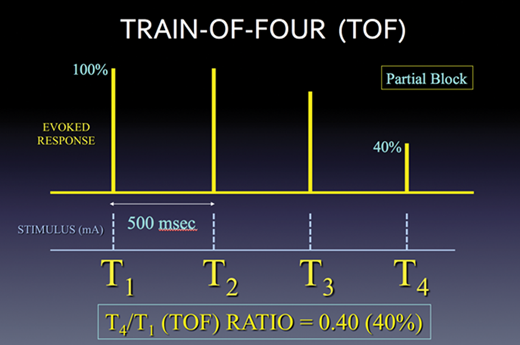
- ATOF consists of four ST stimuli at a frequency of 4 Hz
- BTOF does not require a “baseline” or “control” muscle response
- CTOF “fade” is defined as a weaker fourth twitch than the first twitch
- DTOF is delivered every 15-20 sec to prevent potentiation of subsequent responses
- ETOF ratios >0.40 cannot be reliably detected subjectively (visually or tactilely)
13Double burst stimulation (DBS) characteristics include all of the following, EXCEPT:
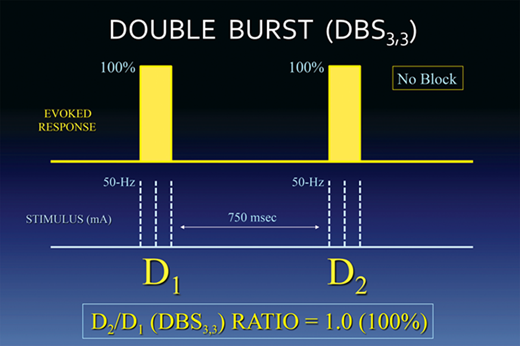
- AThe two mini-tetanic bursts are separated by 0.5 sec
- BDBS is delivered no more frequently than every 20 sec to prevent subsequent response potentiation
- CIn DBS, similar to TOF pattern, no control (“baseline”) muscle response is needed
- DDBS ratios >0.60 cannot be reliably detected by subjective (tactile, visual) means
- EIn awakening patients, DBS is more painful than TOF, but less so than tetanic stimulation
14Potential side-effects associated with the use of succinylcholine include all of the below, EXCEPT:
- AMyalgia
- BTachycardia
- CAnaphylaxis
- DHyperkalemia
15Since sugammadex has no direct cholinergic properties, anesthesiologist do not require the ready availability of an anticholinergic like glycopyrrolate at the time of reversal.
- AVerdadero
- BFalso
16When administering sugammadex through a peripheral IV, it is important to note that the drug has a physical incompatibility with all of the following drugs except:
- AVerapamil
- BDexamethasone
- CRanitidine
- DOdansetron
Información
- Descripción
- Diplomat of ABA (Fundamental Topics in Anesthesiology) Medicine Test sobre Neuromuscular Blockade, creado por Mike Ru el 28/04/2018.
- Autor
- Mike Ru
- Idioma
- English
- Visitas
- 342
- Etiquetas
- Valoración
- Aún sin valoraciones Valora este test