
Test
ADV-MC_4-5
Crea una cuenta gratis para terminar este test
Guarda tu progreso y consulta tu resultado final.
¿Ya tienes cuenta? Inicia sesión
Preguntas del test (35)
1Goodwill is
- ASeldom reported because it is too difficult to measure.
- BReported when more than book value is paid in purchasing another company
- CReported when the fair value of the acquiree is higher than the fair value of the net identifiable assets acquired
- DGenerally smaller for small companies and increases in amount as the companies acquired increase in size
2See image.
In its December 31, 20X2, consolidated balance sheet, what amount should Wright report as intercompany receivables?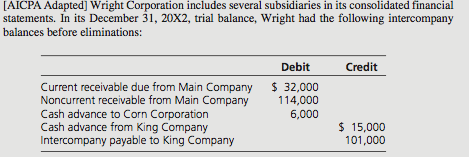
- A$152,000
- B$146,000
- C$36,000
- D$0
3See Image.
At the date of purchase, the fair value of Carr’s assets was $50,000 more than the aggregate carrying amounts. In the consolidated balance sheet prepared immediately after the purchase, the consolidated stockholders’ equity should amount to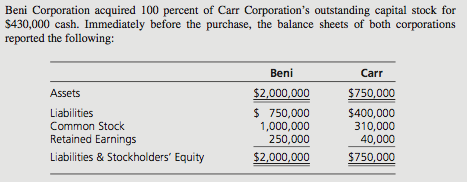
- A$1,680,000.
- B$1,650,000.
- C$1,600,000.
- D$1,250,000.
4See Image.
On December 31, 20X6, Gold Company acquired all of Nugget’s outstanding common stock for $1,500,000 cash. On that date, the fair (market) value of Nugget’s inventories was $450,000, and the fair value of Nugget’s property, plant, and equipment was $1,000,000. The fair values of all other assets and liabilities of Nugget were equal to their book values.
As a result of Gold’s acquisition of Nugget, the consolidated balance sheet of Gold and Nugget should reflect goodwill in the amount of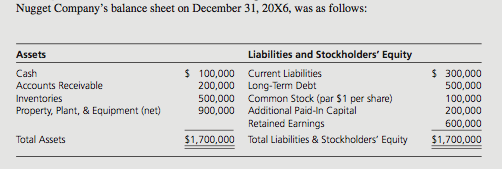
- A$500,000
- B$550,000
- C$600,000
- D$650,000
5On December 31, 20X6, Gold Company acquired all of Nugget’s outstanding common stock for $1,500,000 cash. On that date, the fair (market) value of Nugget’s inventories was $450,000, and the fair value of Nugget’s property, plant, and equipment was $1,000,000. The fair values of all other assets and liabilities of Nugget were equal to their book values.
Assuming Gold uses the equity method to account for investments and that Gold’s (unconsoli- dated) balance sheet on December 31, 20X6, reflected retained earnings of $2,000,000, what amount of retained earnings should be shown in the December 31, 20X6, consolidated balance sheet of Gold and its new subsidiary, Nugget?- A$2,000,000
- B$2,600,000
- C$2,800,000
- D$3,150,000
6On January 1, 20X1, Prim Inc. acquired all of Scrap Inc.’s outstanding common shares for cash equal to the stock’s book value. The carrying amounts of Scrap’s assets and liabilities approxi- mated their fair values, except that the carrying amount of its building was more than fair value. In preparing Prim’s 20X1 consolidated income statement, which of the following adjustments would be made?
- ADecrease depreciation expense and recognize goodwill amortization.
- BIncrease depreciation expense and recognize goodwill amortization
- CDecrease depreciation expense and recognize no goodwill amortization
- DIncrease depreciation expense and recognize no goodwill amortization
7ThefirstexaminationofRuddCorporation’sfinancialstatementswasmadefortheyearended December 31, 20X8. The auditor found that Rudd had acquired another company on January 1, 20X8, and had recorded goodwill of $100,000 in connection with this acquisition. Although a friend of the auditor believes the goodwill will last no more than five years, Rudd’s manage- ment has found no impairment of goodwill during 20X8. In its 20X8 financial statements, Rudd should report
- AAmortization Expense: $0
Goodwill: $100,000 - BAmortization Expense: $100,000
Goodwill: $0 - CAmortization Expense: $20,000
Goodwill: $80,000 - DAmortization Expense: $0
Goodwill: $0
- AAmortization Expense: $0
8Consolidated financial statements are being prepared for a parent and its four subsidiaries that have intercompany loans of $100,000 and intercompany profits of $300,000. How much of these intercompany loans and profits should be eliminated?
- ALoans: $0
Profits: $0 - BLoans: $0
Profits: $300,000 - CLoans: $100,000
Profits: $0 - DLoans: $100,000
Profits: $300,000
- ALoans: $0
9See Image.
In Plum’s March 31, 20X9, consolidated balance sheet, what amount of goodwill should be reported as a result of this business combination?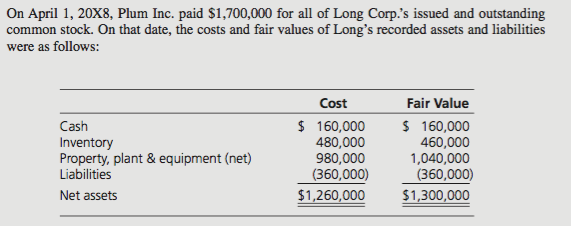
- A$360,000
- B$396,000
- C$400,000
- D$440,000
10See Image.
At the date of the business combination, the book values of Sun’s net assets and liabilities approxi- mated fair value except for inventory, which had a fair value of $85,000, and land, which had a fair value of $45,000.
For each question, indicate the appropriate total that should appear in the consolidated balance sheet prepared immediately after the business combination.
What amount of inventory will be reported?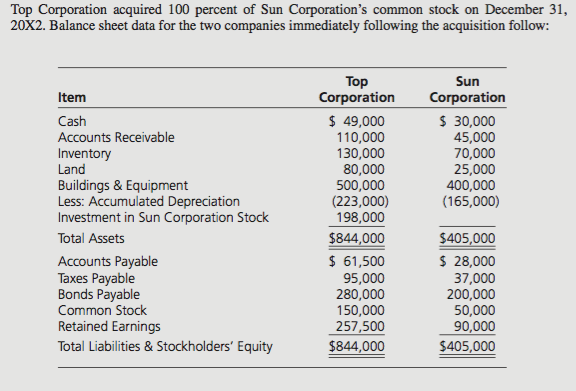
- A$70,000
- B$130,000
- C$200,000
- D$215,000
11See Image.
At the date of the business combination, the book values of Sun’s net assets and liabilities approxi- mated fair value except for inventory, which had a fair value of $85,000, and land, which had a fair value of $45,000.
For each question, indicate the appropriate total that should appear in the consolidated balance sheet prepared immediately after the business combination.
What amount of goodwill will be reported?- A$0
- B$23,000
- C$43,000
- D$58,000
12See Image.
At the date of the business combination, the book values of Sun’s net assets and liabilities approxi- mated fair value except for inventory, which had a fair value of $85,000, and land, which had a fair value of $45,000.
For each question, indicate the appropriate total that should appear in the consolidated balance sheet prepared immediately after the business combination.
What amount of total assets will be reported?- A$84,400
- B$1,051,000.
- C$1,109,000
- D$1,249,000
13See Image.
At the date of the business combination, the book values of Sun’s net assets and liabilities approxi- mated fair value except for inventory, which had a fair value of $85,000, and land, which had a fair value of $45,000.
For each question, indicate the appropriate total that should appear in the consolidated balance sheet prepared immediately after the business combination.
What amount of total liabilities will be reported?- A$265,000.
- B$436,500
- C$701,500
- D$1,249,000.
14See Image.
At the date of the business combination, the book values of Sun’s net assets and liabilities approxi- mated fair value except for inventory, which had a fair value of $85,000, and land, which had a fair value of $45,000.
For each question, indicate the appropriate total that should appear in the consolidated balance sheet prepared immediately after the business combination.
What amount of consolidated retained earnings will be reported?- A$547,500
- B$397,500
- C$347,500
- D$257,500
15See Image.
At the date of the business combination, the book values of Sun’s net assets and liabilities approxi- mated fair value except for inventory, which had a fair value of $85,000, and land, which had a fair value of $45,000.
For each question, indicate the appropriate total that should appear in the consolidated balance sheet prepared immediately after the business combination.
What amount of total stockholders’ equity will be reported?- A$407,500
- B$547,500
- C$844,000
- D$1,249,000
16If A Company acquires 80 percent of the stock of B Company on January 1, 20X2, immediately after the acquisition, which of the following is correct?
- AConsolidated retained earnings will be equal to the combined retained earnings of the two companies.
- BGoodwill will always be reported in the consolidated balance sheet.
- CA Company’s additional paid-in capital may be reduced to permit the carryforward of B Company retained earnings
- DConsolidated retained earnings and A Company retained earnings will be the same
17Which of the following is correct?
- AThe noncontrolling shareholders’ claim on the subsidiary’s net assets is based on the book value of the subsidiary’s net assets
- BOnly the parent’s portion of the difference between book value and fair value of the subsid- iary’s assets is assigned to those assets
- CGoodwill represents the difference between the book value of the subsidiary’s net assets and the amount paid by the parent to buy ownership.
- DTotal assets reported by the parent generally will be less than total assets reported on the consolidated balance sheet.
18Which of the following statements is correct?
- AForeign subsidiaries do not need to be consolidated if they are reported as a separate operating group under segment reporting
- BConsolidated retained earnings do not include the noncontrolling interest’s claim on the subsidiary’s retained earnings.
- CThe noncontrolling shareholders’ claim should be adjusted for changes in the fair value of the subsidiary assets but should not include goodwill
- DConsolidation is expected any time the investor holds significant influence over the investee.
19At December 31, 20X9, Grey Inc. owned 90 percent of Winn Corporation, a consolidated subsidiary, and 20 percent of Carr Corporation, an investee in which Grey cannot exercise significant influence. On the same date, Grey had receivables of $300,000 from Winn and $200,000 from Carr. In its December 31, 20X9, consolidated balance sheet, Grey should report accounts receivable from its affiliates of
- A$500,000
- B$340,000
- C$230,000
- D$200,000
20A 70 percent owned subsidiary company declares and pays a cash dividend. What effect does
the dividend have on the retained earnings and noncontrolling interest balances in the parent company’s consolidated balance sheet?- ANo effect on either retained earnings or noncontrolling interest.
- BNo effect on retained earnings and a decrease in noncontrolling interest.
- CDecreases in both retained earnings and noncontrolling interest.
- DA decrease in retained earnings and no effect on noncontrolling interest
21How is the portion of consolidated earnings to be assigned to the noncontrolling interest in consolidated financial statements determined?
- AThe parent’s net income is subtracted from the subsidiary’s net income to determine the noncontrolling interest
- BThe subsidiary’s net income is extended to the noncontrolling interest
- CThe amount of the subsidiary’s earnings recognized for consolidation purposes is multiplied by the noncontrolling interest’s percentage of ownership.
- DThe amount of consolidated earnings on the consolidated worksheets is multiplied by the noncontrolling interest percentage on the balance sheet date
22On January 1, 20X5, Post Company acquired an 80 percent investment in Stake Company. The acquisition cost was equal to Post’s equity in Stake’s net assets at that date. On January 1, 20X5, Post and Stake had retained earnings of $500,000 and $100,000, respectively. During 20X5, Post had net income of $200,000, which included its equity in Stake’s earnings, and declared dividends of $50,000; Stake had net income of $40,000 and declared dividends of $20,000. There were no other intercompany transactions between the parent and subsidiary. On December 31, 20X5, what should the consolidated retained earnings be?
- A$650,000.
- B$666,000.
- C$766,000.
- D$770,000.
23On January 1, 20X8, Ritt Corporation acquired 80 percent of Shaw Corporation’s $10 par common stock for $956,000. On this date, the fair value of the noncontrolling interest was $239,000, and the carrying amount of Shaw’s net assets was $1,000,000. The fair values of Shaw’s identifiable assets and liabilities were the same as their carrying amounts except for plant assets (net) with a re- maining life of 20 years, which were $100,000 in excess of the carrying amount. For the year ended December 31, 20X8, Shaw had net income of $190,000 and paid cash dividends totaling $125,000.
In the January 1, 20X8, consolidated balance sheet, the amount of goodwill reported should be- A$0
- B$76,000
- C$95,000
- D$156,000
24On January 1, 20X8, Ritt Corporation acquired 80 percent of Shaw Corporation’s $10 par common stock for $956,000. On this date, the fair value of the noncontrolling interest was $239,000, and the carrying amount of Shaw’s net assets was $1,000,000. The fair values of Shaw’s identifiable assets and liabilities were the same as their carrying amounts except for plant assets (net) with a re- maining life of 20 years, which were $100,000 in excess of the carrying amount. For the year ended December 31, 20X8, Shaw had net income of $190,000 and paid cash dividends totaling $125,000.
In the December 31, 20X8, consolidated balance sheet, the amount of noncontrolling interest reported should be- A$200,000
- B$239,000
- C$251,000
- D$252,000
25See Image.
At the date of the business combination, the book values of Silk’s net assets and liabilities approxi- mated fair value except for inventory, which had a fair value of $85,000, and land, which had a fair value of $45,000. The fair value of the noncontrolling interest was $64,500 on December 31, 20X2.
For each question below, indicate the appropriate total that should appear in the consolidated bal- ance sheet prepared immediately after the business combination.
What amount of inventory will be reported?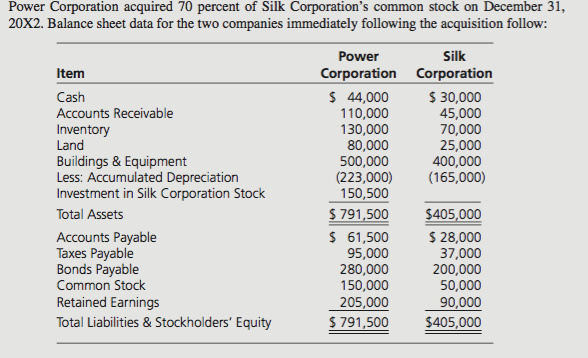
- A$179,000
- B$200,000
- C$210,500
- D$215,000
26See Image.
At the date of the business combination, the book values of Silk’s net assets and liabilities approxi- mated fair value except for inventory, which had a fair value of $85,000, and land, which had a fair value of $45,000. The fair value of the noncontrolling interest was $64,500 on December 31, 20X2.
For each question below, indicate the appropriate total that should appear in the consolidated bal- ance sheet prepared immediately after the business combination.
What amount of goodwill will be reported?- A$0.
- B$28,000
- C$40,000
- D$52,000
27See Image.
At the date of the business combination, the book values of Silk’s net assets and liabilities approxi- mated fair value except for inventory, which had a fair value of $85,000, and land, which had a fair value of $45,000. The fair value of the noncontrolling interest was $64,500 on December 31, 20X2.
For each question below, indicate the appropriate total that should appear in the consolidated balance sheet prepared immediately after the business combination.
What amount of total assets will be reported?- A$1,081,000
- B$1,121,000
- C$1,196,500
- D$1,231,500
28See Image.
At the date of the business combination, the book values of Silk’s net assets and liabilities approxi- mated fair value except for inventory, which had a fair value of $85,000, and land, which had a fair value of $45,000. The fair value of the noncontrolling interest was $64,500 on December 31, 20X2.
For each question below, indicate the appropriate total that should appear in the consolidated balance sheet prepared immediately after the business combination.
What amount of total liabilities will be reported?- A$265,000
- B$436,500
- C$622,000
- D$701,500
29See Image.
At the date of the business combination, the book values of Silk’s net assets and liabilities approximated fair value except for inventory, which had a fair value of $85,000, and land, which had a fair value of $45,000. The fair value of the noncontrolling interest was $64,500 on December 31, 20X2.
For each question below, indicate the appropriate total that should appear in the consolidated balance sheet prepared immediately after the business combination.
What amount will be reported as noncontrolling interest?- A$42,000
- B$52,500
- C$60,900
- D$64,500
30See Image.
At the date of the business combination, the book values of Silk’s net assets and liabilities approximated fair value except for inventory, which had a fair value of $85,000, and land, which had a fair value of $45,000. The fair value of the noncontrolling interest was $64,500 on December 31, 20X2.
For each question below, indicate the appropriate total that should appear in the consolidated balance sheet prepared immediately after the business combination.
What amount of consolidated retained earnings will be reported?- A$295,000
- B$268,000
- C$232,000
- D$205,000
31See Image.
At the date of the business combination, the book values of Silk’s net assets and liabilities approximated fair value except for inventory, which had a fair value of $85,000, and land, which had a fair value of $45,000. The fair value of the noncontrolling interest was $64,500 on December 31, 20X2.
For each question below, indicate the appropriate total that should appear in the consolidated balance sheet prepared immediately after the business combination.
What amount of total stockholders’ equity will be reported?- A$355,000
- B$397,000
- C$419,500
- D$495,000
32See image.
In its income statement for the year ended December 31, 20X3, how much income should Barker report from this investment?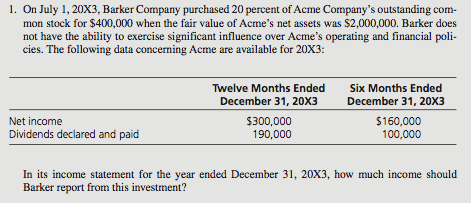
- A$20,000.
- B$32,000.
- C$38,000.
- D$60,000.
33OnJanuary1,20X3,MillerCompanypurchased25percentofWallCorporation’scommonstock; no differential resulted from the purchase. Miller appropriately uses the equity method for this investment, and the balance in Miller’s investment account was $190,000 on December 31, 20X3. Wall reported net income of $120,000 for the year ended December 31, 20X3, and paid dividends on its common stock totaling $48,000 during 20X3. How much did Miller pay for its 25 percent interest in Wall?
- A$172,000
- B$202,000
- C$208,000
- D$232,000
34On January 1, 20X7, Robohn Company purchased for cash 40 percent of Lowell Company’s 300,000 shares of voting common stock for $1,800,000 when 40 percent of the underlying equity in Lowell’s net assets was $1,740,000. The payment in excess of underlying equity was assigned to amortizable assets with a remaining life of six years. As a result of this transaction, Robohn has the ability to exercise significant influence over Lowell’s operating and financial policies. Lowell’s net income for the year ended December 31, 20X7, was $600,000. During 20X7, Lowell paid $325,000 in dividends to its shareholders. The income reported by Robohn for its investment in Lowell should be
- A$120,000
- B$130,000
- C$230,000
- D$240,000
35InJanuary20X0,FarleyCorporationacquired20percentofDavisCompany’soutstandingcom- mon stock for $800,000. This investment gave Farley the ability to exercise significant influence over Davis. The book value of the acquired shares was $600,000. The excess of cost over book value was attributed to an identifiable intangible asset, which was undervalued on Davis’ balance sheet and had a remaining economic life of 10 years. For the year ended December 31, 20X0, Davis reported net income of $180,000 and paid cash dividends of $40,000 on its common stock. What is the proper carrying value of Farley’s investment in Davis on December 31, 20X0?
- A$772,000
- B$780,000
- C$800,000
- D$808,000
Información
- Descripción
- - AdvAcct Test sobre ADV-MC_4-5, creado por susan bye el 30/05/2018.
- Autor
- susan bye
- Idioma
- English
- Visitas
- 325
- Etiquetas
- Valoración
- Aún sin valoraciones Valora este test