
Test
Physiology II: Somatosensory System 1 - Primary Sensory Neurones and their Modalities
Este test tiene tipos de pregunta que se abren en el reproductor de siempre.
Preguntas del test (13)
1The Somatosensory System can be subdivided into 3 parts:
[blank_start]Exteroceptive Division[blank_end]: Registers cutaneous sensation by numerous receptors
[blank_start]Proprioceptive Division[blank_end]: Monitors posture and movement via receptors in muscles, tendons and joints
[blank_start]Enteroceptive Division[blank_end]: Reports upon the internal state of the body- AEnteroceptive Division
- BProprioceptive Division
- CExteroceptive Division
2Resting membrane potential is [blank_start]-90[blank_end]mV, whereras the resting potential of a neuron is [blank_start]-70[blank_end]mV.
- A-90
- B-70
3A [blank_start]nociceptor[blank_end] is a receptor that responds to potentially damaging stimuli by sending 'threat' signals to the brain
- Anociceptor
4[blank_start]Low threshold thermoreceptors[blank_end] mediate cold, cool, indifferent, warm and hot sensations
[blank_start]Thermal nociceptors[blank_end] respond to extreme degrees of heat (both hot and cold)
[blank_start]Chemical nociceptors[blank_end] responds to potentially damaging substances in tissue- ALow threshold thermoreceptors
- BThermal nociceptors
- CChemical nociceptors
- DLow threshold chemical receptors
5Cutaneous afferent fibres in the fingertips are of a [blank_start]high[blank_end] density of innervation, each fibre having a [blank_start]small[blank_end] receptive field in order to allow a [blank_start]high[blank_end] acuity in terms of sensation.
- Ahigh
- Blow
- Csmall
- Dlarge
- Ehigh
- Flow
6Two point discrimination (spacial acuity) in higher in the [blank_start]finger tip[blank_end] but lower in the [blank_start]forearm[blank_end], due to the differing sizes of the afferent fibres' receptive fields.
- Afinger tip
- Bforearm
- Cforearm
- Dfinger tip
7As receptive field size increases, spatial acuity [blank_start]decreases[blank_end].
- Adecreases
- Bincreases
8Which layer of the epidermis contains merkel cells?
- ABasal layer
- BKeratin layer
- CGranular layer
- DPrickle cell layer
9[blank_start]Merkel cells[blank_end]: Sensitive to sustained pressure, texture and edges of objects
[blank_start]Meissner corpuscles[blank_end]: Sensitive to stroking, flutter & low frequency vibration
[blank_start]Pacinian corpuscles[blank_end]: Very sensitive to higher frequency vibration, act as event detectors during object manipulation
[blank_start]Ruffini endings[blank_end]: Sensitive to shearing forces (e.g. drag)- AMerkel cells
- BMeissner corpuscles
- CPacinian corpuscles
- DRuffini endings
10Hairless skin is referred to as [blank_start]glabrous[blank_end] skin
- Aglabrous
11[blank_start]Pacinian corpuscles[blank_end] are found in the subcutaneous tissues
- APacinian corpuscles
- BMeissner corpuscles
- CRuffini endings
12The structure is called a ...
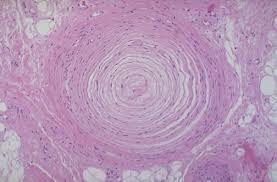
- APacinian Corpuscle
- BMeissner Corpuscle
- CRuffini ending
- DMerkel cell
13Each hair unit is innervated by free nerve endings that either wrap around the follicle or run parallel to it. Label these fibres below.
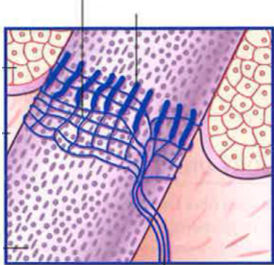
- APalisade Fibres
- BCircumferential Fibres
- CLongitudinal Fibres
Información
- Descripción
- Somatosensory system 1: Primary sensory neurones and their modalities given on 3/5/18
- Autor
- Matthew Coulson
- Idioma
- English
- Visitas
- 54
- Historial
- Creado el 5 sep 2018 · actualizado el 5 sep 2018
- Etiquetas
- Valoración
- Aún sin valoraciones Valora este test