
Test
Synaptic Plasticity
Este test tiene tipos de pregunta que se abren en el reproductor de siempre.
Preguntas del test (47)
1The only way to modify the communication between two neurons is to enhance or reduce the response of the [blank_start]post[blank_end]synaptic neuron.
- Apost
2Habituation saves [blank_start]energy[blank_end].
- Aenergy
3Short-term changes are driven by [blank_start]passive[blank_end] processes, long-term changes are driven by [blank_start]active[blank_end] processes.
- Apassive
- Bactive
4The gill-withdrawal reflex in aplysia can be sensitized (potentiated) when tail and mantle shelf are stimulated
- Atogether
- Bseparately
5Short term potentiation in aplysia
An action potential arrives through the sensory neuron and [blank_start]Ca2+[blank_end] influx leads to transmitter release into the synaptic cleft.
Neurotransmitters from the interneuron lead to the release of [blank_start]Protein kinase A[blank_end] (PKA) within the presynaptic sensory neuron.
PKA does three things:
(a) K+ channels are [blank_start]inhibited[blank_end] and the AP stays longer
(b) Synaptic vesicles are [blank_start]phosphorelated[blank_end]
(c) The [blank_start]exocytosis[blank_end] of the synaptic vesicles is sensitized.
Additionally, [blank_start]calmodulin[blank_end] reacts on Ca2+ and amplifies the whole mehanism.- ACa2+
- BK+
- CCl-
- DNa+
- EProtein kinase A
- FProtein katalysator A
- GProbiotic kinase A
- Hinhibited
- Iexcited
- Jphosphorelated
- Ksulfinated
- Loxidized
- Mexocytosis
- Nendocytosis
- Ocalmodulin
- Pcalcirax
- Qcalman
6Long-term potentiation in aplysia
(1) [blank_start]PKA[blank_end] activates genes in nucles
(2) [blank_start]Ubiquitin hydrolase[blank_end] makes PKA more stable
(3) [blank_start]New synaptic connections are grown[blank_end]
The facilitating interneuon does not depolarize the sensory neuron! It only modulates!- APKA
- BPKB
- CAKB
- DUbiquitin hydrolase
- EUbiquitin oxygenase
- FNew synaptic connections are grown
- GInterneuron connects to motor neuron
- HMore transmitters are produced
7The molecular learning processes in aplysia involve [blank_start]only presynaptic[blank_end] mechanisms.
- Aonly presynaptic
- Bpresynaptic and postsynaptic
- Conly postsynaptic
8In the hippocampus neurons from the dentate region [blank_start]induce[blank_end] LTP. This happens via the [blank_start]mossy fiber pathway[blank_end] (dentate region to CA3).
Neurons from the other hemisphere [blank_start]do not induce[blank_end] LTP. Their signals travel via the [blank_start]commissural pathway[blank_end].- Ainduce
- Bdo not induce
- Cmossy fiber pathway
- DSchaffer collateral pathway
- Eperforant fiber pathway
- Fcommissural pathway
- Gdo not induce
- Hinduce
- Icommissural pathway
- Jmossy fiber pathway
- Kperforant fiber pathway
- LSchaffer collateral pathway
9During LTP there is also a feedback signal to the presynaptic cell. One example is [blank_start]NO[blank_end], which [blank_start]diffuses[blank_end] to the presynaptic cell.
- ANO
- BNO2
- CCO2
- DCO
- Ediffuses
- Fis transported
10The mechanism for long-term potentiation
- Acan happen after one signal
- Bneeds multiple signals to be activated
11Early phase of long-term potentiation:
During normal, low-frequency synaptic transmission Na+ and K+ flow only through [blank_start]AMPA[blank_end] receptors.
During a high or repeated depolarization of the postsynaptic membrane the [blank_start]Mg2+[blank_end] blockade of the [blank_start]NMDA[blank_end] receptors is released and K+, Na+ and Ca2+ flow through these channels.
This leads to an electric-independent [blank_start]Ca2+[blank_end] signal.- AAMPA
- BNMDA
- CMg2+
- DK+
- ECa2+
- FNMDA
- GAMPA
- HCa2+
- IMg2+
- JK+
12During the late phase of LTP
- Athe number of synapses increases.
- Bthere are less transmission failures between the synapses.
- Cthe increase of synapses can be measured, because we know that each synapse transmits a signal of 4 pA.
- Dthe increase of synapses can be measured, because we know that each synapse transmits a signal of 8 pA.
- Ethe number synapses decreases
13The discusses model of early and late LTP is holds for CA3 and CA1 neurons and therefore for the
- ASchaffer collateral pathway
- Bmossy fiber pathway
- Cperforant pathway
14The importance of NMDA receptors for LTP can be seen in a behavioral experiment with knockout-mice.
- AThe mutants learn but are slower.
- BThe mutants do not learn.
- CAfter a few days the mutants do not remember.
- DAfter a few hours the mutants do not remember.
15A receptor critically involved in LTP is [blank_start]NMDA[blank_end].
- ANMDA
16The early phase of LTP makes use of [blank_start]cGMP[blank_end]. It is [blank_start]short[blank_end]-lasting and [blank_start]does not require[blank_end] protein synthesis.
The late phase of LTP makes use of [blank_start]cAMP[blank_end]. It is [blank_start]long[blank_end]-lasting and [blank_start]requires[blank_end] protein synthesis.- Adoes not require
- Brequire
- CcGMP
- DcAMP
- EAMPA
- FcAMP
- GcGMP
- HNMDA
- Ishort
- Jlong
- Klong
- Lshort
- Mrequires
- Ndoes not require
17Since there are so many different neuronal phenotypes that all serve different purposes, the [blank_start]morphology[blank_end] of a neuron is very important when it comes to STP and LTP.
- Amorphology
18While the dendrites of neurons are [blank_start]relatively stable[blank_end], filopodia are [blank_start]dynamic[blank_end] and can extend and retract.
After a contact to [blank_start]a neighbouring axon[blank_end], the filopodium [blank_start]becomes a dendritic spine[blank_end].
The process of filopodia growth is triggered by electrical activity and the activation of [blank_start]NMDA[blank_end] receptors.- Arelatively stable
- Bvery flexible
- Cdynamic
- Dfixed
- Ea neighbouring axon
- Fanother dendrite
- Ga synapse
- Hbecomes a dendritic spine
- Iretracts
- JNMDA
- KAMPA
19Overexpression of [blank_start]SynCAM (synaptic cell adhesion molecule)[blank_end] in [blank_start]HEK (human embryonic kidney)[blank_end] cells leads to expression of synapses.
- ASynCAM (synaptic cell adhesion molecule)
- Bglutamate
- CcGMP
- DHEK (human embryonic kidney)
- EE.coli
- FStraphylococcus
20The more mature the neuron, the [blank_start]better[blank_end] the LTP.
The more mature the neuron, the [blank_start]less dense[blank_end] are its protrusions (filopodia).- Abetter
- Bworse
- Cless dense
- Ddenser
21Molecules like SynCAM that initiate intracellular synaptogenesis programs are called [blank_start]extracellular recognition molecules[blank_end].
- Aextracellular recognition molecules
- Bintracellular recognition molecules
- Cadhesion molecules
22Developing neurons have [blank_start]low[blank_end] potential for synaptic plasticity because [blank_start]stable[blank_end] synapses are required for proper synapse function.
- Alow
- Bhigh
- Cstable
- Ddynamic
23Attached to the postsynaptic membrane is [blank_start]PSD[blank_end] ([blank_start]postsynaptic density[blank_end]).
It ensures receptors are in close proximity to presynaptic neurotransmitter release sites.- APSD
- Bpostsynaptic density
24The postsynaptic region is a very rigid structure
- Ato allow for the best recognition of a presynaptic signal.
- Bto reduce the risk of filopodia retraction.
- Cto facilitate with the building of new synapses.
25CaMKII (a Ca-dependent protein kinase) sits [blank_start]directly behind[blank_end] the NMDA receptors.
- Adirectly behind
- Bin a certain distance to
26On the postsynaptic site short-term plasticity can be achieved by bringing more receptors to the post-synaptic membrane.
This is done with [blank_start]AMPA[blank_end] receptors.- AAMPA
- BNMDA
27Three models of the formation of new dendritic spines
- ANew spines emerge directly.
- BLTP induction leads to generation of new spines via filopodia.
- CNew spines originate via the division of existing spines.
28[blank_start]NMDA[blank_end] receptor properties provide the biological correlate for Hebb's postulate.
[blank_start]Presynaptic[blank_end] glutamate release depolarizes the postsynaptic neuron via [blank_start]AMPA[blank_end] receptors.
After removal of the [blank_start]Mg2+[blank_end] block by depolarization glutamate causes [blank_start]Ca2+[blank_end] influx via NMDA receptors.
Ca2+-dependent [blank_start]postsynaptic[blank_end] mechanisms lead then to the change in synaptic efficacy.
Coincidence detector: [blank_start]NMDA receptors[blank_end]
Coincidence signal: [blank_start]Ca2+ flux[blank_end]- APresynaptic
- BPostsynaptic
- CAMPA
- DMg2+
- ECa2+
- FNMDA receptors
- GCa2+ flux
- HK+ flux
- INa+ flux
- JAMPA receptosrs
- KNMDA
- Lpostsynaptic
- Mpresynaptic
29Different relations between spike-timing and long term effects (LTP or LTD) are possible!
A timing of +- [blank_start]5 ms[blank_end] can be critical.- A5 ms
- B10 ms
- C2 ms
- D50 ms
30A very important role in LTP play [blank_start]theta[blank_end]-rhythms.
The [blank_start]formatio reticularis[blank_end] activates the [blank_start]septum[blank_end] with a rhythm of [blank_start]10-30[blank_end] Hz. The rhythm is received by [blank_start]granule cells[blank_end] and [blank_start]CA1[blank_end] neurons in the [blank_start]hippocampus[blank_end].
To induce LTP an action potential must reach a CA1 at the [blank_start]peak[blank_end] of the theta-oscillation.- Atheta
- Balpha
- Cbeta
- Dgamma
- Eepsilon
- Fformatio reticularis
- Gseptum
- Hdentate gyrus
- Iseptum
- Jdentate gyrus
- Kcorpus callosum
- L5-10
- M70-90
- N120-140
- O~ 200
- Pgranule cells
- Qinterneurons
- RCA3
- SSchaffer collaterals
- TCA1
- UCA3
- Vhippocampus
- Whypothalamus
- Xpeak
- Yvalley
- Z10-30
31The unidirection of pre- and postsynaptic cells exists [blank_start]only on the synaptic level[blank_end].
Neurons [blank_start]can[blank_end] (can or cannot) be pre- and postsynaptic to each other simultaneously.- Aonly on the synaptic level
- Balso on the neuronal level
- Ccan
- Dcannot
32A kind of backpropagation within the cells happens when an AP travels from the cell body back to the dendrites. This is called [blank_start]dendritic action potential[blank_end].
- Adendritic action potential
33[blank_start]Single[blank_end] synaptic contacts can lead to LTP or LTD processes triggering multiple neuronal circuit processes.
- ASingle
- BOnly multiple
34The decision whether a signal is propagated forward through the axon or backward to the dendrites is made at the [blank_start]soma[blank_end].
- Asoma
- Bdenrites
- Caxon
- Dpostsynaptic density
35In what respect are dendritic action potentials different to APs in the axon?
- ADendrites are passive and the signal is attenuated.
- BThey do not differ, a dAP is created by the influx of Na+ ions through Na+-channels.
- CAdditional K+ channels make the dendritic membrane much less excitable than the axonal membrane and there is an active reduction of the dAP amplitude along the dendrite.
36What are these different types of inputs called?
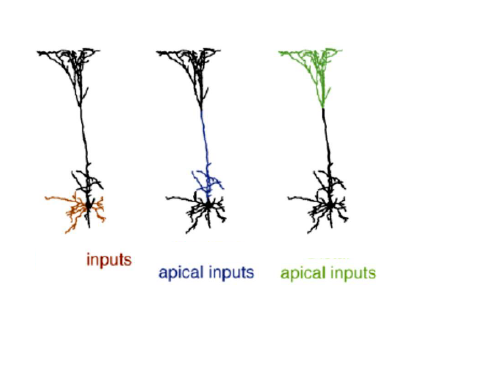
- Abasal
- Bproximal
- Cdistal
37There can be different types of STDP even within one neuron, depending on the location, e.g. further down the axon or at the dendrites.
- AVerdadero
- BFalso
38Triggering of backpropagating dendritic spikes is influenced by [blank_start]biochemical properties of dendrites[blank_end].
- Abiochemical properties of dendrites
- Bprotein synthese at the soma
- Cproperties of the postsynaptic density
39Active dendritic properties such as dendritic spikes are crucial for synaptic integration and plasticity.
- AVerdadero
- BFalso
40Synapses far away from cell body are more sensitive for STDP.
- AVerdadero
- BFalso
41Short-term habituation in aplysia's gill withdrawal reflex are due to [blank_start]reduced transmitter release[blank_end].
[blank_start]There are no[blank_end] postsynaptic changes in glutamate receptor density.- AThere are no
- BThere are also
- Creduced transmitter release
- Dreduced receptor density
- Eincreased transmitter relase
42Short-term potentiation in aplysia
Release of [blank_start]serotonin[blank_end] of the facilitating interneuron leads to activation of [blank_start]adenylyl cyclase[blank_end], the production of [blank_start]cAMP[blank_end] and release of inhibition on [blank_start]PKA[blank_end].
PKA [blank_start]blocks[blank_end] K+ channels which leads to a longer action potential.
PKA also [blank_start]increases[blank_end] the exocytosis of neurotransmitters and [blank_start]opens[blank_end] further Ca2+ channels.
An amplifying mechanism is provided by [blank_start]calmodulin[blank_end] which activates more adenylyl cyclase.- Acalmodulin
- Bserotonin
- Cadenylyl cyclase
- DcAMP
- EPKA
- Fblocks
- Gincreases
- Hopens
43Persistent activity of PKA is modulated by [blank_start]ubiquitin hydrolase[blank_end] and leads to the growth of new [blank_start]synapses[blank_end].
- Aubiquitin hydrolase
- Bsynapses
44NMDA receptors work as a coincidence detector in LTP.
The two signals that must be present are:
- [blank_start]depolarization[blank_end] of the postsynaptic cell
- [blank_start]glutamate[blank_end] in the synaptic cleft- Adepolarization
- Bglutamate
45SynCAM is expressed in the [blank_start]dendritic[blank_end] cell.
It is an extracellular recognition molecule, meaning that it [blank_start]sticks out of the membrane[blank_end].- Adendritic
- Bpresynaptic
- Csticks out of the membrane
- Dfloats around in the synaptic cleft
46In the early phase of LTP on the presynaptic site [blank_start]more[blank_end] neurotransmitters are released and on the postsynaptic site new [blank_start]AMPA[blank_end] receptors are brought to the membrane.
- Amore
- Bless
- CAMPA
- DNMDA
47During the late phase of LTP new synapses are grown via [blank_start]CREB[blank_end]-mediated gene expression.
- ACREB
Información
- Descripción
- Master (From Membrane to Brain [Lecture]) Neuroscience Test sobre Synaptic Plasticity, creado por Lukas Paulun el 18/11/2018.
- Autor
- Lukas Paulun
- Idioma
- Deutsch
- Visitas
- 395
- Etiquetas
- Valoración
- Aún sin valoraciones Valora este test