
Test
Quiz #2 [MCQ | Chapters 13,17,18]
Preguntas del test (60)
1Accounting profit is equal to total revenue minus
- Aimplicit costs.
- Bvariable costs.
- Cthe sum of implicit and explicit costs.
- Dexplicit costs.
- Emarginal costs.
2Economic profit is equal to total revenue minus
- Avariable costs.
- Bimplicit costs.
- Cexplicit costs.
- Dmarginal costs.
3Nicole owns a small pottery factory. She can make 1,000 pieces of pottery per year and sell them for €100 each. It costs Nicole €20,000 for the raw materials to produce the 1,000 pieces of pottery. She has invested €100,000 in her factory and equipment: €50,000 from her savings and €50,000 borrowed at 10 per cent. (Assume that she could have loaned her money out at 10 per cent, too.) Nicole can work at a competing pottery factory for €40,000 per year. The accounting profit at Nicole's pottery factory is
- A€30,000.
- B€35,000.
- C€75,000.
- D€70,000.
- E€80,000
4Nicole owns a small pottery factory. She can make 1,000 pieces of pottery per year and sell them for €100 each. It costs Nicole €20,000 for the raw materials to produce the 1,000 pieces of pottery. She has invested €100,000 in her factory and equipment: €50,000 from her savings and €50,000 borrowed at 10 percent (assume that she could have loaned her money out at 10 percent, too). Nicole can work at a competing pottery factory for €40,000 per year. The economic profit at Nicole's pottery factory is
- A€80,000.
- B€30,000.
- C€75,000.
- D€70,000.
- E€35,000.
5If there are implicit costs of production,
- Aaccounting profit will exceed economic profit.
- Beconomic profit will always be zero.
- Ceconomic profit will exceed accounting profit.
- Daccounting profit will always be zero.
- Eeconomic profit and accounting profit will be equal.
6If a production function exhibits diminishing marginal product, its slope
- Ais linear (a straight line).
- Bbecomes steeper as the quantity of the input increases.
- Ccould be any of these answers.
- Dbecomes flatter as the quantity of the input increases.
7If a production function exhibits diminishing marginal product, the slope of the corresponding total-cost curve
- Ais linear (a straight line).
- Bcould be any of these answers.
- Cbecomes steeper as the quantity of output increases.
- Dbecomes flatter as the quantity of output increases.
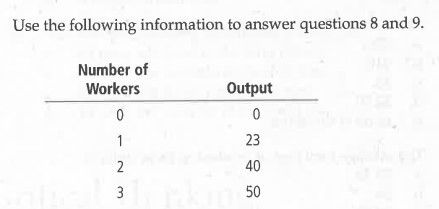
8The marginal product of labour as production moves from employing one worker to employing two workers is
- A10
- B0
- C23
- D40
- E17
9The production process described above exhibits
- Aconstant marginal product of labour.
- Bdiminishing marginal product of labour.
- Cincreasing returns to scale.
- Dincreasing marginal product of labour.
- Edecreasing returns to scale.
10Which of the following is a variable cost in the short run?
- Arent on the factory
- Bwages paid to factory labour
- Cinterest payments on borrowed financial capital
- Dpayment on the lease for factory equipment
- Esalaries paid to upper management
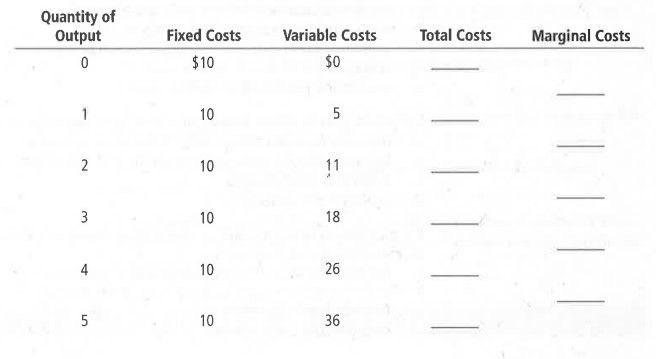
11The average fixed cost of producing four units is
- A€2.50.
- B€26.
- Cnone of these answers.
- D€10.
- E€5.
12The average total cost of producing three units is
- A€28.
- B€6.
- C€3.33.
- D€18.
- E€9.33.
13The marginal cost of changing production from three units to four units is
- A€7.
- B€5
- C€8.
- D€9.
- E€6.
14The efficient scale of production is:
- Atwo units.
- Bthree units.
- Cone unit.
- Dfive units.
- Efour units.
15When marginal costs are below average total costs,
- Aaverage fixed costs are rising.
- Baverage total costs are falling.
- Caverage total costs are rising.
- Daverage total costs are minimized.
16If marginal costs equal average total costs,
- Aaverage total costs are falling.
- Baverage total costs are rising.
- Caverage total costs are maximized.
- Daverage total costs are minimized.
17If, as the quantity produced increases, a production function first exhibits increasing marginal product and later diminishing marginal product, the corresponding marginal-cost curve will
- Abe flat (horizontal).
- Bslope upward.
- Cslope downward.
- Dbe U-shaped.
18In the long run, if a very small factory were to expand its scale of operations, it is likely that it would initially experience
- Aan increase in average total costs.
- Bdiseconomies of scale.
- Ceconomies of scale.
- Dconstant returns to scale.
19The efficient scale of production is the quantity of output that minimizes
- Aaverage fixed cost.
- Baverage total cost.
- Caverage variable cost.
- Dmarginal cost.
20Which of the following statements is true?
- AAll costs are fixed in the short run.
- BAll costs are variable in the long run.
- CAll costs are variable in the short run.
- DAll costs are fixed in the long run.
21The market for hand tools (such as hammers and screwdrivers) is dominated by Draper, Stanley, and Craftsman. This market is best described as
- Amonopolistically competitive.
- Ba monopoly.
- Can oligopoly.
- Dcompetitive.
22A market structure in which many firms sell products that are similar but not identical is known as
- Amonopolistic competition.
- Bmonopoly.
- Cperfect competition.
- Doligopoly.
23If oligopolists engage in collusion and successfully form a cartel, the market outcome is
- Athe same as if it were served by competitive firms.
- Befficient because cooperation improves efficiency.
- Cthe same as if it were served by a monopoly.
- Dknown as a Nash equilibrium.
24Suppose an oligopolist individually maximizes its profits. When calculating profits, if the output effect exceeds the price effect on the marginal unit of production, then the oligopolist
- Ashould produce more units.
- Bhas maximized profits.
- Cis in a Nash equilibrium.
- Dshould produce fewer units.
- Eshould exit the industry.
25As the number of sellers in an oligopoly grows larger, an oligopolistic market looks more like
- Amonopoly.
- Ba competitive market.
- Cmonopolistic competition.
- Da collusion solution.
26When an oligopolist individually chooses its level of production to maximize its profits, it produces an output that is
- Amore than the level produced by a monopoly and less than the level produced by a competitive market.
- Bless than the level produced by a monopoly and more than the level produced by a competitive market.
- Cless than the level produce by either monopoly or a competitive market.
- Dmore than the level produced by either monopoly or a competitive market.
27When an oligopolist individually chooses its level of production to maximize its profits, it charges a price that is
- Amore than the price charged by either monopoly or a competitive market.
- Bless than the price charged by either monopoly or a competitive market.
- Cmore than the price charged by a monopoly and less than the price charged by a competitive market.
- Dless than the price charged by a monopoly and more than the price charged by a competitive market.
28As the number of sellers in an oligopoly increases,
- Aoutput in the market tends to fall because each firm must cut back on production.
- Bthe price in the market moves further from marginal cost.
- Ccollusion is more likely to occur because a larger number of firms can place pressure on any firm that defects.
- Dthe price in the market moves closer to marginal cost.
29A situation in which oligopolists interacting with one another each choose their best strategy given the strategies that all the other oligopolists have chosen is known as a
- ANash equilibrium.
- Bdominant strategy.
- Ccartel.
- Dcollusion solution.
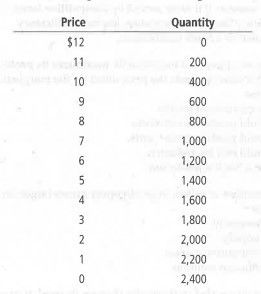
30Under competition, the price and quantity in this market would be
- A$8; 800
- B$6; 1.200
- C$4; 1.600
- D$2; 2.000
- E$0; 2.400
31If the duopolists in this baseball market collude and successfully form a cartel, what is the price that each should charge in order to maximize profits?
- A$8
- B$7
- C$6
- D$5
- E$4
32If the duopolists in this baseball market collude and successfully form a cartel, how much profit will each earn?
- A$2.700
- B$3.200
- C$3.500
- D$3.600
- E$7.200
33 If the duopolists are unable to collude, how much profit will each earn when the market reaches a Nash equilibrium?
- A$2.700
- B$3.200
- C$3.500
- D$3.600
- E$7.200
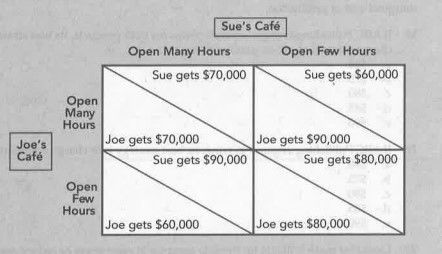
34The dominant strategy for Sue and Joe is for
- Aboth to be open for many hours
- Bboth to be open for a few hours
- CSue to be open for many hours while Joe is open for few hours
- DSue to be open for few hours while Joe is open for many hours
- EThere is no dominant strategy in this prisoners' dilemma game
35Suppose Sue and Joe agreed to collude and jointly maximize their profits. If Sue and Joe were to be able to repeatedly play the game shown earlier and they agreed on a penalty for defecting from their agreement, what is the likely outcome of the game?
- ABoth are open for many hours
- BBoth are open for a few hours
- CSue is open for many hours while Joe is open for few hours
- DSue is open for few hours while Joe is open for many hours
36Many economists argue that resale price maintenance
- Ais price fixing and therefore is prohibited by law
- BEnhance the market power of the producer
- CHas a legitimate purpose of stopping discount retailers from free riding on the services provided by full-service retailers
- DBoth A and B
37Collusion is difficult for an oligopoly to maintain
- ABecause antitrust laws make collusion illegal
- BBecause in the case of oligopoly, self-interest is in conflict with cooperation
- CIf additional firms enter of the oligopoly
- DFor all of the above reasons
38If ABC Publishing charges separate prices for both products, its best strategy is to charge prices that, when combined, total
- A$60
- B$75
- C$80
- D$85
- E$90
39If ABC Publising engages in tying, its best strategy is to charge a combined price of:
- A$60
- B$75
- C$80
- D$85
- E$90
40Laws that make it illegal for firms to conspire to raise prices of reduce production are known as
- APro-competition laws
- BAntitrust laws
- CAntimonopoly laws
- DAnticollusion laws
- EAll of the above
41The most important factors of production are
- Alabour, land, and capital.
- Bwater, earth, and knowledge.
- Cmoney, stocks, and bonds.
- Dmanagement, finance, and marketing.
42If a factor exhibits diminishing marginal product, hiring additional units of the factor will
- Acause a reduction in output.
- Bhave no effect on output.
- Cincrease the marginal product of the factor.
- Dgenerate ever smaller amounts of output.
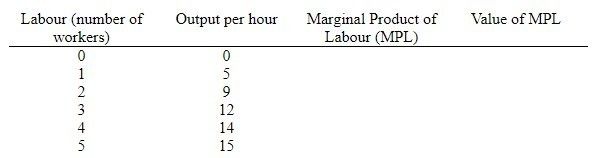
43What is the marginal product of labour as the firm moves from using three workers to using four workers?
- A14
- B0
- Cnone of these answers
- D2
- E12
44If the price of output is €4 per unit, what is the value of the marginal product of labour as the firm moves from using four workers to using five workers?
- A€60
- B€4
- C€12
- D€8
- E€56
45If this profit-maximizing firm sells its output in a competitive market for €3 per unit and hires labour in a competitive market for €8/hour, then this firm should hire
- Afour workers.
- Bthree workers.
- Ctwo workers.
- Dfive workers.
- Eone worker.
46The value of the marginal product of labour is
- Athe price of the output times the wage of labour.
- Bthe price of the output times the marginal product of labour.
- Cnone of these answers.
- Dthe wage of labour times the quantity of labour.
- Ethe wage of labour times the marginal product of labour.
47For a competitive, profit-maximizing firm, the value-of-the-marginal-product curve for capital is the firm's
- Asupply curve of capital.
- Bdemand curve for capital.
- Cproduction function.
- Dmarginal cost curve.
48An increase in the supply of labour
- Aincreases the value of the marginal product of labour and decreases the wage.
- Bdecreases the value of the marginal product of labour and decreases the wage.
- Cdecreases the value of the marginal product of labour and increases the wage.
- Dincreases the value of the marginal product of labour and increases the wage.
49A decrease in the demand for fish
- Adecreases the value of the marginal product of fishermen, reduces their wage, and reduces employment in the fishing industry.
- Bincreases the value of the marginal product of fishermen, increases their wage, and increases employment in the fishing industry.
- Cdecreases the value of the marginal product of fishermen, reduces their wage, and increases employment in the fishing industry.
- Dincreases the value of the marginal product of fishermen, increases their wage, and decreases employment in the fishing industry.
50What will a decrease in the supply of fishermen do to the market for capital employed in the fishing industry?
- Aincrease the demand for fishing boats and decrease rental rates on fishing boats
- Bdecrease the demand for fishing boats and increase rental rates on fishing boats
- Cdecrease the demand for fishing boats and decrease rental rates on fishing boats
- Dincrease the demand for fishing boats and increase rental rates on fishing boats
51An increase in the demand for apples will cause all but which of the following?
- Aa decrease in the number of apple pickers employed
- Ban increase in the value of the marginal product of apple pickers
- Can increase in the price of apples
- Dan increase in the wage of apple pickers
52A decrease in the supply of farm tractors will cause all but which of the following?
- Aan increase in the rental rate for tractors
- Ba decrease in the rental rate of farmland
- Can increase in the value of the marginal product of tractors
- Dan increase in the wage of farm workers
53If both input and output markets are competitive and firms are profit maximizing, then in equilibrium each factor of production earns
- Aan amount equal to the price of output times total output.
- Bthe amount allocated by the political process.
- Can equal share of output.
- Dthe value of its marginal product.
54An individual firm's demand for a factor of production
- Aslopes downward because an increase in the production of output reduces the price at which the output can be sold in a competitive market, thereby reducing the value of the marginal product as more of the factor is used.
- Bslopes downward due to the factor's diminishing marginal product.
- Cslopes upward due to the factor's increasing marginal product.
- Dis perfectly elastic (horizontal) if the factor market is perfectly competitive.
55An increase in the demand for a firm's output
- Adecreases the prosperity of the firm but increases the prosperity of the factors hired by the firm.
- Bdecreases the prosperity of both the firm and the factors hired by the firm.
- Cincreases the prosperity of both the firm and the factors hired by the firm.
- Dincreases the prosperity of the firm but decreases the prosperity of the factors hired by the firm.
56A competitive, profit-maximizing firm should hire workers up to the point where
- Athe wage, the rental price of capital, and the rental price of land are all equal.
- Bthe marginal product of labour equals zero and the production function is maximized.
- Cthe value of the marginal product of labour equals the wage.
- Dthe marginal product of labour equals the wage.
57Which of the following is not true with regard to workers who have a high value of marginal product?
- Ahave skills that are in relatively scarce supply.
- Bproduce output for which there is great demand.
- Cusually have little capital with which to work.
- Dare usually highly paid.
58An increase in the price of automobiles shifts the demand for autoworkers to the
- Aleft and decreases the wage.
- Bright and decreases the wage.
- Cright and increases the wage.
- Dleft and increases the wage.
59When capital is owned by the firm as opposed to being directly owned by households, capital income may take any of the following forms except
- Ainterest.
- Bdividends.
- Cincreases in stocks of goods.
- Dretained earnings.
60Suppose that a war is fought with biological weapons. The weapons destroy people but not capital. What is likely to happen to equilibrium wages and rental rates after the war when compared to their values before the war?
- AWages rise and rental rates fall.
- BWages rise and rental rates rise.
- CWages fall and rental rates rise.
- DWages fall and rental rates fall.
Información
- Descripción
- Hell on Earth (Quizzes #2 & #3 [Chapters 1-3, 4-6, 13-17-18, 23-24]) Economics [Teacher: Abdinova Makpal ; Final Exam + Quizzes] ▼ Test sobre Quiz #2 [MCQ | Chapters 13,17,18], creado por Good Guy Beket el 02/12/2018.
- Autor
- Good Guy Beket
- Idioma
- English
- Visitas
- 624
- Etiquetas
- Valoración
- Aún sin valoraciones Valora este test