
Test
Economics Final Exam [Chap. 3-4]
Preguntas del test (40)
1If a nation has an absolute advantage in the production of a good,
- Ait can benefit by restricting imports of that good.
- Bit will specialize in the production of that good and export it.
- Cit can produce that good using fewer resources than its trading partner.
- Dnone of these answers.
- Eit can produce that good at a lower opportunity cost than its trading partner.
2If a nation has a comparative advantage in the production of a good,
- Ait can produce that good at a lower opportunity cost than its trading partner.
- Bit can benefit by restricting imports of that good.
- Cit can produce that good using fewer resources than its trading partner.
- Dit must be the only country with the ability to produce that good.
- Enone of these answers.
3Which of the following statements about trade is true?
- AUnrestricted international trade benefits every person in a country equally.
- BTrade can benefit everyone in society because it allows people to specialize in activities in which they have a comparative advantage.
- CPeople that are skilled at all activities cannot benefit from trade.
- DTrade can benefit everyone in society because it allows people to specialize in activities in which they have an absolute advantage.
4According to the principle of comparative advantage,
- Acountries should specialize in the production of goods that they enjoy consuming.
- Bcountries with a comparative advantage in the production of every good need not specialize.
- Ccountries should specialize in the production of goods for which they have a lower opportunity cost of production than their trading partners.
- Dcountries should specialize in the production of goods for which they use fewer resources in production than their trading partners.
5Which of the following statements is true?
- AA self-sufficient country can, at best, consume on its production possibilities frontier.
- BOnly countries with an absolute advantage in the production of every good should strive to be self-sufficient.
- CA self-sufficient country consumes outside its production possibilities frontier.
- DSelf-sufficiency is the road to prosperity for most countries.
6Suppose a country's workers can produce 4 watches per hour or 12 rings per hour. If there is no trade,
- Athe domestic price of 1 ring is 1/4 of a watch.
- Bthe domestic price of 1 ring is 3 watches.
- Cthe domestic price of 1 ring is 1/3 of a watch.
- Dthe domestic price of 1 ring is 12 watches.
- Ethe domestic price of 1 ring is 4 watches.
7Suppose a country's workers can produce 4 watches per hour or 12 rings per hour. If there is no trade,
- Athe opportunity cost of 1 watch is 1/4 of a ring.
- Bthe opportunity cost of 1 watch is 4 rings.
- Cthe opportunity cost of 1 watch is 3 rings.
- Dthe opportunity cost of 1 watch is 12 rings.
- Ethe opportunity cost of 1 watch is 1/3 of a ring.
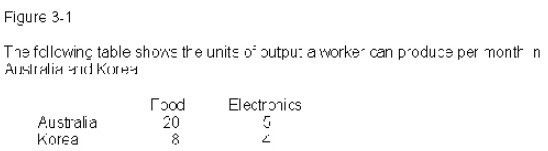
8Refer to Figure 3-1. Which of the following statements about absolute advantage is true?
- AAustralia has an absolute advantage in the production of food while Korea has an absolute advantage in the production of electronics.
- BKorea has an absolute advantage in the production of food while Australia has an absolute advantage in the production of electronics.
- CAustralia has an absolute advantage in the production of both food and electronics.
- DKorea has an absolute advantage in the production of both food and electronics.
9Refer to Figure 3-1. The opportunity cost of 1 unit of electronics in Australia is
- A4 units of food.
- B5 units of food.
- C1/5 of a unit of food.
- D1/4 of a unit of food.
10Refer to Figure 3-1. The opportunity cost of 1 unit of electronics in Korea is
- A4 units of food.
- B1/4 units of food.
- C2 units of food.
- D1/2 of a unit of food.
11Refer to Figure 3-1. The opportunity cost of 1 unit of food in Australia is
- A1/5 of a unit of electronics.
- B5 units of electronics.
- C4 units of electronics.
- D1/4 of a unit of electronics.
12Refer to Figure 3-1. The opportunity cost of 1 unit of food in Korea is
- A1/2 of a unit of electronics.
- B1/4 units of electronics.
- C2 units of electronics.
- D4 units of electronics.
13Refer to Figure 3-1. Which of the following statements about comparative advantage is true?
- AAustralia has a comparative advantage in the production of both food and electronics.
- BKorea has a comparative advantage in the production of both food and electronics.
- CAustralia has a comparative advantage in the production of food while Korea has a comparative advantage in the production of electronics.
- DKorea has a comparative advantage in the production of food while Australia has a comparative advantage in the production of electronics.
- ENeither country has a comparative advantage.
14Refer to Figure 3-1. Korea should
- Aproduce neither good because it has an absolute disadvantage in the production of both goods.
- Bspecialize in electronics production, export electronics, and import food.
- Cproduce both goods because neither country has a comparative advantage.
- Dspecialize in food production, export food, and import electronics
15Refer to Figure 3-1. Prices of electronics can be stated in terms of units of food. What is the range of prices of electronics for which both countries could gain from trade?
- AThe price must be greater than 1/5 of a unit of food but less than 1/4 of a unit of food.
- BThe price must be greater than 4 units of food but less than 5 units of food.
- CThe price must be greater than 1/4 of a unit of food but less than 1/2 of a unit of food.
- DThe price must be greater than 2 units of food but less than 4 units of food.
16Suppose the world consists of two countries: the UK and Spain. Further, suppose there are only two goods--food and clothing. Which of the following statements is true?
- AIf the UK has an absolute advantage in the production of food, then Spain must have an absolute advantage in the production of clothing.
- Bnone of these answers.
- CIf the UK has a comparative advantage in the production of food, Spain might also have a comparative advantage in the production of food.
- DIf the UK has a comparative advantage in the production of food, it must also have a comparative advantage in the production of clothing.
- EIf the UK has a comparative advantage in the production of food, then Spain must have a comparative advantage in the production of clothing.
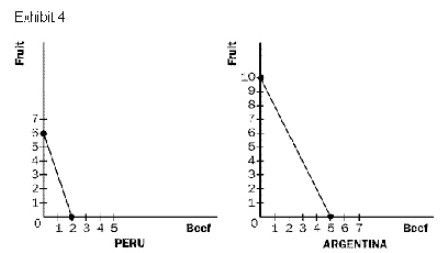
17Use the production possibilities frontiers in Exhibit 4 to answer the question. Assume each country has the same number of workers, say 20 million, and that each axis is measured in metric tons per month. Argentina has a comparative advantage in the production of
- Aneither fruit nor beef.
- Bfruit
- Cboth fruit and beef.
- Dbeef
18Use the production possibilities frontiers in Exhibit 4 to answer the question. Assume each country has the same number of workers, say 20 million, and that each axis is measured in metric tons per month. Peru will export
- Aboth fruit and beef.
- Bbeef.
- Cfruit
- Dneither fruit nor beef.
19Use the production possibilities frontiers in Exhibit 4 to answer the question. Assume each country has the same number of workers, say 20 million, and that each axis is measured in metric tons per month. The opportunity cost of producing a metric ton of beef in Peru is
- A1/3 ton of fruit.
- B6 tons of fruit.
- C1 ton of fruit.
- D2 tons of fruit.
- E3 tons of fruit.
20Joe is a tax accountant. He receives €100 per hour doing tax returns. He can type 10,000 characters per hour into spreadsheets. He can hire an assistant who types 2,500 characters per hour into spreadsheets. Which of the following statements is true?
- Anone of these answers.
- BJoe should hire the assistant as long as he pays the assistant less than €25 per hour.
- CJoe should not hire an assistant because the assistant cannot type as fast as he.
- DJoe should hire the assistant as long as he pays the assistant less than €100 per hour.
21A perfectly competitive market has
- Afirms that set their own prices.
- Bonly one seller.
- Cat least a few sellers.
- Dmany buyers and sellers.
- Enone of these answers.
22If an increase in the price of blue jeans leads to an increase in the demand for
tennis shoes, then blue jeans and tennis shoes are- Acomplements.
- Binferior goods.
- Cnormal goods.
- Dnone of these answers.
- Esubstitutes
23The law of demand states that an increase in the price of a good
- Aincreases the supply of that good.
- Bdecreases the quantity demanded for that good.
- Cdecreases the demand for that good.
- Dincreases the quantity supplied of that good.
- Enone of these answers.
24The law of supply states that an increase in the price of a good
- Anone of these answers.
- Bincreases the quantity supplied of that good.
- Cincreases the supply of that good.
- Ddecreases the demand for that good.
- Edecreases the quantity demanded for that good.
25If an increase in consumer incomes leads to a decrease in the demand for camping equipment, then camping equipment is
- Aa normal good.
- Bnone of these answers.
- Can inferior good.
- Da substitute good.
- Ea complementary good.
26A monopolistic market has
- Amany buyers and sellers.
- Bnone of these answers.
- Cfirms that are price takers.
- Donly one seller.
- Eat least a few sellers.
27Which of the following shifts the demand for watches to the right?
- Aan increase in the price of watches
- Bnone of these answers
- Ca decrease in the price of watch batteries if watch batteries and watches are complements
- Da decrease in consumer incomes if watches are a normal good
- Ea decrease in the price of watches
28All of the following shift the supply of watches to the right except
- Aan advance in the technology used to manufacture watches.
- Ban increase in the price of watches.
- CAll of these answers cause an increase in the supply of watches.
- Da decrease in the wage of workers employed to manufacture watches.
- Emanufacturers' expectation of lower watch prices in the future.
29If the price of a good is above the equilibrium price,
- Athere is a surplus and the price will rise.
- Bthere is a shortage and the price will fall.
- Cthere is a shortage and the price will rise.
- Dthe quantity demanded is equal to the quantity supplied and the price remains unchanged.
- Ethere is a surplus and the price will fall.
30If the price of a good is below the equilibrium price,
- Athere is a shortage and the price will rise.
- Bthe quantity demanded is equal to the quantity supplied and the price remains unchanged.
- Cthere is a shortage and the price will fall.
- Dthere is a surplus and the price will rise.
- Ethere is a surplus and the price will fall.
31If the price of a good is equal to the equilibrium price,
- Athere is a shortage and the price will fall.
- Bthe quantity demanded is equal to the quantity supplied and the price remains unchanged.
- Cthere is a surplus and the price will rise.
- Dthere is a shortage and the price will rise.
- Ethere is a surplus and the price will fall.
32An increase (rightward shift) in the demand for a good will tend to cause
- Aan increase in the equilibrium price and quantity.
- Bnone of these answers.
- Can increase in the equilibrium price and a decrease in the equilibrium quantity.
- Da decrease in the equilibrium price and an increase in the equilibrium quantity.
- Ea decrease in the equilibrium price and quantity.
33A decrease (leftward shift) in the supply for a good will tend to cause
- Aan increase in the equilibrium price and quantity.
- Ba decrease in the equilibrium price and an increase in the equilibrium quantity.
- Cnone of these answers.
- Da decrease in the equilibrium price and quantity.
- Ean increase in the equilibrium price and a decrease in the equilibrium quantity.
34Suppose there is an increase in both the supply and demand for personal computers. In the market for personal computers, we would expect
- Athe equilibrium quantity to rise and the equilibrium price to rise.
- Bthe equilibrium quantity to rise and the equilibrium price to fall.
- Cthe equilibrium quantity to rise and the equilibrium price to remain constant.
- Dthe change in the equilibrium quantity to be ambiguous and the equilibrium price to rise.
- Ethe equilibrium quantity to rise and the change in the equilibrium price to be ambiguous.
35Suppose there is an increase in both the supply and demand for personal computers. Further, suppose the supply of personal computers increases more than demand for personal computers. In the market for personal computers, we would expect
- Athe change in the equilibrium quantity to be ambiguous and the equilibrium price to fall.
- Bthe equilibrium quantity to rise and the equilibrium price to rise.
- Cthe equilibrium quantity to rise and the change in the equilibrium price to be ambiguous.
- Dthe equilibrium quantity to rise and the equilibrium price to fall.
- Ethe equilibrium quantity to rise and the equilibrium price to remain constant.
36Which of the following statements is true about the impact of an increase in the price of lettuce?
- ABoth the demand for lettuce will decrease and the equilibrium price and quantity of salad dressing will fall.
- BThe supply of lettuce will decrease.
- CThe demand for lettuce will decrease.
- DThe equilibrium price and quantity of salad dressing will fall.
- EThe equilibrium price and quantity of salad dressing will rise.
37Suppose a frost destroys much of the Florida orange crop. At the same time, suppose consumer tastes shift toward orange juice. What would we expect to happen to the equilibrium price and quantity in the market for orange juice?
- APrice will decrease; quantity is ambiguous.
- BThe impact on both price and quantity is ambiguous.
- CPrice will increase; quantity will increase.
- DPrice will increase; quantity will decrease.
- EPrice will increase; quantity is ambiguous.
38Suppose consumer tastes shift toward the consumption of apples. Which of the following statements is an accurate description of the impact of this event on the market for apples?
- AThere is an increase in the quantity demanded of apples and in the supply for apples.
- BThere is an increase in the demand and supply of apples.
- CThere is an increase in the demand for apples and a decrease in the supply of apples.
- DThere is a decrease in the quantity demanded of apples and an increase in the supply for apples.
- EThere is an increase in the demand for apples and an increase in the quantity supplied of apples.
39Suppose both buyers and sellers of wheat expect the price of wheat to rise in the near future. What would we expect to happen to the equilibrium price and quantity in the market for wheat today?
- AThe impact on both price and quantity is ambiguous.
- BPrice will decrease; quantity is ambiguous.
- CPrice will increase; quantity will decrease.
- DPrice will increase; quantity is ambiguous.
- EPrice will increase; quantity will increase.
40An inferior good is one for which an increase in income causes a(n)
- Adecrease in supply.
- Bincrease in demand.
- Cincrease in supply.
- Ddecrease in demand.
Información
- Descripción
- Hell on Earth (Final Exam Prep) Economics [Teacher: Abdinova Makpal ; Final Exam + Quizzes] ▼ Test sobre Economics Final Exam [Chap. 3-4], creado por Good Guy Beket el 27/12/2018.
- Autor
- Good Guy Beket
- Idioma
- English
- Visitas
- 1.629
- Etiquetas
- Valoración
- Aún sin valoraciones Valora este test