
Test
Bio 23 - Exam 4
Este test tiene tipos de pregunta que se abren en el reproductor de siempre.
Preguntas del test (48)
1If ammonia is so toxic, how do fish diffuse it out of their bodies directly?
- AThey don't - they convert it to uric acid!
- BThey use the surrounding water to diffuse it
- CThe kidneys help to break down ammonia
- DThe liver helps to break down ammonia
- EAmmonia isn't toxic to fish in small quantities
2Which of these are NOT a function of the kidneys?
- Aregulation of ion concentration in the blood
- Belimination of organic waste products
- Cbreaking down ammonia
- Dregulation of blood volume and pressure
- Erecovering nutrients lots in urine
3Urea is 100,000x MORE toxic than ammonia
- AVerdadero
- BFalso
4Match each pair correctly
- Abody cells - ammonia
liver - urea
kidneys - urine - Bbody cells - urea
liver - urine
kidneys - ammonia - Cbody cells - ammonia
liver - urine
kidneys - uric acid - Dbody cells - urea
liver - uric acid
kidneys - ammonia - Ebody cells - uric acid
liver - ammonia
kidneys - urine - Fbody cells - ammonia
liver - uric acid
kidneys - urea
- Abody cells - ammonia
5An unknown animal contains a single ear bone with very well-developed hearing. What type of waste would you expect this animal to produce?
- Aammonia
- Burea
- Curine
- Duric acid
- EOnly animals with 3 ear bones can have well-developed hearing!
6What are the correct steps of going through the nephron?
- A1. Collecting Tubule
2. Ascending Loop of Henle
3. Descending Loop of Henle
4. Proximal Convoluted Tubule
5. Glomerus & Renal Corpuscle
6. Distal Convoluted Tubule - B1. Ascending Loop of Henle
2. Descending Loop of Henle
3. Collecting Tubule
4. Proximal Convoluted Tubule
5. Distal Convoluted Tubule
6. Glomerus & Renal Corpuscle - C1. Glomerus & Renal Corpuscle
2. Proximal Convoluted Tubule
3. Descending Loop of Henle
4. Ascending Loop of Henle
5. Distal Convolute Tubule
6. Collecting Tubule - D1. Glomerus & Renal Corpuscle
2. Distal Convoluted Tubule
3. Proximal Convoluted Tubule
4. Ascending Limb of Loop of Henle
5. Descending Limb of Loop of Henle
6. Collecting Tubule - E1. Glomerus & Renal Corpuscle
2. Proximal Convoluted Tubule
3. Distal Convoluted Tubule
4.Descending Limb of Loop of Henle
5. Collecting Tubule
6. Ascending Limp of Loop of Henle
- A1. Collecting Tubule
7Match the function:
Glomerus & Renal Corpuscle - [blank_start]_____[blank_end]
Proximal Convoluted Tubule - [blank_start]_______[blank_end]
Descending Limb of Loop of Henle - [blank_start]______[blank_end]
Ascending Limb of Loop of Henle - [blank_start]_______[blank_end]
Distal Convoluted Tubule - [blank_start]________[blank_end]
Collecting Tubule - [blank_start]___________[blank_end]- Apassive formation of ultrafiltrate
- BActive & passive reabsorption
- CH2O absorption 25% of original h20remain
- Dion absorption - no osmosis here
- Eh20 absorption - 5-20% of h20 remaining
- Freceives fluid & makes final adjustments
8Which is NOT a way that animals reduce water loss?
- Ahyperthermia
- Beating halophytes
- Cnever drinking
- Ddon't sweat
- Enot producing ammonia
9Which of the following about nerve impulses is correct?
- AAll stimuli are the same
- BAll nerve impulses are the same
- CAll nerves connect to the same part of the brain
- DRadiant energy is not an effective stimulus
10Match with the type of vision:
Distance Vision:
1) Ciliary bodies [blank_start]relaxed[blank_end]
2) [blank_start]Tension[blank_end] on suspensory ligaments
3) Lens [blank_start]flat[blank_end]
Close Vision:
1) Ciliary body [blank_start]contracts[blank_end]
2) [blank_start]No Tension[blank_end] on suspensory ligament
3) Lens [blank_start]spherical[blank_end]- Arelaxed
- BTension
- Cflat
- Dcontracts
- ENo Tension
- Fspherical
11Vertebrate is to [blank_start]inverted retina[blank_end] as invertebrate is to [blank_start]verted retina[blank_end]
- Ainverted retina
- Bverted retina
12Match the eye to the animal:
Prey Animal - [blank_start]high visual field,[blank_end] [blank_start]mostly monocular vision[blank_end]
Predator Animal - [blank_start]smaller visual field[blank_end], [blank_start]mostly binocular vision[blank_end]
horse - [blank_start]sloped retina[blank_end]
bird - [blank_start]eye with sclerotic ring[blank_end]
arthropods - [blank_start]compound eye[blank_end]- Ahigh visual field,
- Bmostly monocular vision
- Csmaller visual field
- Dmostly binocular vision
- Esloped retina
- Feye with sclerotic ring
- Gcompound eye
13Match the correct eye terms:
1) Dark Vision - [blank_start]postsynaptic neurons inhibited[blank_end] -> [blank_start]neurotransmitter released[blank_end]
2) Light Vision - [blank_start]postsynaptic neurons released[blank_end] -> [blank_start]nothing released[blank_end]
3) Rods - [blank_start]light vision[blank_end]
4) Cones - [blank_start]Color vision[blank_end]- Apostsynaptic neurons inhibited
- Bneurotransmitter released
- Cpostsynaptic neurons released
- Dnothing released
- Elight vision
- FColor vision
14An example of active generation would be: detecting electric field from a prey.
- AVerdadero
- BFalso
15Which of these is not a stimulus?
- AEnergy
- Belectrical
- Cchemical
- Dradiant
- Emechanical
- Fall of these are stimuli
16Water can have both high and low albedo
- AVerdadero
- BFalso
17A rainstorm is blowing in, you can use the environmental lapse rate to learn about the change in air temperate from it.
- AVerdadero
- BFalso
18Which of the following which you expect to hold the most amount of heat?
- Aenvironmental lapse rate
- Bdry adiabatic lapse rate
- Cmoist adiabatic lapse rate
19Which of the following are major air circulation cells?
- Ahenle cell
- Bferrell cell
- Chadley cell
- Dequator cell
- Emiddle cell
- Fpolar cell
- Gregional cell
20Match the correct terms:
[blank_start]March[blank_end] & [blank_start]September Equinox[blank_end] - equator faces the sun directly; 12 hours of daylight and nighttime
[blank_start]June Solstice[blank_end] - Nothern hemisphere tilts towards the sun; longer days than nights
[blank_start]December Solstice[blank_end] - Nothern hemisphere tilts away from the sun; longer nights than days- AMarch
- BSeptember Equinox
- CJune Solstice
- DDecember Solstice
- EMarch Solstice
- FSeptember Solstice
- GJune Equinox
- HDecember Equinox
- IDecember
- JJune
- KSeptember
21Which of the following is NOT a regional effect on climate?
- AElevation
- BProximity to an ocean or body of water
- Crain shadow
- Dcloud covering
22High mountains have a climate similar to the poles due to:
- Aenvironmental lapse rate
- Brain shadow
- Cdry adiabatic lapse rate
- Dmoist adiabatic lapse rate
- Ealbedo
- Fdistribution of solar energy
23Which of the following are used to classify a terrestrial biome?
- Atemperature
- Bprecipitation
- Cvegetation type
- Dorganisms
- Epopulations
- Falbedo
24Match the description to the biome:
Extremely cold, frozen, no vegetation - [blank_start]Polar Desert[blank_end]
Long cold winters, short cool summers; soil has permafrost layer; low growing plants and mosses - [blank_start]Tundra[blank_end]
Very cold climate, has extremely wide annual temperate range; limited species, coniferous trees - [blank_start]Boreal Forest[blank_end]
Wide range of annual temperature; layered vegetation, lots of species, trees lose leaves in winter - [blank_start]Deciduous Forest[blank_end]
Lots of rain, cool wet winters, mild foggy summers; Douglas fir, coast redwoods and other conifers - [blank_start]Temperate rain forest[blank_end]
Summer rains and winter snows; grassy vegetation, dry climate, fires & grazing animals keep out trees- [blank_start]temperate grasslands[blank_end]
Little rain; vegetation specialized for conserving water, greatest fluctuation in daily temperatures - [blank_start]Cold Desert[blank_end]
Mediterranean climate; hot dry summers and cool wet winters, plants adapted to fires - [blank_start]Chaparral[blank_end]
Little rain; sand and camel deserts - [blank_start]Hot Deserts[blank_end]
Distinct wet and prolonged dry periods; grasses with scattered trees due to fires and grazing animals - [blank_start]Tropical Savanna[blank_end]
Pronounced dry season; grassy vegetation but more trees; found between savanna and rainforest - [blank_start]Tropical scrubland[blank_end]
Warm, wet climate; no limit on plant growth, highest species diversity on earth - [blank_start]Tropical Rain Forest[blank_end]
- APolar Desert
- BTundra
- CBoreal Forest
- DDeciduous Forest
- ETemperate rain forest
- Ftemperate grasslands
- GCold Desert
- HChaparral
- IHot Deserts
- JTropical Savanna
- KTropical scrubland
- LTropical Rain Forest
25Species diversity....
[blank_start]increases[blank_end] towards equator
[blank_start]decreases[blank_end] at higher elevation
[blank_start]increases[blank_end] on larger land areas
[blank_start]decreases[blank_end] with increasing isolation- Aincreases
- Bdecreases
- Cdecreases
- Dincreases
- Eincreases
- Fdecreases
- Gdecreases
- Hincreases
26Match to the correct terms for aquatic biomes:
[blank_start]Photic Zone[blank_end] - Uppermost layer
[blank_start]Littoral Zone[blank_end] - Part of Photic Zone; rooted plants grow here
[blank_start]Aphotic Zone[blank_end] - Cold and Dark; lots of nutrients here
[blank_start]Pelagic Zone[blank_end] - ocean far from shore; a marine "desert"- APhotic Zone
- BLittoral Zone
- CAphotic Zone
- DPelagic Zone
27Which of the following applies to lichen?
- Asecondary succession
- Bprimary succession
- Cpioneer stage
- Dintermediate stage
- Eclimax community
28Match the following:
1) Pioneer Vegetation -
(a) [blank_start]r[blank_end] selected species
(b) [blank_start]poor[blank_end] competitors in established communities
(c) [blank_start]high[blank_end] reproductive rates
2) Climax Community
(a) [blank_start]k[blank_end] selected species
(b) [blank_start]good[blank_end] competitors in established communities
(c) [blank_start]low[blank_end] reproductive rates- Ar
- Bpoor
- Chigh
- Dmedium
- Ek
- Ft
- Gm
- Hz
- Igood
- Jlow
- Kstable
29Introduced European weeds are more common in disturbed area.
- AVerdadero
- BFalso
30An ecosystem includes all organisms and all non-living aspects of an environment.
- AVerdadero
- BFalso
31What is the basis of nearly all ecosystems on Earth?
- Asolar radiation
- Bfungi
- Clichens
- Dgreen plants & algae
- Ecarbon
32~25% of energy at each trophic level is transferred to the next.
- AVerdadero
- BFalso
33Which of the following is a producer?
- Aalgae
- Bfungi
- Cplankton
- Dbacteria
- Ecrustacean
34DDT was banned around the world. However, nearly all organisms tested contain DDT.
- AVerdadero
- BFalso
35Which of the following would you expect biological magnification to have the biggest effect on?
- APlankton - Their bodies are small so it's easy for harmful effects to kill them.
- BPlants & Algae - Environmental toxins will hurt them first since they are at the lowest trophic level.
- CBirds - Birds have evolved very little resistance to newer environmental toxins.
- DPolar Bears - By eating at a higher trophic, the harmful substances accumulate in their bodies more quickly.
36Polyandry is the most common mating system observed.
- AVerdadero
- BFalso
37Which of the following is NOT a characteristic of a population?
- Adensity
- Bdispersion
- Cbirth rate
- Ddeath rate
- Eimmigration
- Femigration
- Gbio mass
38Ecological density takes into consideration that not all habitat is equal.
- AVerdadero
- BFalso
39[blank_start]Density Dependent Limiting Factor[blank_end] - Competition, Disease & parasitism, predation
[blank_start]Density Independent Limiting Factor[blank_end] - Weather & Geological Events- ADensity Dependent Limiting Factor
- BDensity Independent Limiting Factor
- CCarrying Capacity
- DNatural Selection
40Label the graph correctly. Not all terms will be used
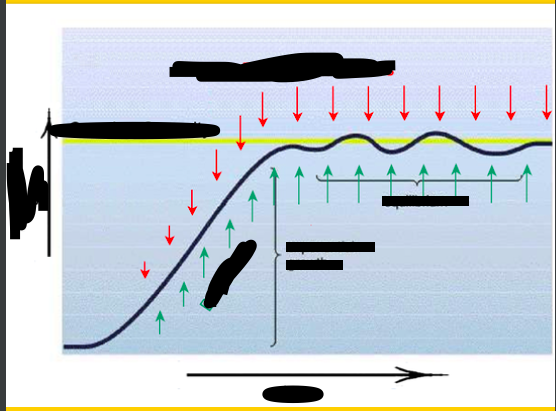
- ADensity Dependent Factors
- BBirth Rate
- Cexponential growth
- Dcarrying capacity
- Epopulation size
- Fevolution
- Grate of change
- Hnatural selection
- Iequilibrium
- Jtime
- Kage
41Which of the following is NOT considered to be an island?
- AMountain in a "sea" of lowlands
- BOases in a "sea" of desert
- CSmall lake in a "sea" of lake
- DGrove of trees in a "sea" of grassland
- EThese are all islands
42Match the islands:
[blank_start]Small-Distant Islands[blank_end] - have fewest species
[blank_start]Large-Near Islands[blank_end] - Have most species
[blank_start]Small-Near islands -[blank_end] have high colonization and high extinction rate = high turnover rate
[blank_start]Large-Distant Islands[blank_end] - have low colonization and low extinction rate = low turnover rate- ASmall-Distant Islands
- BLarge-Near Islands
- CSmall-Near islands -
- DLarge-Distant Islands
43Lots of edge is important for a healthy reserve!
- AVerdadero
- BFalso
44Which of the following are POSITIVE feedback loops?
- AMelting ice makes earth absorb more heat
- Bheating causes more water vapor - traps more heat
- Cmelting permafrost releases CO2 from tundra
- Dheating oceans = photosynthesis in algae so less CO2 removed from the atmosphere
- EMore water vapor makes more white clouds and cools the earth
- FIncreases CO2 may make plants grow faster/more which remove CO2
45It's hard to differentiate between innate and learned behavior.
- AVerdadero
- BFalso
46Which of the following pertain to fixed action potentials?
- Aappears intelligent but is automatic
- Bonce started goes to completion
- Crequires a releaser
- Dpart of simple aggregation
- ETucking behavior in African Lovebirds
47Because of habituation, if an animal is repeatedly exposed to a stimulus it is going to respond [blank_start]more.[blank_end]
- Amore
- Bless
- Cthe same
48Altruistic behavior puts a species own safety and reproduction at risk. Why do we still see animals displaying these behaviors?
- AAnimals that display altruism usually have short lifespans because of it.
- BAnimals are compassionate.
- CThey only display altruism to their offspring.
- DAltruism increases inclusive fitness
Información
- Descripción
- Test sobre Bio 23 - Exam 4, creado por Sylas Eckhart el 29/05/2019.
- Autor
- Sylas Eckhart
- Idioma
- English
- Visitas
- 45
- Etiquetas
- Valoración
- Aún sin valoraciones Valora este test