
Test
The Kidney: Filtration, Reabsorption and Secretion
Este test tiene tipos de pregunta que se abren en el reproductor de siempre.
Preguntas del test (34)
1Label this image to describe the gross anatomy of the kidney.
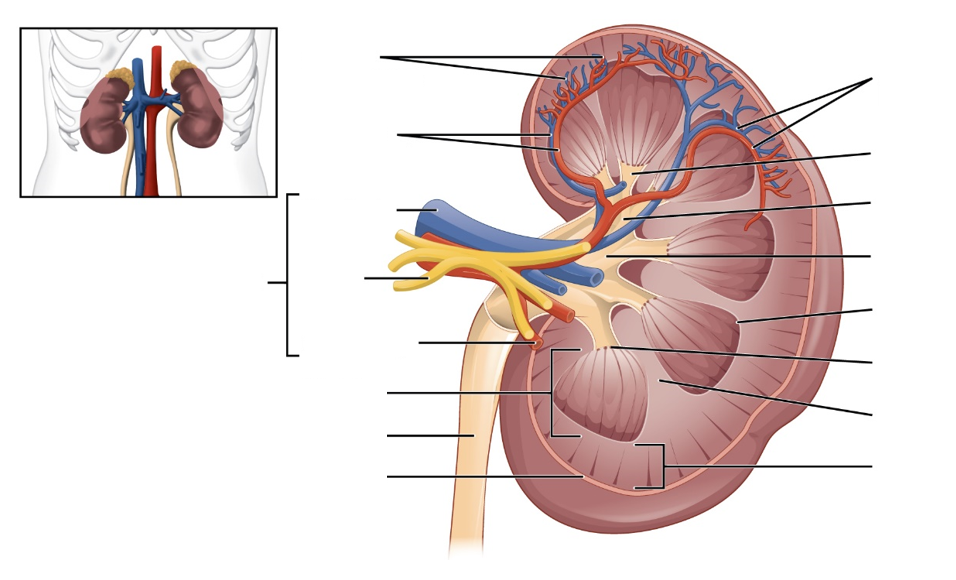
- ACortical blood vessels
- BInterlobar blood vessels
- CHilum
- DRenal vein
- ERenal nerve
- FRenal artery
- GUreter
- HRenal pelvis
- IMajor calyx
- JMinor calyx
- KArcuate blood vessels
- LPyramid
- MPapilla
- NRenal column
- OCortex
- PCapsule
- QMedulla
2Label this image to show the functional unit of the kidney - the nephron.
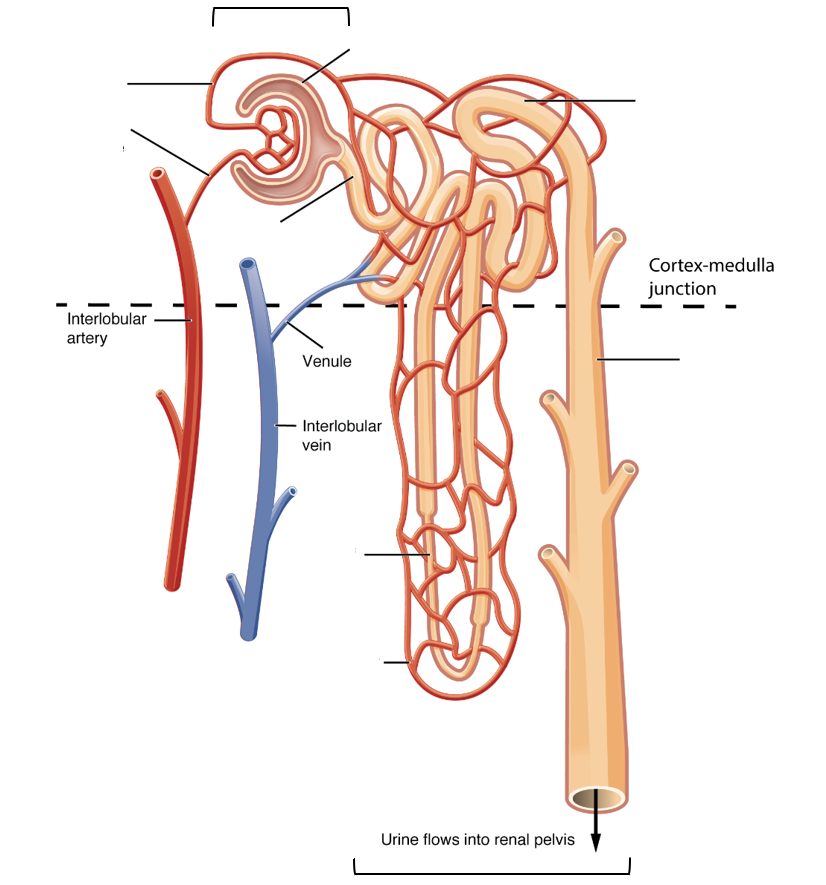
- ACorpuscle
- BTubule
- CBowman's capsule
- DDistal convoluted tubule
- EProximal convoluted tubule
- FLoop of Henle
- GPeritubular capillaries
- HCollecting duct
- IAfferent arteriole
- JEfferent arteriole
3Label this image to show the anatomy of the renal corpuscle.
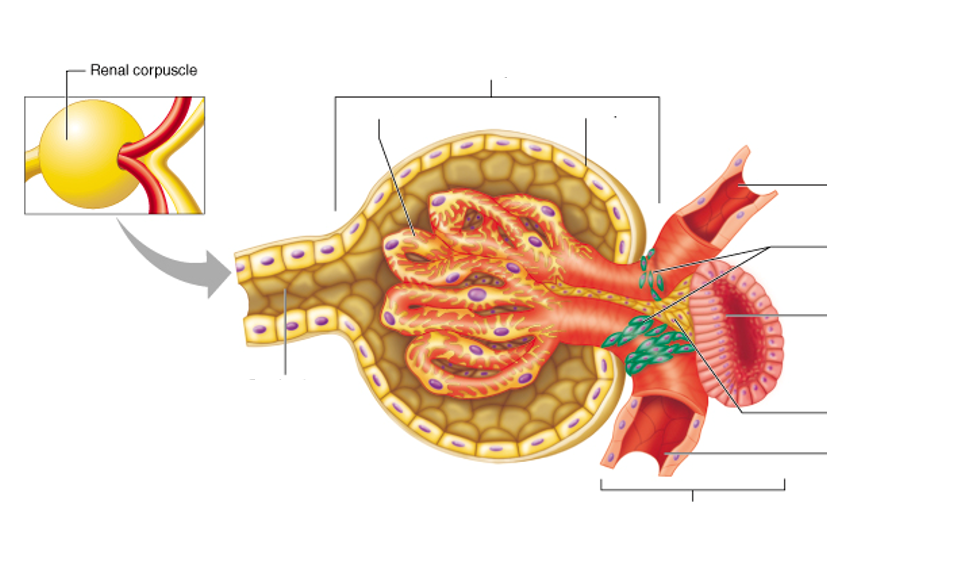
- AProximal convoluted tubule
- BGlomerulus
- CBowman's capsule
- DRenal corpuscle
- EEfferent arteriole
- FAfferent arteriole
- GJuxtaglomerular apparatus
- HMacula densa cell
- IMesangial cell
- JGranular juxtaglomerular cell
4Why do capillaries in the glomerulus have relatively high permeability?
- AHighly fenestrated endothelium - wide pores
- BWall is only single cell thick
- CVery narrow pores but in abundance
- DEndothelial cells are dense in transport proteins
5Label this image to show the cells surrounding a glomerular capillary.
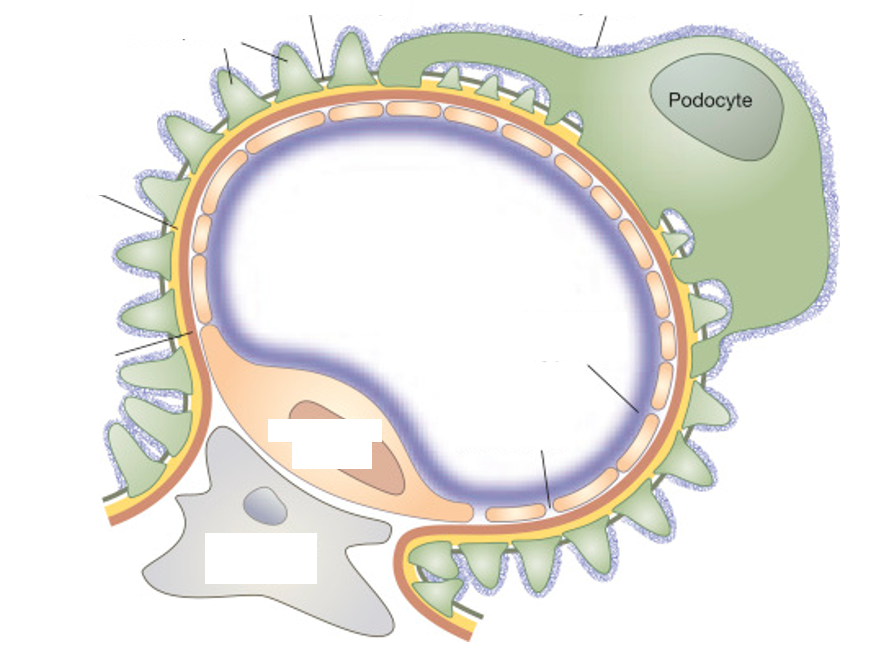
- AGlycocalyx
- BBasement membrane
- CEndothelial cell
- DMesangial cell
- EFenestrations
- FEndothelial glycocalyx
- GFoot processes
- HSlit diaphragm
- IGlycolax
6The basement membrane of the glomerulus has fixed anions throughout.
- AVerdadero
- BFalso
7The branching processes of the podocytes make contact with those neighbouring them.
- AVerdadero
- BFalso
8Which proteins listed here are responsible for the joining of podocyte foot processes to contibute towards filtration?
- ANephrin
- BPodocin
- CDystrophin
- DIntegrin
- ELaminin
- FFibronectin
9How does nephrin between the podocyte foot processes contribute towards filtration?
- AStrong negative charge repels protein to prevent it from entering the Bowman's space
- BStrong positive charge attracts sodium to ensure it enters the Bowman's space
- CForms a mesh-like membrane that prevents large molecules from crossing
- DIs protonated by hyrogen ions to prevent them from crossing into the Bowman's space
10Which cells of the juxtaglomerular apparatus have smooth muscle properties that change the surface area of the basement membrane?
- AMesangial cells
- BJuxtaglomerular cells
- CExtraglomerular mesangial cells
11What is the function of the granular juxtaglomerular cells?
- ASecrete renin into the blood of the afferent arteriole
- BSecrete renin into the distal convoluted tubule
- CHave smooth muscle properties to change the surface area of the basement membrane
- DDetect sodium concentration of the fluid in the ascending loop
12Which cells of the juxtaglomerular apparatus detect sodium concentration of the fluid in the ascending loop of Henle?
- AMacula densa
- BGranular cells
- CMesangial cells
13What do we describe the peritubular capillaries as in relation to the loop of Henle?
- AVasa recta
- BArterial arcades
- CAscending and descending arteries
- DCollateral arteries
14Glomerular filtration is passive.
- AVerdadero
- BFalso
15What is true of the relationship to glomerular filtration of molecular size?
- ASmaller size = more freely filtered
- BSmaller size = excluded
- CSmaller size = always reabsorbed
- DSmaller size = always secreted
16What is true of the relationship between glomerular filtration and molecular charge?
- AThe basement membrane has fixed anions so attracts cations which are more able to enter the filtrate
- BThe basement membrane has fixed cations so attracts anions which are more able to enter the filtrate
- CCharged molecules cannot enter the filtrate
- DAll charged molecules enter the filtrate at the same rate
17Glomerular filtration rate is the [blank_start]volume[blank_end] of fluid filtered from glomeruli per [blank_start]minute[blank_end]. It is measured in [blank_start]ml[blank_end]/[blank_start]min[blank_end]. GFR depends on [blank_start]Starling[blank_end] force, the [blank_start]surface area[blank_end] of the filtration interface and the [blank_start]permeability[blank_end] of the capillaries. It is regulated by both [blank_start]neural[blank_end] and hormonal input.
- Avolume
- Bminute
- Cml
- Dmin
- EStarling
- Fsurface area
- Gpermeability
- Hneural
18Fill in the blanks to describe the four Starling forces that contribute towards glomerular filtration rate.
The [blank_start]hydrostatic[blank_end] pressure of the capillaries is [blank_start]higher[blank_end] than the [blank_start]hydrostatic[blank_end] pressure of the Bowman's space. Thus, fluid is inclined to move [blank_start]out of[blank_end] the capillaries.
The [blank_start]colloid oncotic[blank_end] pressure in the capillary is [blank_start]higher[blank_end] in the capillaries than in the Bowman's capsule. Thus, fluid is inclined to move [blank_start]into[blank_end] the capillaries.
Despite this, the net glomerular filtration pressure is [blank_start]positive[blank_end], so fluid moves [blank_start]out of[blank_end] the capillaries.- Ahydrostatic
- Bhydrostatic
- Chigher
- Dout of
- Ecolloid oncotic
- Fhigher
- Ginto
- Hpositive
- Iout of
19If we constrict the afferent arteriole...
We [blank_start]reduce[blank_end] the hydrostatic pressure in the capillaries and [blank_start]decrease[blank_end] GFR.
If we dilate the afferent arteriole...
We [blank_start]increase[blank_end] the hydrostatic pressure in the capillaries and [blank_start]increase[blank_end] GFR.
If we constrict the efferent arteriole...
We [blank_start]increase[blank_end] the hydrostatic pressure in the capillaries and [blank_start]increase[blank_end] GFR.
If we dilate the efferent arteriole...
We [blank_start]reduce[blank_end] the hydrostatic pressure in the capillaries and [blank_start]decrease[blank_end] GFR.- Areduce
- Bdecrease
- Cincrease
- Dincrease
- Eincrease
- Fincrease
- Greduce
- Hdecrease
20Which nervous system innervates the glomerular mesangial cells covering the capillaries?
- ASympathetic
- BParasympathetic
- CEnteric
- DSomatic
21How do we increase glomerular filtration rate by changing the surface area of the filtration interface?
- ARelax the mesangial cells to increase surface area of the basement membrane
- BContract the mesangial cells to increase surface area of the basement membrane
- CRelax the macula densa to increase surface area of the basement membrane
- DIncrease the number of pores in the fenestrated epithelium of the capillaries
22Secretion is the movement of solutes from the peritubular capillaries into the tubules AND the movement of molecules from the wall of the tubule directly into its lumen.
- AVerdadero
- BFalso
23Fill in the blanks below to describe the secretion of organic acids (anions) into the tubule.
1. Organic anion enters tubule epithelial cell from blood in exchange for [blank_start]dicarboxylate[blank_end] via an [blank_start]ATP[blank_end] dependent organic anion transporter (OAT).
2. [blank_start]Dicarboxylate[blank_end] accumulates in cell by [blank_start]metabolism[blank_end] and the action of [blank_start]Na+[blank_end] coupled transport to drive this co-transport.
3. The organic anion enters the tubule lumen via [blank_start]ATP[blank_end]-dependent transporters.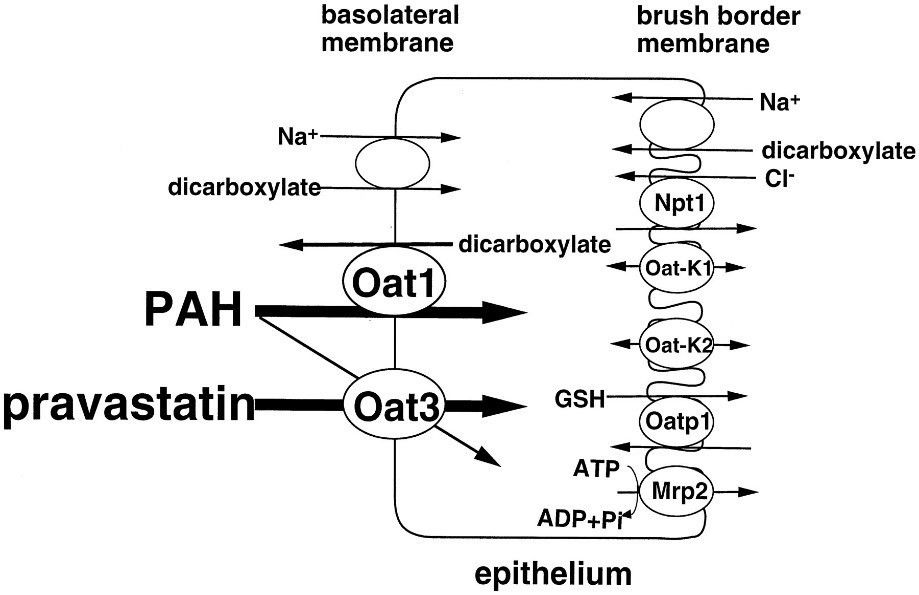
- Adicarboxylate
- BATP
- CDicarboxylate
- Dmetabolism
- ENa+
- FATP
24What molecule do organic acids (anions) enter the tubule epithelial cells with from the blood in secretion?
- ADicarboxylate
- BNa+
- CCl-
- DPAH
25What transporters do organic cations enter the tubule epithelial cells via?
- AFacilitated organic cation transporters (OCT)
- BATP-dependent organic cation transporters
- CNa+-dependent organic cation transporters
- DMultidrug/toxin extrusion antiporter proteins
26Which ions do organic bases enter the tubule lumen in exchange for during secretion?
- ANa+
- BH+
- CK+
- DCl-
27Which transporters do organic bases (cations) enter the tubule lumen via?
- AMultidrug/toxin extrusion antiporter proteins (MATEs)
- BNovel-type organic cation transporters (OCTNs)
- CNa+/K+ pumps
- DFacilitated organic cation transporters (OCTs)
28Reabsorption occurs in the [blank_start]proximal tubule[blank_end]. The epithelium here is [blank_start]simple columnar[blank_end] and has a [blank_start]brush-border[blank_end] to increase surface area. This epithelium is dense in [blank_start]mitochondria[blank_end] to supply primary and secondary active transporters. The tubule has [blank_start]Na+[blank_end] coupled cotransporters, a [blank_start]tubular maximum[blank_end] system whereby the membrane can be saturated and specific transporters for [blank_start]glucose[blank_end] and amino acids respectively.
- Aproximal tubule
- Bsimple columnar
- Cbrush-border
- Dmitochondria
- ENa+
- Ftubular maximum
- Gglucose
29How are glucose, amino acids, phosphates and sulphates reabsorbed?
- ANa+ coupled cotransporters
- BPassive reabsorption
- CK+ coupled cotransporters
- DATP-dependent transport proteins
30How are urea, chloride, potassium and calcium ions reabsorbed?
- APassive reabsorption
- BNa+ coupled cotransporters
- CATP-dependent transport proteins
- DK+ coupled cotransporters
31FIll in the blanks below to describe the reabsorption of glucose in the proximal tubule.
1. Glucose is taken up via [blank_start]sodium[blank_end]-dependent glucose co-transporters (SGLT) on the [blank_start]luminal[blank_end] membrane.
2. The [blank_start]GLUT[blank_end] facilitated transporters on the [blank_start]basal[blank_end] membrane allows [blank_start]facilitated[blank_end] diffusion into the capillaries upon binding of [blank_start]glucose[blank_end].
3. The Na+/K+ [blank_start]ATPase[blank_end] maintains a [blank_start]concentration gradient[blank_end] of sodium by moving sodium out of the cell into the [blank_start]capillary[blank_end].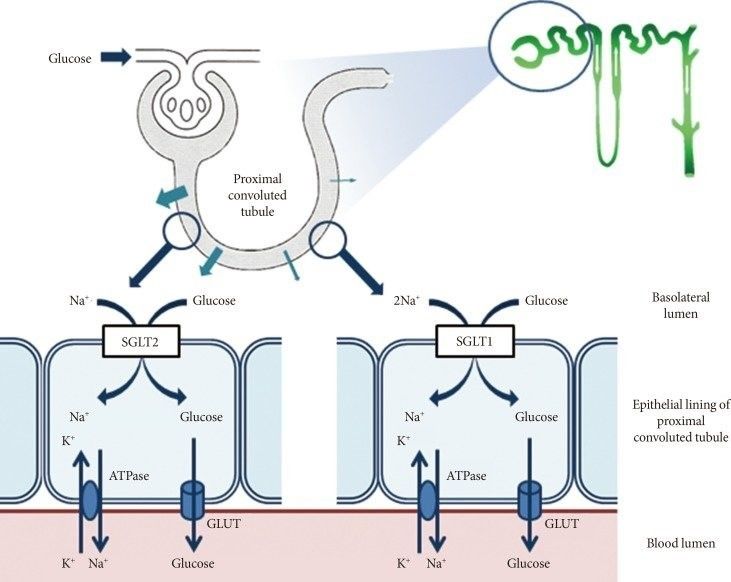
- Asodium
- Bluminal
- CGLUT
- Dbasal
- Efacilitated
- Fglucose
- GATPase
- Hconcentration gradient
- Icapillary
32Why is there a renal threshold of glucose reabsorption?
- AThe SGLT transporters become saturated at high concentrations of glucose
- BThe SGLT transporters close at high concentrations of glucose
- CHigh concentrations of glucose cause contraction of the mesangial cells to reduce the surface area of the glomerular capillaries
- DThe SGLT transporters don't open at low concentrations of glucose
33The transporters required for reabsorption of amino acids in the tubule are specific to their properties (uncharged, acidic, basic etc)
- AVerdadero
- BFalso
34How many sodium-dependent amino acid transporters are there?
- A6
- B8
- C2
- D20
Información
- Descripción
- Principles of Physiology and Pharmacology Test sobre The Kidney: Filtration, Reabsorption and Secretion, creado por Charlotte Jakes el 23/12/2019.
- Autor
- Charlotte Jakes
- Idioma
- English
- Visitas
- 375
- Etiquetas
- Valoración
- Aún sin valoraciones Valora este test