
Test
Astronomy: The Solar System Units- 19, 21-25, 34-39, and 51-52
Preguntas del test (51)
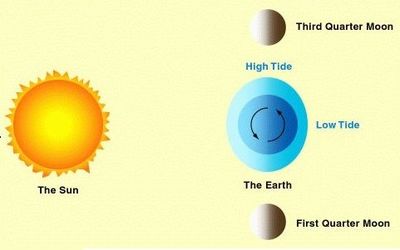
1In the picture, what type of tides is Earth experiencing?
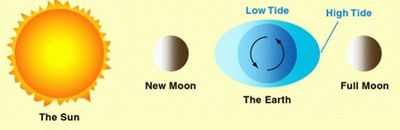
- ASpring tides
- BNeap tides
- CWeak tides
- DLeap tides
2Mercury has a radius of 2440km and a mass of 3.30x10^23kg. What is Mercury's density?
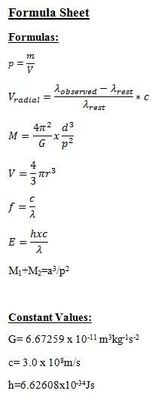
- A5.423x10^12kg/km^3
- B5.423x10^11kg/km^3
- C5,423kg/km^3
- D5.42kg/km^3
3The Earth has a density of 5.52kg/L and a volume of 1.082x10^24L. What is the mass of the Earth?
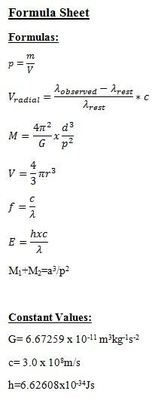
- A5.52x10^20kg
- B52,000kg
- C5.97x10^24kg
- D5.11x10^-24kg
4If the Moon is in its First and Third Quarter phases, what type of tides is being experienced on Earth?
- ALeap Tides
- BNeap Tides
- CSpring Tides
- DWeak Tides
5Compute the mass of Jupiter given observations of the Galilean moons: the moon Io takes 1.796 days to complete an orbit, and it orbits at an average distance of 423,000 km (units are in days/km/kg, so use G = 4.98x10^-10)
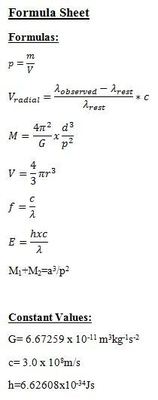
- A4.4x10^21kg
- B1.035x10^27kg
- C1.86x10^27kg
- D1.081x10^27kg
6A galaxy is moving away from the Earth at a velocity of +100000m/s. To what wavelength would the H alpha line have shifted to? (assume the rest wavelength of H alpha is 656.25nm).
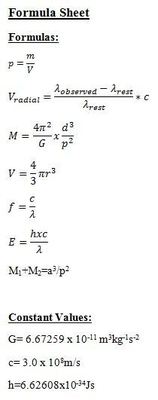
- A457nm
- B656.25nm
- C0.218nm
- D656.47nm
7There is a star with an observed wavelength of 645nm and a rest wavelength of 650nm. How fast is the star moving, and is it moving away or towards the Earth?
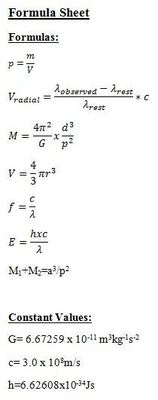
- A-2.3x10^6m/s and moving towards the Earth
- B2.3x10^6m/s and moving away from the Earth
- C2.5x10^4m/s and moving towards the Earth
- D-2.5x10^4m/s and moving away from the Earth
8There are two stars in a binary star system orbiting each other. Star Q is 10 solar masses and Star BB is 6 solar masses. They are 4 Au apart. How long does it take them to complete one orbit?
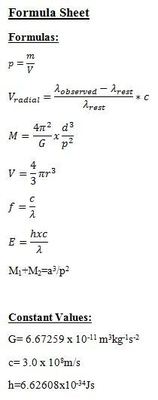
- A8yrs
- B2yrs
- C4yrs
- D1yr
9Our lab has recorded a previously undetected electromagnetic pulse from deep space. Our equipment indicates that the pulse has an energy of 4.96x10^-28J. What is the pulse's approximate wavelength and then indicate placement on the electromagnetic spectrum?
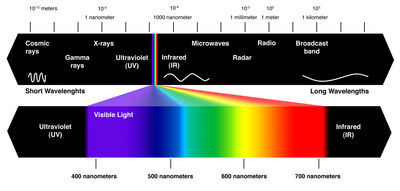
- A550nm and it would be Greenish-Blueish Visible Light
- B1nm and it would be X-rays
- C1000nm and it would be Infrared
- D400nm and it would be Violet Visible Light
10The Sun produces energy by:
- ANuclear Fusion between Hydrogen atoms in its core
- BNuclear Fission between Hydrogen atoms in its core
- CNuclear Fusion between Helium atoms in its core
- DNuclear Fission between Helium atoms in its core
11What are the layers of the Sun from the innermost to outermost layer?
- AConvection Zone, Core, Radiative Zone, Photosphere, Chromosphere, Corona
- BCore, Radiative Zone, Convection Zone, Photosphere, Chromosphere, Corona
- CRadiative Zone, Convection Zone, Core, Photosphere, Corona, Chromosphere
- DRadiative Zone, Core, Photosphere, Corona, Convection Zone, Chromosphere
12As the Sun progresses through its life cycle, it will have __________ amounts of Hydrogen and ___________ amounts of Helium.
- ALower, Lower
- BHigher, Lower
- CLower, Higher
- DHigher, Higher
13How long does it take for a photon to reach the surface of the Sun?
- A10 million years
- B10 thousand years
- C10 minutes
- D100 years
14What are Solar Prominences?
- ACool, dark spots on the Sun's surface
- BSolar winds or "belches" that spew photons towards the Earth
- CA huge plume of glowing gas channeled by magnetic fields
- DA winding up of the Sun's magnetic field
15True or False:
Coronal Mass Ejections can affected the Earth's communications, satellites, and even power grids.- AVerdadero
- BFalso
16In this diagram, the Earth is experiencing Spring Tides.
- AVerdadero
- BFalso
17Some lab equipment has recorded a burst of electromagnetic energy with a frequency of 10^6Hz. What is the wavelength of this electromagnetic energy, and where does it fit on the electromagnetic spectrum?
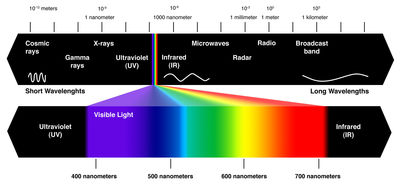
- A300nm and it is Blue Visible Light
- B300nm and it is Ultraviolet Light
- C1nm and it is X-rays
- D1m and it is a Radio Wave
18The Solar Cycle is the change in Sunspot and Flare activity from year to year following approximetly an 11 year cycle.
- AVerdadero
- BFalso
19Sunspots cause Solar Flares, which are brief but bright eruptions of hot gas in the chromosphere.
- AVerdadero
- BFalso
20Sunspots are:
- ALarge, dark regions on the surfaces of the sun.
- BCooler than the surrounding surface.
- Ccapable of making magnetic arcs that can channel solar prominences.
- DAll of the above
21The picture represents what type of spectrum, characterized by bright lines at certain wavelengths separated by darker regions in which little or no radiation is emitted?

- AAbsorption-line spectrum
- BElectromagnetic spectrum
- CContinuous spectrum
- DEmission-line spectrum
22This picture represents an absorption-line spectrum, which results when light with a continuous spectrum passes through a cool gas.

- AVerdadero
- BFalso
23The longer the wavelength of light, the higher level of energy it carries.
- AVerdadero
- BFalso
24A blackbody is a theoretical object that reflects all the radiation falling on it.
- AVerdadero
- BFalso
25Wien's law states that the hotter a body is, the more strongly it will radiate at short wavelengths.
- AVerdadero
- BFalso
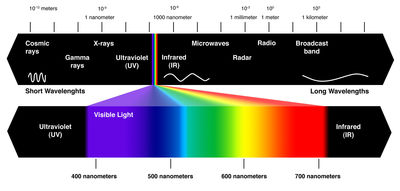
26A Red Giant Star is hotter than a Blue Giant Star.
- AVerdadero
- BFalso
27A continuous spectrum is spectrum in which the intensity changes smoothly with the wavelength, and all colors are present.
- AVerdadero
- BFalso
28According to Doppler Shift: Waves shorten as a source approaches the observer and lengthens as it recedes.
- AVerdadero
- BFalso
29The planets in order from closest to the Sun to furthest from the Sun follow which order?
- AMercury, Venus, Earth, Mars, Jupiter, Saturn, Uranus, Neptune
- BMars, Venus, Earth, Mercury, Jupiter, Uranus, Neptune, Saturn
- CEarth, Mercury, Venus, Jupiter, Mars, Neptune, Saturn, Uranus
- DJupiter, Saturn, Earth, Mars, Venus, Neptune, Uranus, Mercury
30The outer planets (Jupiter, Saturn, Neptune and Uranus) are also known as Terrestrial Planets.
- AVerdadero
- BFalso
31Venus is the largest of the terrestrial planets
- AVerdadero
- BFalso
32The orbits of the planets are roughly circular, although not quite.
- AVerdadero
- BFalso
33The asteroid belt in the solar system is located between which two planets?
- AEarth and Mars
- BMars and Jupiter
- CJupiter and Saturn
- DSaturn and Neptune
34The Kuiper Belt and the Oort Cloud are areas beyond Neptune where objects (asteroid, comets, dwarf planets..etc) exist, orbiting the Sun.
- AVerdadero
- BFalso
35Venus is odd among the planets because it:
- AHas an sideways axis
- BIs composed like a gas giant, but is between terrestrial planets
- COrbits the Sun opposite of the other planets
- DRotates slowly, and backwards in comparison to other planets
36Uranus' axis is nearly vertical, which is odd in comparison to the other planets, which axis' lie at distinct tilts.
- AVerdadero
- BFalso
37The Gas Giants have a much lower density in comparison to the Terrestrial Planets because:
- AOnly the Terrestrial Planets have large, solid iron cores
- BThe Gas Giants are made of solely lighter carbon gases
- CThe Gas Giants are very large with a large amount of mass
- DThe volume of the Gas Giants is very small
38The element Cooltonium has just been discovered. Scientist learn that it has a half-life of 20 years in which the parent atoms turn into another recently discovered element, Losertonium. A sample of Cooltonium has 10,000 atoms of Cooltonium and 0 atoms of Losertonium. How many atoms of Cooltonium will be left after 5 half-lives?
- A312.5 atoms
- B500 atoms
- C.003125 atoms
- D5,000 atoms
39We are able to get close to the age of the Solar System based off of meteorites found on Earth.
- AVerdadero
- BFalso
40Which is the correct order for the creation of the solar system (from earliest to latest)?
- AThe planets formed first by hot gases, the Sun then formed afterwards, the moons and other satellites were then captured by the Sun and Planets.
- BThe Sun formed first from hot gas, the Sun captured wandering planets, the planets captured wandering asteroids to make moons.
- CThe Sun formed first from hot gases, then the planets formed by condensation and accretion, and moons and satellites were later captured by the planets.
- DThe Sun formed, then the Sun spun off gas and dust which formed the planets, the planets spun off dust which solidified into moons
41Condensation occurs when a gas cools and its molecules stick together to form liquid or solid particles.
- AVerdadero
- BFalso
42The Earth is differentiated because its hot, molten state cooled very quickly.
- AVerdadero
- BFalso
43It is believed the Earth was bombarded by meteorites early in its formation.
- AVerdadero
- BFalso
44One way we detect exo-planets is through Doppler Shift.
- AVerdadero
- BFalso
45The Earth is made of layers. The order of these layers from innermost to outermost is:
- ASolid core, liquid core, upper mantle, lower mantle, crust
- BLiquid core, solid core, upper mantle, lower mantle, crust
- CSolid core, lower mantle, upper mantle, liquid core, crust
- DSolid core, liquid core, lower mantle, upper mantle, crust
46Convection taking place in the Earth's Mantle allows for Plate Tectonics which can significantly change the surface of the Earth.
- AVerdadero
- BFalso
47The bright, white areas on the moon are called:
- AMaria
- BHighlands
- CCraters
- DRilles
48The Moon's large, smooth, dark areas are called:
- AMaria
- BRilles
- CHighlands
- DCraters
49The Maria are much older than the Highlands, as indicated by the large amounts of craters.
- AVerdadero
- BFalso
50Due to synchronous rotation, the same side of the Moon is always facing the Earth.
- AVerdadero
- BFalso
51What is the Greenhouse Effect?
- AIt is an effect where plants grow significantly better in certain location on the Earth
- BIt is a phenomenon caused by gases that traps heat in the Earth's atmosphere, keeping it warm.
- CIt is a protective layer that reflects all dangerous solar rays from impacting the Earth
- DIt is another name for the Earth's atmosphere
Información
- Descripción
- This is made to prepare students of BGSU ASTR 2120: The Solar System. It was created using information from Pathways to Astronomy (Third Edition) by Stephen E. Schneider and Thomas T. Arny. It consists of 51 Multiple Choice and True and False Questions. A few mathematical based questions was taken from this website (http://physics.bgsu.edu/~layden/A212H/practice_probs_exam1.htm) and credit for them goes to Dr. Layden of BGSU. To view explanations and solutions view the link in the comments.
- Autor
- Rebekkah Gresh
- Idioma
- English
- Visitas
- 331
- Etiquetas
- Valoración
- Aún sin valoraciones Valora este test