
Test
pharma midterm
Crea una cuenta gratis para terminar este test
Guarda tu progreso y consulta tu resultado final.
¿Ya tienes cuenta? Inicia sesión
Preguntas del test (29)
1A 29-year-old woman with epilepsy takes carbamazepine to manage her focal seizures. Most of the carbamazepine in her blood is bound to plasma proteins, with only the free fraction active. The free fraction must cross several barriers to reach its action site. Which characteristic would enhance this diffusion across biological membranes?
- AHydrophilicity
- BLarge molecular size
- CWeak acid with a pKa of 7.4
- DWeak base with a pKa of 7.4
2A 17-year-old athlete takes 400 mg of naproxen after pratctice for muscle soreness. Naproxen has a half-life of approximately 4 hours. What percentage of the initial dose will remain in his bloodstream after 8 hours?
- A0%
- B12.5%
- C25%
- D50%
- E75%
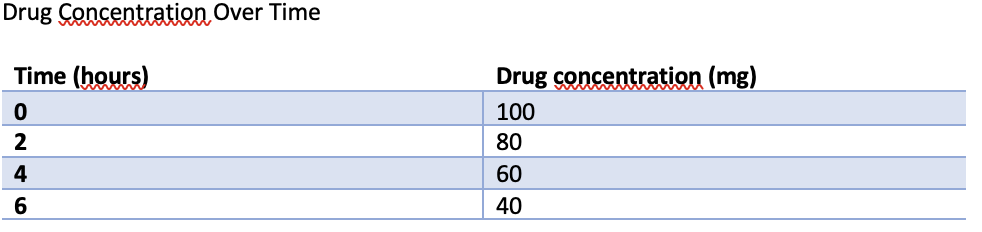
3Which statement is accurate for the drug shown in the example below?

- AThe rate of elimination is constant
- BThe elimination half-life varies with the dose
- CThe volume of distribution varies with the dose
- DThe clearance varies with the dose
- EThe rate of elimination varies directly with the dose
4Which statement is accurate for the drug shown in the example below
- AThe rate of elimination is constant
- BThe elimination half-life varies with the dose
- CThe volume of distribution varies with the dose
- DThe clearance varies with the dose
- EThe rate of elimination varies directly with the dose
5A 30-year-old man presents to his doctor with frequent urination and pelvic pain. Examination shows a swollen prostate, and he is prescribed trimethoprim-sulfamethoxale to be taken twice daily for 30 days. The antibiotic has a half-life of 10 hours. How long will it take to reach approximately 90% of its steady-state concentration?
- A10h
- B20h
- C30h
- D40h
- E50h
6A 32-year-old man with a known history of asthma arrives at the emergency department struggling to breathe. HIs oxygen saturation is at 85%, and he is given oxygen immediately. Which route of albuterol administration would provide the most rapid relief?
- AInhalation
- BIntranasal spray
- CSubcutaneous injection
- DSublingual
- ETopical application
7A newly developed medication, Drug Y, shows promise in treating inflammatory conditions. Its actions are mediated through the P-glycoprotein system. Which of the following is least likely to be influenced by this system?
- ADrug transport limitation to the brain
- BReduced absorption of drugs in the intestines
- CTransport of drugs into bile for excretion
- DTransfer of drugs into intestinal lumen
- ETransfer of drugs from fetal to maternal systems
8An experimental antibiotic, Drug Z, is eliminated by the kidneys and enters through the renal arteries before reaching the Bowman's space. Which of the following factors would have the least effect on its elimination rate?
- AGlomerular filtration rate of 60mL/min
- BGlomerular filtration rate of 110 mL/min
- CLipid solubility
- DReduction in plasma protein binding by 50%
- ERenal plasma flow of 210 mL/min
9A 13-year-old boy with Type 1 diabetes uses insulin before meals to control blood sugar. In his cells, glucose is phosphorylated, preventing it from leaving. Two enzymes, glucokinase and hexokinase, can phosphorylate glucose. Glucokinase, found mainly in the liver, has a lower affinity but a higher capacity than hexokinase, which is found in most other tissues. How would hexokinase's kinetic properties differ from those of glucokinase?
- AHigher Km and higher Vmax
- BHigher Km and lower Vmax
- CLower Km and higher Vmax
- DLower Km and lower Vmax
- ENo kinetic difference
10A novel blood pressure medication, Drug C, acts as a partial agonist at beta-adrenergic receptors, while norepinephrine is a full agoinst at the same receptors. Which statement accurately describes the potency comparison between Drug C and norepinephrine?
- ADrug C and norepinephrine are equally potent because they target the same receptor
- BDrug C is more potent because it's a partial agonist
- CNorepinephrine is more potent because it's a full agonist
- DNorepinephrine is more potent due to its endogenous origin
- ERelative potency cannot be determined from the information provided
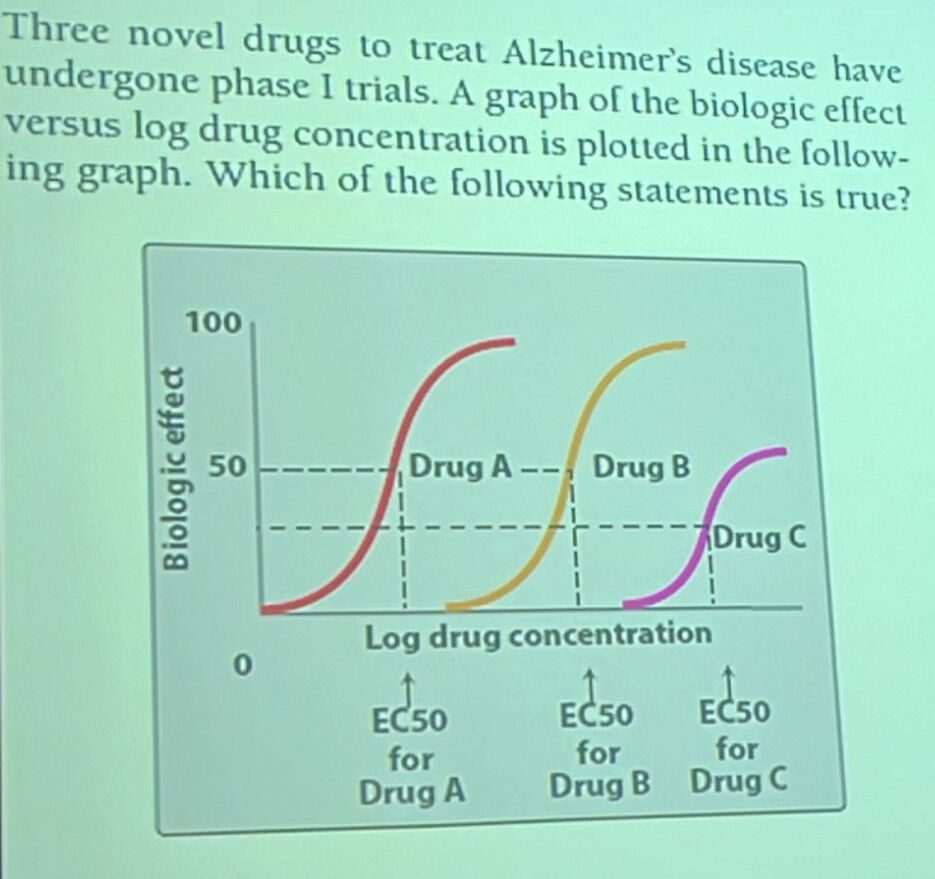
11Which of the following statements about the potency of the drugs is correct?
- ADrug A is the most potent drug among the three.
- BDrug C has the highest potency.
- CDrug B is less potent than Drug C.
- DAll three drugs have the same potency.
- EDrug C is more potent than Drug A but less potent than Drug B.
12Based on the EC50 values observed in the graph, which drug requires the highest concentration to reach 50% of its maximum effect?
- ADrug A
- BDrug B
- CDrug C
- DAll three drugs require the same concentration.
- EBoth Drugs B and C require higher concentrations than Drug A.
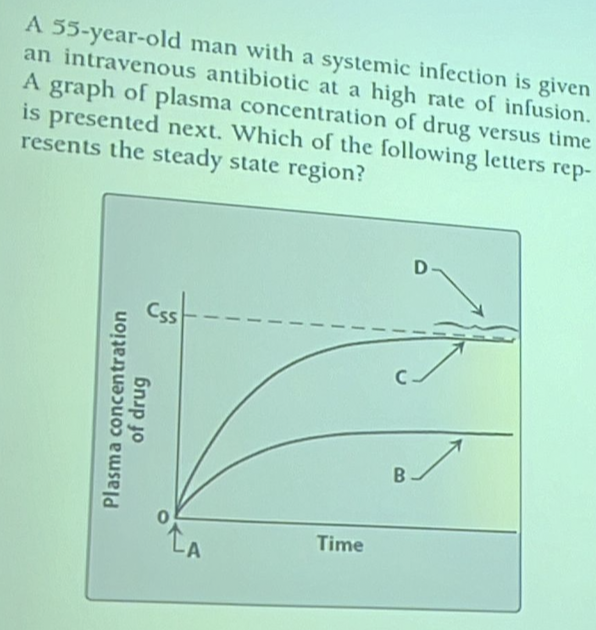
13In the graph above, which letter represents the initial phase of drug administration, where the plasma concentration of the drug starts to rise rapidly?
- ALetter A
- BLetter B
- CLetter C
- DLetter D
14Which of the following letters represents the phase where the drug concentration in the plasma reaches a plateau, indicating that the drug has reached steady-state concentration?
- ALetter A
- BLetter B
- CLetter C
- DLetter D
15At which point (letter) would you expect fluctuations in drug concentration due to dosing intervals, assuming the drug is given intermittently instead of as a continuous infusion?
- ALetter A
- BLetter B
- CLetter C
- DLetter D
16If the dosing rate is increased, which of the following changes would most likely occur in the graph?
- AThe curve will reach steady state (Css) faster but at the same concentration level
- BThe steady-state concentration (Css) will be reached at a higher level than shown in the current graph.
- CThe time to reach steady state will be shorter for all drug concentrations.
- DThe graph will shift to the left without any change in Css.
17Drugs that are administered IV are
- ARapidly absorbed
- BSubject to first-pass metabolism
- C100% bioavailable
- DRapidly excreted by the kidneys
- ERapidly metabolized by the liver
18A 27-year-old woman presents to her primary care physician with a positive pregnancy test. She is surprised by the result, as she has been taking combined oral contraceptives (COCs) consistently for the past two years without any missed doses. Recently, she was prescribed a course of amoxicillin for a sinus infection. She completed the antibiotic treatment a week ago. She denies any history of vomiting or diarrhea during this time, which might interfere with the absorption of her oral contraceptive pills.
- AThe antibiotics directly reduced the effectiveness of her oral contraceptive by accelerating its metabolism in the liver.
- BThe antibiotics disrupted her gut microbiota, reducing glucuronidase activity and leading to reduced enterohepatic recycling of the contraceptive hormone, thus decreasing its effectiveness.
- CThe antibiotics caused direct damage to the ovarian follicles, leading to hormonal imbalance and contraceptive failure.
- DThe patient likely missed doses of her oral contraceptive during her antibiotic treatment, leading to contraceptive failure.
19A woman is taking oral contraceptive (OCs). Which of the following drugs is unlikely to reduce the effectiveness of the PCs?
- ACarbamazepine
- BPhenytoin
- CKetoconazole
- DPhenobarbital
- ERifampin
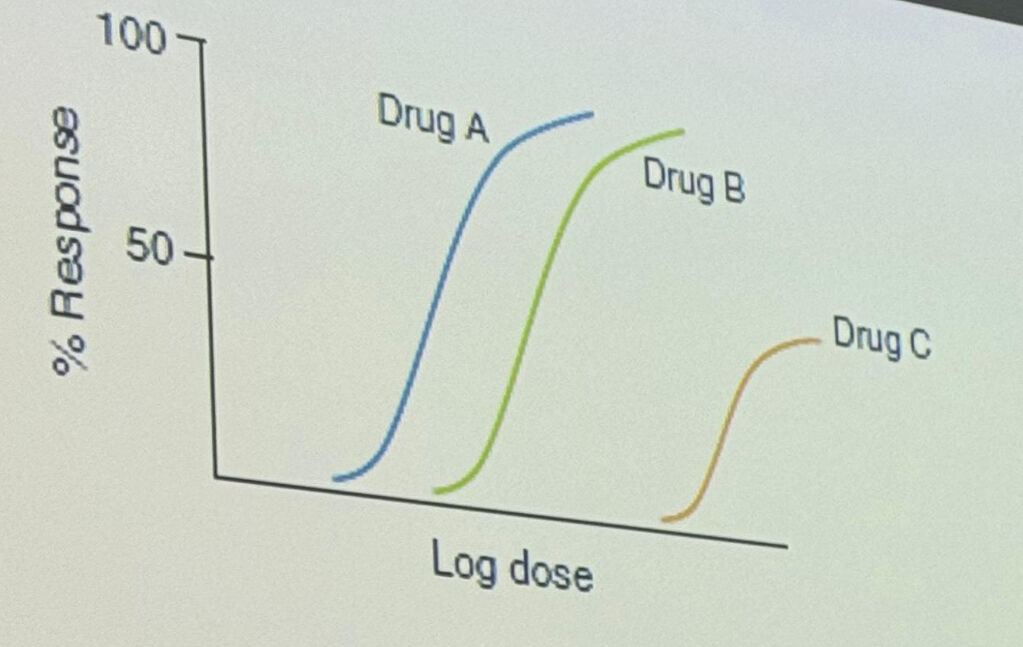
20The data presented in the figure below show that:
- ADrugs A and B have equal efficacy
- BDrug B and C have equal efficacy
- CDrug B is a partial agonist
- DDrugs A and C have the same affinity and efficacy
- EDrugs A and B have equal potency
21A 60-year-old woman with osteoarthritis has been successfully managing her pain with Dose A of a new analgesic, Drug X, which initially provided substantial pain relief. Over the past few months, however, she has noticed that her usual dose of Drug X no longer provides adequate relief, and her physician increases her dose to Dose B to achieve the same level of pain control. After a few more months, she requires an even higher dose, similar to Dose C, to maintain the desired effect.
The image below shows the dose-response curves of Drug X at different points in the patient's treatment, Based on the graph and the patient's experience, which of the following statements best explains the observed shift in the dose-response curve for Drug X?- AThe patient has developed tolerance to Drug X, requiring higher doses to achieve the same therapeutic effect.
- BDrug X's efficacy has decreased over time, necessitating an increase in the dose to achieve any therapeutic response.
- CDose C is a partial agonist, which explains the need for higher doses.
- DThe patient has become hypersensitive to Drug X, resulting in the need for increased doses.
22Normally, acetaminophen has a volume of distribution (Vd) of 70 L and a clearance (Cl) of 350 mL/min. If acetaminophen is administered to a patient with only 50% renal function, which pharmacokinetic parameter would differ from its normal value?
- AThe loading dose would be higher
- BThe maintenance dose would be lower
- CThe half-life would be shorter
- DThe volume of distribution would be 35 L
- EThe clearance would be 700 mL/min
23A patient is given a single intravenous (IV) bolus dose of a drug, and the plasma concentration is measured to be 5 mg/L at 6 hours post-administration. The drug has a volume of distribution of 10 L and an elimination half-life of 1 hours. What loading dose should have been administered to achieve the initial plasma concentration?
- A3000 mg
- B3050 mg
- C3100 mg
- D3150 mg
- E3200 mg
24An intravenous (IV) infusion of a drug is started at a rate of 400 mg/h. If the clearance of the drug is 50 L/h, what is the anticipated plasma concentration at steady state?
- A2 mg/L
- B4 mg/L
- C8 mg/L
- D16 mg/L
- E32 mg/L
25A new drug that interacts with beta receptors is being evaluated. Healthy volunteers are given varying dosages of either epinephrine or the new study drug. The data below shows the percentage of patients achieving a 10 beats/min increase in heart rate with each drug.
Based on the graph, which of the following best describes the action of the study drug on beta receptors?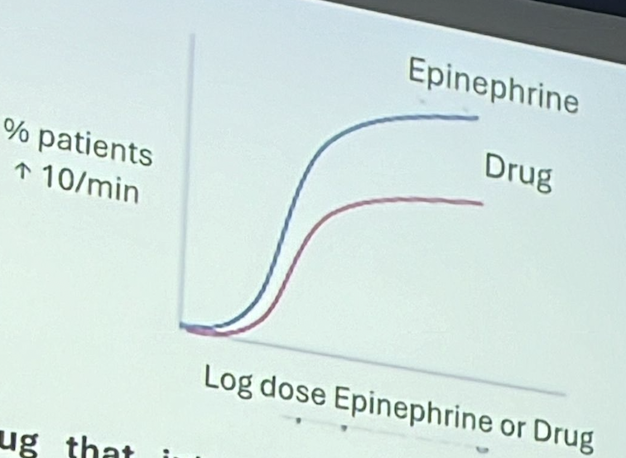
- ACompetitive antagonist
- BNon-competitive antagonist
- CFull agonist
- DPartial agonist
26Twenty-two patients with schizophrenia are administered haloperidol at various dosages, and their serum levels of haloperidol are measured. Patients with a 25% reduction in positive symptoms on a standard scale are considered responders to therapy, while patients who experience any extrapyramidal side effects are considered to have therapy toxicity. The graph below shows the percentage of patients responding to therapy and the percentage of patients experienceing toxicity as a function of the serum levels of haloperidol.
For clinical treating schizophrenia, which of the following ranges represents the therapeutic window of haloperidol (ng/mL)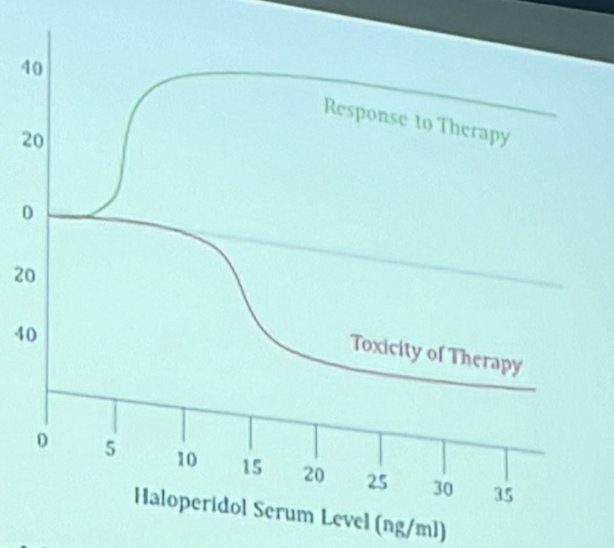
- A0 to 5 ng/mL
- B5 to 15 ng/mL
- C5 to 20 ng/mL
- D0 to 20 ng/mL
- E15 to 30 ng/mL
27A 17-year-old girl is brought to the emergency department after ingesting a toxic amount of salicylic acid (aspirin) in a suicide attempt. Her parents mention that she consumed an unknown number of aspirin tablets. As part of the treatment, sodium bicarbonate is administered to enhance the elimination of the toxin.
Which of the following changes in urinary pH, excretion of salicylic acid, and serum potassium would occur if sodium bicarbonate is administered to this patient?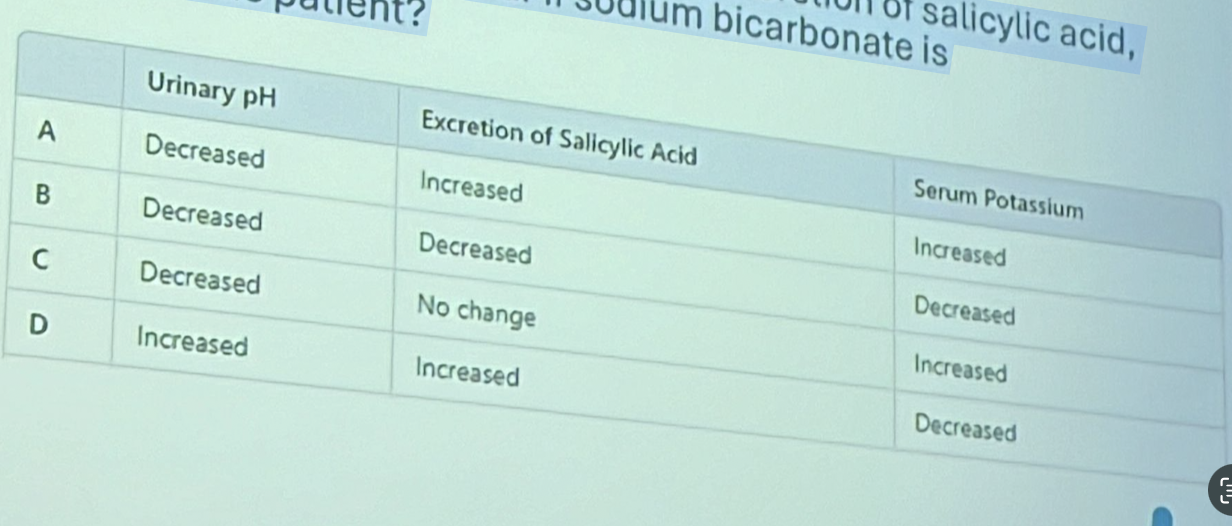
- AA
- BB
- CC
- DD
28A researcher is conducting a retrospective study on breast cancer recurrence. Records of a number of patients with hormone receptor-positive, early-stage breast cancer who received adjuvant therapy with tamoxifen were analyzed. Various clinical, demographic, and drug concentration data were reviewed. A comparison of patients who had disease recurrence with those who remained cancer-free showed that some of the relapsed patients had lower serum concentrations of endoxifen and 4-hydroxytamoxifen, the active metabolites of tamoxifen.
Which of the following is the most likely cause of the drug's ineffectiveness in this subset of patients?- AActivating mutation affecting a downstream signal transducer
- BDecreased hepatic N-acetyltransferase activity
- CDeficiency of thiopurine methyltransferase enzyme
- DOverexpression of P-glycoprotein in the tumor cells
- EPolymorphism of a cytochrome P450 enzyme
29A 57-year-old Caucasian male with severe pyelonephritis is admitted to the hospital. His past medical history includes diabetes, hypertension, and two episodes of transient ischemic attacks. His serum creatinine level is 3.2 mg/dL, so he needs to be started on an antibiotic that relies primarily on non-renal clearance.
Which of the following characteristics should the antibiotic also have if hepatic metabolism and clearance is preferred?- ALow volume of distribution
- BPoor oral absorption
- CHigh lipophilicity
- DLow rate of redistribution
- EPoor penetration into the CNS
Información
- Descripción
- Test sobre pharma midterm, creado por Lena Schleifer el 06/11/2024.
- Autor
- Lena Schleifer
- Idioma
- English
- Visitas
- 2
- Etiquetas
- Valoración
- Aún sin valoraciones Valora este test