
Test
P5 Quiz
Este test tiene tipos de pregunta que se abren en el reproductor de siempre.
Preguntas del test (23)
1Electric current is the flow of electric charge.
- AVerdadero
- BFalso
2When two objects are rubbed together and become charged, what moves between them?
- AProtons
- BNeutrons
- CElectrons
3
When two plastic rods are rubbed and brought together, they attract each other. This is because:- AOne is positively charged and the other is negatively charged
- BThey are both positively charged
- CThey are both negatively charged
4Jackie rubs a balloon against Sam's hair. The hair sticks to the balloon. When Jackie removes the balloon, Sams hair stands on end for a few minutes, then slowly falls back down again. Explain what happens to each object.
The balloon and the hair are [blank_start]insulators[blank_end]. When the balloon is [blank_start]rubbed[blank_end] against the hair, [blank_start]electrons[blank_end] are transferred from the balloon to the hair, meaning the balloon is [blank_start]positively[blank_end] charged and the hair is [blank_start]negatively[blank_end] charged. The hair sticks to the balloon as the objects are [blank_start]oppositely[blank_end] charged and opposite charges [blank_start]attract[blank_end]. As the strands of hair have the [blank_start]same[blank_end] charge they [blank_start]repel[blank_end], causing them to stand on end. The hair slowly begins to fall back down again as the strands of hair begin to be [blank_start]discharged[blank_end].- Ainsulators
- Brubbed
- Celectrons
- Dpositively
- Enegatively
- Foppositely
- Gattract
- Hrepel
- Idischarged
- Jsame
5Metals are good electrical conductors because they have free atoms. This means there are lots of charges free to move. Insulators have no charges free to move, which is why they do not conduct electricity.
- AVerdadero
- BFalso
6In an electrical [blank_start]circuit[blank_end], all the components have charges that are [blank_start]free[blank_end] to move. When a circuit is made, the cell ([blank_start]battery[blank_end]) causes these free charges to move. They move in a [blank_start]continuous[blank_end] loop around the circuit, transferring electrical energy into light and [blank_start]heat[blank_end] at the bulb. The electrons carry a [blank_start]negative[blank_end] charge, so will flow from the negative [blank_start]terminal[blank_end] of the cell towards the [blank_start]positive[blank_end] terminal.
The strength of an electric current is measured in [blank_start]amperes[blank_end], usually shortened to amps. Amps are a measure of how much electric charge is flowing round the circuit per [blank_start]second[blank_end].- Acircuit
- Bfree
- Cbattery
- Dcontinuous
- Eheat
- Fnegative
- Gterminal
- Hpositive
- Isecond
- Jamperes
7What is the unit for measuring electric current?
- AAmpere (A)
- BJoule (J)
- CVolt (V)
8Does an ammeter need to be connected in series or parallel to the component?
- ASeries
- BParallel
9What does this circuit symbol show?

- AAn Ammeter
- BA Voltmeter
- CA Variable Resistor
10The size of a [blank_start]current[blank_end] in a circuit depends on the [blank_start]voltage[blank_end] of the battery and the resistance of the [blank_start]components[blank_end] in the circuit.
Voltage can be thought of as the '[blank_start]push[blank_end]' it exerts on charges in the circuit. A [blank_start]bigger[blank_end] voltage means a bigger 'push', resulting in a [blank_start]larger[blank_end] current. The scientific term for voltage is potential [blank_start]difference[blank_end]. It refers to the difference in [blank_start]energy[blank_end] per unit charge.
An electric current flows when charged [blank_start]particles[blank_end] called electrons move through a [blank_start]conductor[blank_end]. The moving electrons can collide with the [blank_start]atoms[blank_end] of the conductor. This is called resistance and it makes it [blank_start]harder[blank_end] for current to flow. These collisions make the conductor [blank_start]hot[blank_end]. It is this that makes a lamp filament hot enough to [blank_start]glow[blank_end].- Acurrent
- Bvoltage
- Ccomponents
- Dpush
- Ebigger
- Flarger
- Gdifference
- Henergy
- Iparticles
- Jconductor
- Katoms
- Lharder
- Mhot
- Nglow
11Resistance is measured in ohms, Ω. The greater the number of ohms, the greater the resistance. The current flowing through a resistor at a constant temperature is directly proportional to the voltage across the resistor.
- AVerdadero
- BFalso
12A 6 V battery is joined to a lamp. The current is 2 A. What is the resistance of the lamp?
- A12 ohms
- B6 ohms
- C3 ohms
13When [blank_start]components[blank_end] are connected in [blank_start]series[blank_end], their total resistance is the sum of their individual resistances. For example, if a 2 Ω resistor, a 1 Ω resistor and a 3 Ω resistor are connected side by side, their total resistance is 2 + 1 + 3 = [blank_start]6[blank_end] Ω.
If you [blank_start]increase[blank_end] the number of lamps in a series circuit, the total [blank_start]resistance[blank_end] will increase and less current will flow. The resistance in a circuit can also be altered using [blank_start]variable[blank_end] resistors. For example, these components may be used in dimmer switches, or to control the volume of a CD player.- Acomponents
- Bseries
- C6
- Dincrease
- Eresistance
- Fvariable
14At low temperatures, the resistance of a thermistor is high and little current can flow through them
At high temperatures, the resistance of a thermistor is low and more current can flow through them- AVerdadero
- BFalso
15In the dark and at low light levels, the resistance of an LDR is low and more current can flow through it
In bright light, the resistance of an LDR is high and little current can flow through it- AVerdadero
- BFalso
16If there is a change in the resistance of one component then this will result in a change in the potential differences across all of the other components in the circuit.
- AVerdadero
- BFalso
17What is the reading on the ammeter labelled A1 in this circuit?
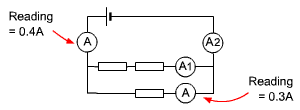
- A0.4 A
- B0.3 A
- C0.1 A
18A [blank_start]voltage[blank_end] is produced when a magnet is moving into a coil of wire. This process is called electromagnetic [blank_start]induction[blank_end]. The direction of the induced voltage is [blank_start]reversed[blank_end] when the magnet is moved out of the coil again. It can also be reversed if the other pole of the magnet is moved into the [blank_start]coil[blank_end]. If the coil is part of a [blank_start]complete[blank_end] circuit then a current will be induced in the circuit.
It is not practical to [blank_start]generate[blank_end] large amounts of electricity by passing a magnet in and out of a coil of wire. Instead, generators induce a current by [blank_start]spinning[blank_end] a coil of wire inside a magnetic field, or by spinning a [blank_start]magnet[blank_end] inside a coil of wire. As this happens, a [blank_start]potential[blank_end] difference is produced between the ends of the coil, which causes a [blank_start]current[blank_end] to flow. When a wire is moved in the magnetic field of a [blank_start]generator[blank_end], the movement, magnetic field and current are all at right angles to each other. If the wire is moved in the [blank_start]opposite[blank_end] direction, the induced current also moves in the opposite direction.
Remember that one side of a coil in a generator moves [blank_start]up[blank_end] during one half turn, and then down during the next half turn.
This means that as a coil is rotated in a magnetic field, the induced current [blank_start]reverses[blank_end] direction every [blank_start]half turn[blank_end]. This is called [blank_start]alternating[blank_end] current (AC).- Avoltage
- Binduction
- Creversed
- Dcoil
- Ecomplete
- Fgenerate
- Gspinning
- Hmagnet
- Ipotential
- Jcurrent
- Kgenerator
- Lopposite
- Mup
- Nreverses
- Ohalf turn
- Palternating
19Which of the following will increase the voltage induced across a circuit?
- AUsing a magnet with a stronger magnetic field
- BHaving an iron core inside the coil
- CHaving more turns of wire in the coil
- DRotating the coil or magnet faster
- ERotating the coil/magnet in the opposite direction
- FUsing a bigger magnet
20What is the voltage of mains electricity in the UK?
- A230V
- B240V
- C12V
- D120V
21Transformers do not work with DC supplies.
- AVerdadero
- BFalso
22Why do power stations use generators that produce [blank_start]AC[blank_end] current?
As it is [blank_start]necessary[blank_end] to use transformers to increase the voltage of electricity before it is transported using the [blank_start]national[blank_end] grid. The [blank_start]voltage[blank_end] in power lines is kept very high an the current very [blank_start]low[blank_end] to reduce the amount of [blank_start]wasted[blank_end] energy. If a high current was passing through the [blank_start]tine[blank_end] cables (which have high [blank_start]resistance[blank_end]) lots of energy would be transferred to [blank_start]thermal[blank_end] energy as there would be lots of collisions. By keeping the current low, we [blank_start]minimise[blank_end] heat loss and wasted energy.- Anecessary
- Bnational
- Clow
- Dwasted
- Ethin
- Fresistance
- Gthermal
- Hminimise
- Ivoltage
- JAC
23The ratio between the voltages in the coils is the same as the ratio of the number of turns in the coils.
Primary voltage / secondary voltage = turns on primary / turns on secondary- AVerdadero
- BFalso
Información
- Descripción
- GCSE (P5 - Electric Circuits) Physics Test sobre P5 Quiz, creado por Leah Firmstone el 27/11/2015.
- Autor
- Leah Firmstone
- Idioma
- English
- Visitas
- 44
- Historial
- Creado el 27 nov 2015 · actualizado el 20 sep 2016
- Etiquetas
- Valoración
- Aún sin valoraciones Valora este test