
Test
What do you know about Polyester and Condensation Polymerisation?
Este test tiene tipos de pregunta que se abren en el reproductor de siempre.
Preguntas del test (15)
1A polyester is a [blank_start]polymer[blank_end] (a chain of [blank_start]repeating[blank_end] units) where the individual units are held together by [blank_start]ester[blank_end] linkages.
- Apolymer
- Brepeating
- Cester
2Polyesters are polymers formed from a [blank_start]dicarboxylic acid[blank_end] and a [blank_start]diol[blank_end].
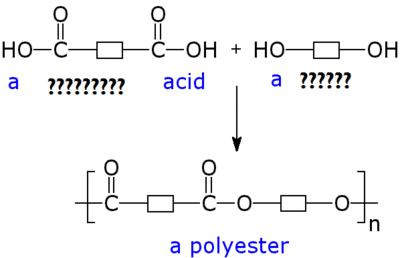
- Adicarboxylic acid
- Bdiol
3Polyesters are extremely important polymers. Their most familiar applications are in these things:
(Ticket all that are correct)
- AClothing
- BFood packaging
- CCarbonated soft drinks bottles
- DDiet pills
- ESnake charming flutes
- FPlastic water bottles
- GTattoos
4PET stands for polyethylene terephthalate (PET). It is the most common thermoplastic polymer resin of the polyester family and is used in fibers for clothing, containers for liquids and foods, thermoforming for manufacturing, and in combination with glass fiber for engineering resins.
- AVerdadero
- BFalso
5In Britain, PET may be referred to by its brand name: [blank_start]Terylene[blank_end]. PET consists of polymerized units of the monomer ethylene terephthalate, with repeating (C10H8O4) units.
- ATerylene
- BDoublecon
- CLavasan
6Can items made of PET be recycled?
- AVerdadero
- BFalso
7Why is polyester used for filling anoraks and bedding duvets?
- ATo give good heat insulation
- BTo provide bounciness
- CTo give a plastic feel
8In condensation [blank_start]polymerisation[blank_end], when the monomers join together a small [blank_start]molecule[blank_end] gets lost. That's different from [blank_start]addition[blank_end] polymerisation which produces polymers like poly(ethene) - in that case, nothing is lost when the monomers join together.
A polyester is made by a reaction involving an [blank_start]acid[blank_end] with two -COOH groups, and an [blank_start]alcohol[blank_end] with two -OH groups.- Apolymerisation
- Bmolecule
- Caddition
- Dacid
- Ealcohol
9Additional Polymers are formed when many identical monomers join together to form a...

- A... diamine.
- B... nylon.
- C... polymer.
- D... monomer structure.
10Polyesters are polymers in which the individual monomers are joined together by ester bonds.
They are made by reacting a carboxylic acid with two COOH groups, and an alcohol with two –[blank_start]OH[blank_end] groups, or molecules with both a hydroxyl and [blank_start]carboxylic acid[blank_end] group, e.g. 4-hydroxy-benzoic acid. The reaction process is called [blank_start]esterfication[blank_end].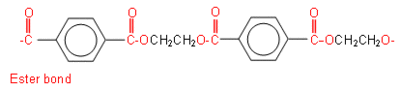
- AOH
- Bcarboxylic acid
- Cesterfication
11Benzene-1,4-dicarboxylic acid reacts with ethan-1,2-diol. These two compounds can link together to form a polymer, and so what molecule is lost (as a result of this ester linkage)?
- ACH
- BH2O
- CH
- DH2
12Nylon 66 is a type of [blank_start]polyamide[blank_end] or nylon. Nylons come in many types, and the two most common for textile and plastics industries are nylon 6 and nylon 66. It has the chemical formula (C12H22N2O2)n
- Apolyamide
13Condensation polymerisation: Label the image below.
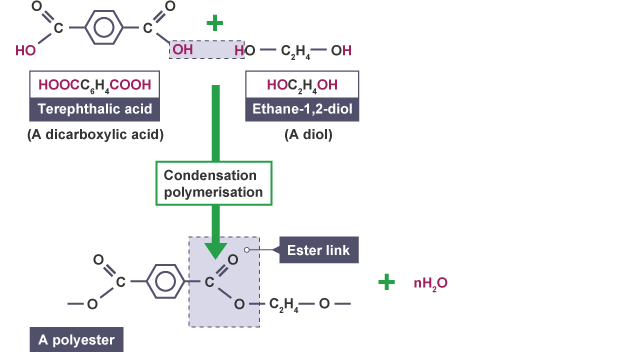
- AA diacid and a diol react
- BA polyester is formed
14Hydrolysis of polyesters:
Simple [blank_start]esters[blank_end] are easily hydrolysed by reaction with [blank_start]dilute[blank_end] acids or alkalis.
Polyesters are attacked readily by [blank_start]alkalis[blank_end], but much more slowly by dilute acids. [blank_start]Hydrolysis[blank_end] by water alone is so slow as to be completely unimportant. (You wouldn't expect your polyester fleece to fall to pieces if you went out in the rain!)
If you spill [blank_start]dilute[blank_end] alkali on a fabric made from polyester, the [blank_start]ester[blank_end] linkages are broken. [blank_start]Ethane[blank_end]-1,2-[blank_start]diol[blank_end] is formed together with the salt of the [blank_start]carboxylic acid[blank_end].
Because you produce small molecules rather than the original polymer, the [blank_start]fibres[blank_end] are destroyed, and you end up with a hole!- Aesters
- Bdilute
- Calkalis
- DHydrolysis
- Edilute
- Fester
- GEthane
- Hdiol
- Icarboxylic acid
- Jfibres
15Polyesters today are commonly used to produce trousers, skirts, sheets, boat sails and filling materials. Why are polyesters such a good choice for production of these particular things? (Tick all that are correct)
- Acan rip easily
- Binsoluble in water
- Clinking of several esters within the fibers
- Dstrong
- Edoesn't retain its shape
- Fheat-resistant
- Gtakes a long time to dry out
- Hreacts to most chemicals
- Ireacts violently to water
Información
- Descripción
- Test yourself on condensation polymerisation and polyesters in this quiz.
- Autor
- Alice Mercury
- Idioma
- English
- Visitas
- 420
- Etiquetas
- Valoración
- Aún sin valoraciones Valora este test