
Test
1.1 Structure of the Earth
Este test tiene tipos de pregunta que se abren en el reproductor de siempre.
Preguntas del test (22)
1Label the layers of the Earth.
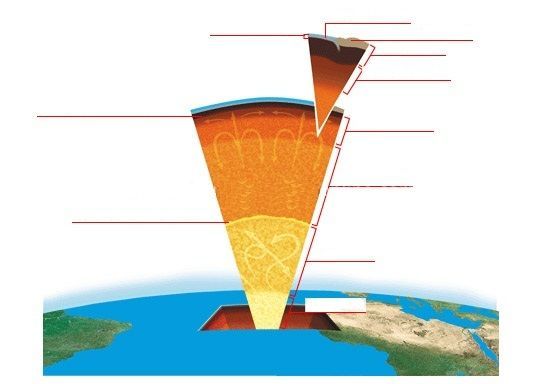
- ACrust
- BOceanic Plate
- CMoho
- DUpper mantle
- ELower mantle
- FInner core
- GOuter core
- HGutenberg
- IContinental plate
- JLithosphere
- KAsthenosphere
- LLehmann discontinuity
2What is the composition of the oceanic crust?
- ABasalt
- BDolerite
- CGranite
- DAndesite
- EGabbro
3What is the age of the oceanic crust?
- A160Ma
- B135Ma
- C180Ma
4A rheid is a [blank_start]solid material that flows[blank_end].
- Asolid material that flows
5The density of the continental crust is 2.7 g/cm3.
- AVerdadero
- BFalso
6The average thickness of the oceanic crust is [blank_start]7km[blank_end].
- A7km
7The average thickness of the continental crust is [blank_start]35km[blank_end].
- A35km
8Partial melting is where a proportion of the [blank_start]minerals[blank_end] in a rock have a lower [blank_start]melting point[blank_end] allowing them to melt whilst the rest remain solid.
- Aminerals
- Bcrystals
- Cgrains
- Dfreezing point
- Eboiling point
- Fmelting point
9What minerals are peridotite composed of?
- AAmphibole
- BPyroxene
- COlivine
- DQuartz
- EMuscovite
10Peridotite is an ultramafic igneous rock with a [blank_start]coarse[blank_end] crystal grain size.
- Afine
- Bmedium
- Ccoarse
11Properties of the [blank_start]lithosphere[blank_end]:
- It is made up of the crust and top part of the upper [blank_start]mantle[blank_end].
- High geothermal gradient
- It is [blank_start]solid[blank_end].
- It is made of igneous, metamorphic and sedimentary rocks.
- P and S waves gradually [blank_start]speed up[blank_end] with depth.
- Density 2.7 to [blank_start]3.3[blank_end] g/cm3.- Asolid
- Bmantle
- Cspeed up
- D3.3
- Elithosphere
12Properties of the asthenosphere:
- It is a [blank_start]rheid[blank_end]
- It is 5% partially molten
- low geothermal gradient
- below the [blank_start]lithosphere[blank_end]
- made of [blank_start]peridotite[blank_end]
- P and S waves slow down
- density [blank_start]>3.3[blank_end] g/cm3- Arheid
- Blithosphere
- Cperidotite
- D>3.3
13At what depth is the Lehmann Discontinuity?
- A5100km
- B2900km
- C700km
- D35km
14At what depth is Gutenberg discontinuity?
- A2900km
- Bav 35km
- C5100km
- D700km
15What depth is the lower mantle?
- A700km-2900km
- B2900km-5100km
- C35km-700km
- D5100km-6370km
16What is the depth of the inner core?
- A2900km-5100km
- B5100km-6370km
- C35km-700km
- D700km-2900km
17What is the depth of the upper mantle?
- A35km-700km
- B2900km-5100km
- C5100km-6370km
- D700km-2900km
18Direct evidence for the composition of the crust:
B[blank_start]oreholes[blank_end]
- [blank_start]Cores[blank_end] of igneous and metamorphic rock are brought to the surface from depths of about [blank_start]11[blank_end] km (geological)
M[blank_start]ining[blank_end]
_ Rocks can be observed at depth in [blank_start]mines[blank_end]. The deepest mine is about 4 km.
V[blank_start]olcanic eruptions[blank_end]
- Crustal rocks brought up in [blank_start]eruptions[blank_end] such as fragments from volcanic vent or magma chamber
O[blank_start]phiolites[blank_end]
- Oceanic crust is [blank_start]obducted[blank_end] and exposed by erosion allowing rocks such as [blank_start]basalt[blank_end], dolerite or gabbro to be seen- Aoreholes
- Bining
- Colcanic eruptions
- Dphiolites
- E11
- Fbasalt
- Gobducted
- HCores
- Imines
- Jeruptions
19Direct evidence for the composition of the mantle:
Mantle xenoliths
- Peridotite is brought to the [blank_start]surface[blank_end] in volcanic eruptions.
Ophiolites
- Peridotite is sometimes found at the [blank_start]base[blank_end] of ophiolites.
[blank_start]Kimberlite[blank_end] pipes
- Bring up [blank_start]xenoliths[blank_end] of [blank_start]peridotite[blank_end] from the mantle from up to 250 km depth.- Aperidotite
- Bxenoliths
- Csurface
- Dbase
- EKimberlite
20How are seismic waves used as indirect evidence for the state of the layers of the Earth?
Asthenosphere:
- [blank_start]Decrease[blank_end] in velocities of P and S waves due to reduction in [blank_start]rigidity[blank_end] caused by 5% partial melting.
Lower Mantle:
- Increase in velocity of P and S waves as pressure increases and rocks become more [blank_start]incompressible[blank_end].
Outer core:
- P waves suddenly [blank_start]slow[blank_end] as they enter [blank_start]liquid[blank_end] outer core as rigidity is [blank_start]low[blank_end].
- S waves stop completely as they cannot be transmitted in a [blank_start]liquid[blank_end].
Inner Core:
- P waves speed up at Lehmann Discontinuity as they enter [blank_start]solid[blank_end] inner core.
- S waves are [blank_start]regenerated[blank_end] by P waves.- ADecrease
- Brigidity
- Cincompressible
- Dliquid
- Elow
- Fliquid
- Gsolid
- Hregenerated
- Islow
21Indirect evidence for the composition of the Earth:
[blank_start]Core[blank_end]
- [blank_start]Iron[blank_end] meteorites
- Earth has a magnetic field
- Earth has a high average density of [blank_start]5.5[blank_end]gm/cm3 and the density of the oceanic crust is 2.9g/cm3 and the continental crust is 2.7g/cm3 so therefore the density of the core must be high.
Mantle
- [blank_start]Stony[blank_end] meteorites which are [blank_start]less[blank_end] dense like the mantle.- ACore
- BIron
- C5.5
- DStony
- Eless
22Complete the table to show each layer of the Earth with its approximate composition.
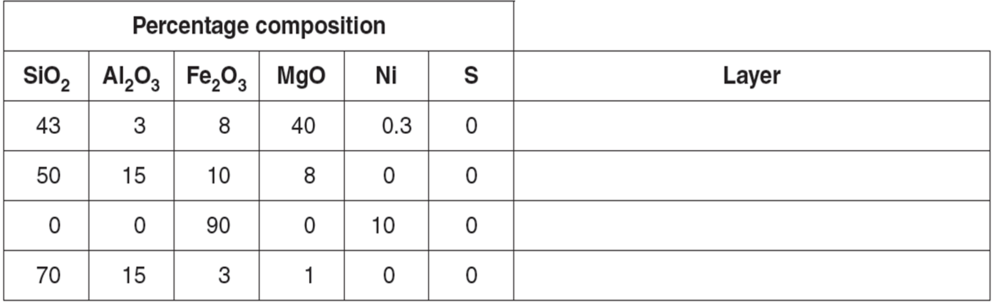
- Aoceanic crust
- Bcontinental crust
- Ccore
- Dmantle
- Ecore
- Foceanic crust
- Gmantle
- Hcontinental crust
- Imantle
- Jcore
- Koceanic crust
- Lcontinental crust
- Mmantle
- Noceanic crust
- Ocontinental crust
- Pcore
Información
- Descripción
- pgs. 6-11
- Autor
- Izzy Backhouse
- Idioma
- English
- Visitas
- 76
- Etiquetas
- Valoración
- Aún sin valoraciones Valora este test