
Test
Weathering and Sediment Transport
Este test tiene tipos de pregunta que se abren en el reproductor de siempre.
Preguntas del test (23)
1Complete the table of definitions.
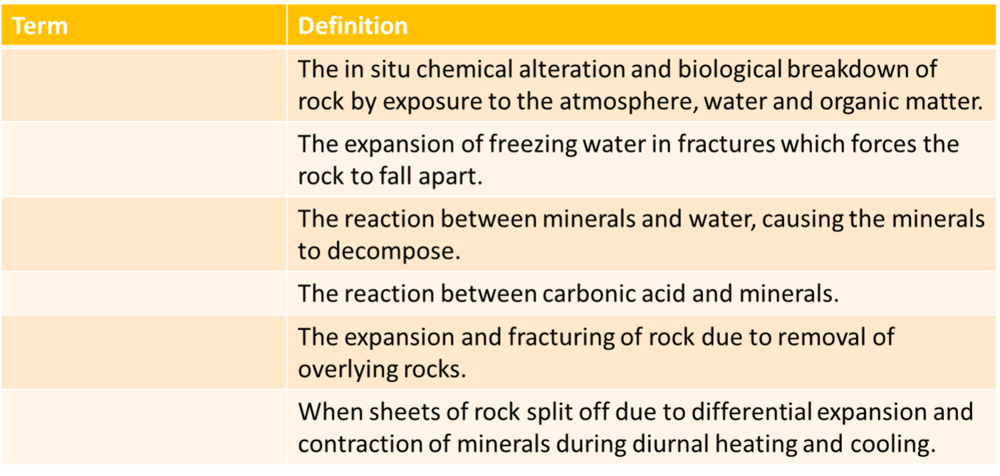
- AWeathering
- BCarbonation
- CHydrolysis
- DFrost Shattering
- EPressure Release
- FExfoliation
2[blank_start]Burrowing[blank_end] = The action of holes being dug by invertebrate and [blank_start]vertebrate[blank_end] animals that mixes and [blank_start]brings[blank_end] to the surface rock and [blank_start]soil[blank_end] particles. This [blank_start]facilitates[blank_end] weathering at greater depth by providing access for [blank_start]atmospheric[blank_end] gases and [blank_start]water[blank_end].
- ABurrowing
- Bvertebrate
- Cbrings
- Dsoil
- Efacilitates
- Fatmospheric
- Gwater
3[blank_start]Root action[blank_end] = The [blank_start]mechanical[blank_end] and chemical weathering of rocks by the wedging action of [blank_start]roots[blank_end].
- ARoot action
- Bmechanical
- Croots
4Complete the table on climate and weathering below.
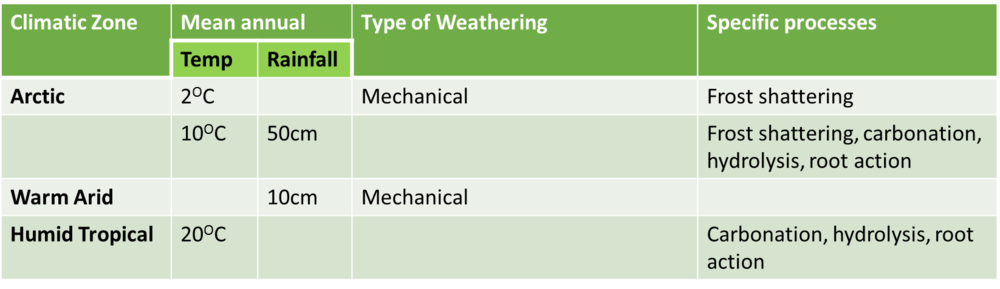
- ATemperate
- B20oC
- C200cm
- DBiological, Chemical & Mechanical
- EExfoliation
- FChemical & some biological
- G10cm
5Complete the table on weathering and climate below.
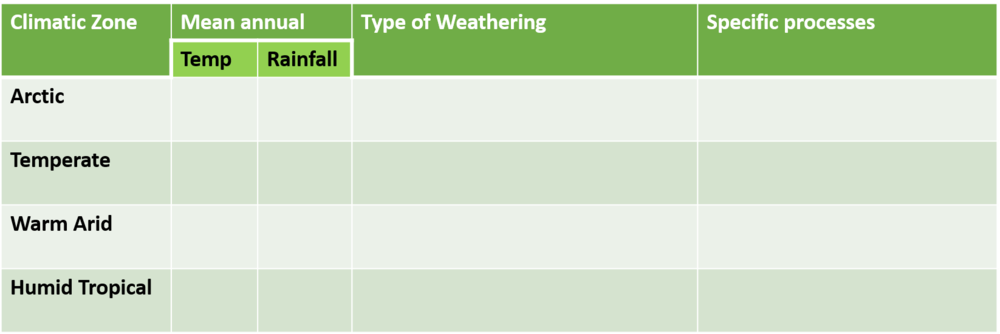
- A2oC
- B-2oC
- C200cm
- D300cm
- E150cm
- FMechanical
- GBiological
- HChemical
- IFrost Shattering
- J10 oC
- K50cm
- LBio, Chem & Mechanical
- MFrost-S, carbonation, hydrolysis, Root-A
- N20oC
- O10cm
- P10 cm
- Q25cm
- R20 oC
- SMechanical_
- TExfoliation
- UChemical & some Biological
- VCarbonation, hydrolysis, root action
6Frost shattering:
Water enters [blank_start]cracks[blank_end], joints and bedding planes.
In climates where daily [blank_start]temperature[blank_end] fluctuate above and below [blank_start]0oC[blank_end], water freezes and expands by [blank_start]9%[blank_end].
This exerts [blank_start]pressure[blank_end] on rocks, producing a residue of angular fragments called [blank_start]scree[blank_end].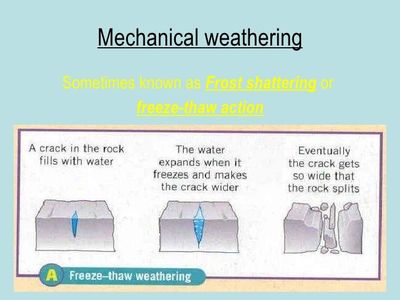
- Ascree
- Bshards
- Cbreccia
- D9%
- E7%
- F12%
- Gcracks
- Hburrows
- Istructures
- J0oC
- K5oC
- L-2oC
- Mpressure
- Nforce
- Otension
- Ptemperatures
- Qpressures
- Rwindspeeds
7[blank_start]Exfoliation[blank_end]:
- Aka. onion-skin weathering.
- Different [blank_start]minerals[blank_end] expand and contract by different [blank_start]amounts[blank_end] during heating and cooling, causing the rock to [blank_start]disintegrate[blank_end].
- [blank_start]Curved[blank_end] sheets [blank_start]peel[blank_end] off from the rock.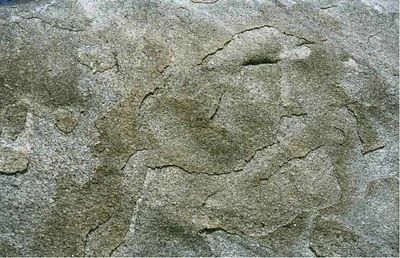
- AExfoliation
- Bminerals
- Camounts
- Ddisintegrate
- ECurved
- Fpeel
8Pressure Release:
Atmospheric [blank_start]pressure[blank_end] at the Earth's surface is much lower than pressures within the Earth.
Pressure is released from rock due to [blank_start]erosion[blank_end] of the rocks above them.
Rocks expand, producing [blank_start]fractures[blank_end] which are more widely [blank_start]spaced[blank_end] the [blank_start]further[blank_end] they are from the surface.
Rocks that are well [blank_start]jointed[blank_end] or have many bedding planes are [blank_start]less[blank_end] affected.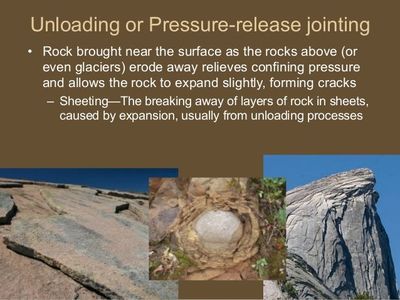
- Apressure
- Berosion
- Cfractures
- Dspaced
- Efurther
- Fjointed
- Gless
9Carbonation:
[blank_start]Carbon dioxide[blank_end] gas in the atmosphere reacts with rainwater and [blank_start]pore[blank_end] water in the soil to form [blank_start]carbonic[blank_end] acid.
The air in pore spaces is rich in carbon dioxide due to decomposing [blank_start]plant[blank_end] litter.
This makes groundwater more acidic than rainwater which then reacts with [blank_start]carbonate[blank_end] minerals in the rock.- ACarbon dioxide
- Bpore
- Ccarbonic
- Dhydrochloric
- Eplant
- Fanimal
- Gcarbonate
10Carbonation Equation:
[blank_start]CaCO3[blank_end] + H2CO3 --> [blank_start]Ca2+[blank_end] + 2HCO3-
Calcite + [blank_start]Carbonic acid[blank_end] --> Calcium + [blank_start]Hydrogen carbonate[blank_end] ions in solution.- ACaCO3
- BCa2+
- CCarbonic acid
- DHydrogen carbonate
11Carbonation is important in the weathering of [blank_start]limestone[blank_end].
[blank_start]Limestone[blank_end] generally contains insoluble [blank_start]impurities[blank_end] which are left behind as clay [blank_start]residues[blank_end].- Alimestone
- BLimestone
- Cimpurities
- Dresidues
12Name the three methods of sediment transport in water:
S[blank_start]uspension[blank_end]
S[blank_start]altation[blank_end]
T[blank_start]raction[blank_end]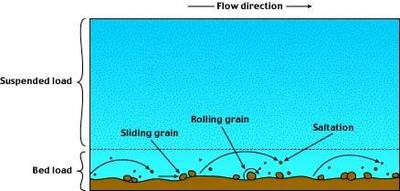
- Auspension
- Baltation
- Craction
13How does ice transport sediment?
- AIt pushes it.
- BThe sediment is embedded within it.
14Select the 2 correct facts about traction.
- AIt is the transport of material by rolling and sliding along a surface.
- BIt is the transport of material by bouncing.
- CIt occurs in the suspended load.
- DIt is the transport of material in water or air without it touching the Earth's surface.
- EIt occurs in the bed load.
15Which medium of transport moves loose weathered material down slopes?
- AWind
- BGravity
- CRivers
- DSea
- EIce
16Which medium of transport can carry large amounts of rock debris?
- AGravity
- BIce
- CWind
- DRivers
- ESea
17Which medium of transport lifts and transports finer grained sediment?
- AWind
- BSea
- CGravity
- DRivers
- EIce
18[blank_start]Attrition[blank_end] = the wearing down of sedimentary grains due to [blank_start]collisions[blank_end] with other grains during transport.
[blank_start]Abrasion[blank_end] = the wearing away of the Earth's surface by the action of the wind, water or ice [blank_start]dragging[blank_end] sediment over it or hurling it at the surface.- AAttrition
- BAbrasion
- CErosion
- DTraction
- Ecollisions
- Fdragging
19Erosion = the wearing away of the land surface and the removal of sediment by means of transport.
- AVerdadero
- BFalso
20Saltation = the transport of the smaller grains in the [blank_start]bed load[blank_end] by [blank_start]bouncing[blank_end] the along the [blank_start]bed[blank_end].
Suspension = the transport of material in the [blank_start]suspended[blank_end] load of a water based transport medium, [blank_start]without[blank_end] it touching the Earth's surface.- Asuspended
- Bbed load
- Cbed
- Dbouncing
- Ewithout
21Solution = the transport of [blank_start]ions[blank_end] dissolved in [blank_start]water[blank_end].
- Particularly K, [blank_start]Ca[blank_end], Na
- this method of transportation is [blank_start]invisible[blank_end] so can not be shown on a diagram- Aions
- Bwater
- CCa
- Dinvisible
22Clay particles require high velocities for erosion because they are [blank_start]flat[blank_end], [blank_start]platy[blank_end] and [blank_start]cohesive[blank_end] so tend to stick together.
Clay particles remain in [blank_start]suspension[blank_end] even at low current velocities because they are [blank_start]small[blank_end], have a [blank_start]low[blank_end] mass and are [blank_start]buoyant[blank_end].- Aflat
- Bround
- Cplaty
- Dsheety
- Ebuldgey
- Fcohesive
- Grepellent
- Hsuspension
- Isaltation
- Jtraction
- Ksolution
- Lsmall
- Mmedium
- Nbig
- Olow
- Phigh
- Qbuoyant
- Rgaseous
23Grains get rounder the longer they have been transported.
- AVerdadero
- BFalso
Información
- Descripción
- Quiz on content from pgs. 104-109 in OCR AS Geology textbook.
- Autor
- Izzy Backhouse
- Idioma
- English
- Visitas
- 51
- Etiquetas
- Valoración
- Aún sin valoraciones Valora este test