
Test
1.3 Continental Drift
Este test tiene tipos de pregunta que se abren en el reproductor de siempre.
Preguntas del test (15)
1Why are earthquakes rare in ocean basins away from MORs?
- AOcean basins are found in the middle of the plate where there is no tectonic activity.
- BEarthquakes only occur at MOR's.
- CIt is aseismic.
2Why is there a positive heat flow over the axial rift of an MOR?
- ADue to rising magma and volcanic activity.
- BDue to the density of the rocks.
3How have satellites provided evidence for sea floor spreading?
- AThey can measure the changing distance between two points over time.
- BThey can predict movement of plates.
4[blank_start]Transform[blank_end] faults displace mid-ocean ridges.
They form [blank_start]perpendicular[blank_end] to the axial rift.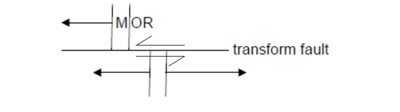
- ATransform
- Bperpendicular
5Seismic [blank_start]tomography[blank_end] has been used to provide evidence for mantle plumes and hot spots by taking [blank_start]3D[blank_end] images of heat flow to show areas of [blank_start]high[blank_end] heat flow compared to cooler ones.
- Atomography
- B3D
- Chigh
6Label the image to show the formation of island chains and seamounts over a hotspot.
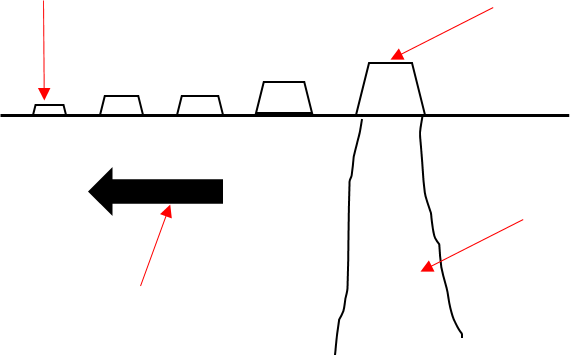
- Aoldest seamount
- Byoungest island
- Cmantle plume
- Ddirection of plate movement
7How does a chain of islands and seamounts develop over a hotspot?
Rising magma creates an [blank_start]island[blank_end].
The plate moves over the [blank_start]hotspot[blank_end].
The mantle plume is [blank_start]stationary[blank_end].
Older islands [blank_start]sink[blank_end] and are eroded.- Aisland
- Bhotspot
- Cstationary
- Dsink
8What is a mantle plume?
- AA stationary area of high heat flow in the mantle which rises from great depths and produces magma that feeds hot spot volcanoes.
- BA body of lower density buoyant material rising upwards.
- CThe surface expression of a mantle plume.
9Using the fit of Africa and S. America describe the evidence for the movements of continents over time.
Fit of the [blank_start]continents[blank_end]
- Fit along edge of continental [blank_start]shelf[blank_end].
- Few [blank_start]overlaps[blank_end] due to younger rock deposited.
- Few gaps due to [blank_start]erosion[blank_end].
Rock types
- Matching [blank_start]rock[blank_end] sequences across the join of the continents
- Same age of rocks across the [blank_start]join[blank_end]
eg. Precambrian - cratons
eg. Carboniferous - [blank_start]glacial deposits[blank_end]
Mountain chains
- Same trend of mountain [blank_start]belts[blank_end] across the join of the continents
- structures such as folds / faults match up
- same rock types in the mountain belt across the join
- same [blank_start]age[blank_end] of mountains across the join
Fossils
- outcrops of fossils match up / same fossils on different continents
- fossils that could not have crossed an ocean the same on both continents
eg reptile - [blank_start]Mesosaurus[blank_end]
eg plants - [blank_start]Glossopteris[blank_end]
Glaciations
- direction of [blank_start]striations[blank_end] shows movement of ice and the striations match up
- glacial [blank_start]erratics[blank_end] can be found on both continents
- glacial rocks match up across the join
- Carboniferous ice [blank_start]sheet[blank_end] can be seen across Africa and South America- Acontinents
- Bshelf
- Coverlaps
- Derosion
- Erock
- Fjoin
- Gglacial deposits
- Hbelts
- Iage
- JMesosaurus
- KGlossopteris
- Lstriations
- Merratics
- Nsheet
10Fossils found in Africa and S. America used as evidence for continental drift:
Reptile = [blank_start]Mesosaurus[blank_end]
Plant = [blank_start]Glossopteris[blank_end]- AMesosaurus
- BGlossopteris
11Label the diagram of an MOR.
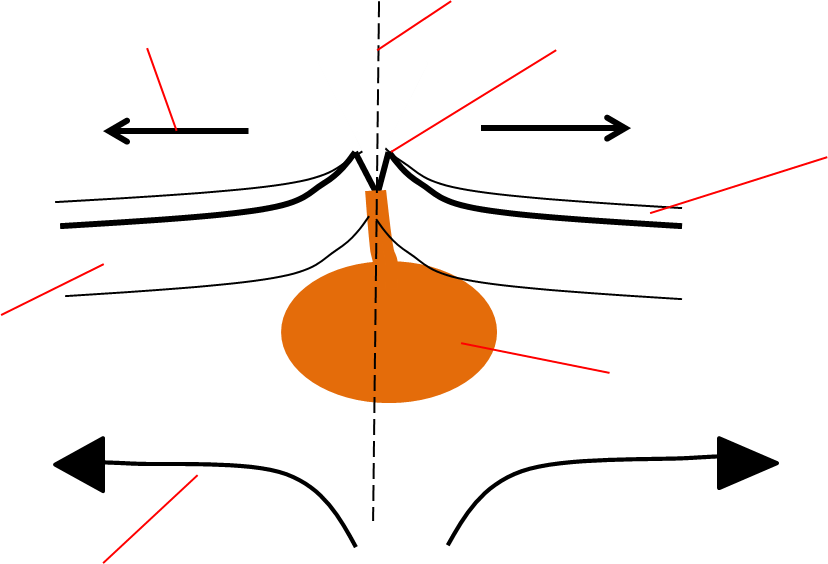
- Aaxial rift
- Bmagma chamber
- Cconvection currents
- Dbasalt pillow lavas
- Ethin layer of sediment
- Fmid-ocean ridge
- Gdirection of plate movement
12Label the diagram of the oceanic-continental convergent plate margin.
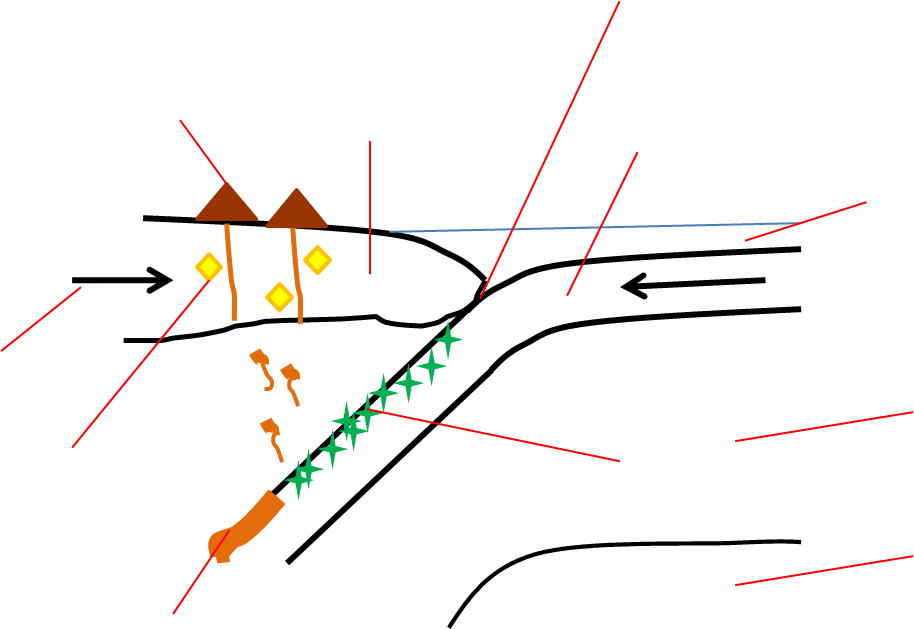
- Apartial melting of subducting plate
- Bbatholith
- Cvolcano
- Ddirection of plate movement
- Econtinental crust
- Ftrench
- Goceanic crust
- HBenioff zone
- IAsthenosphere
- JLithosphere
- Ksea level
- Lrising magma
13Label the diagram of the continental-continental convergent plate margin.
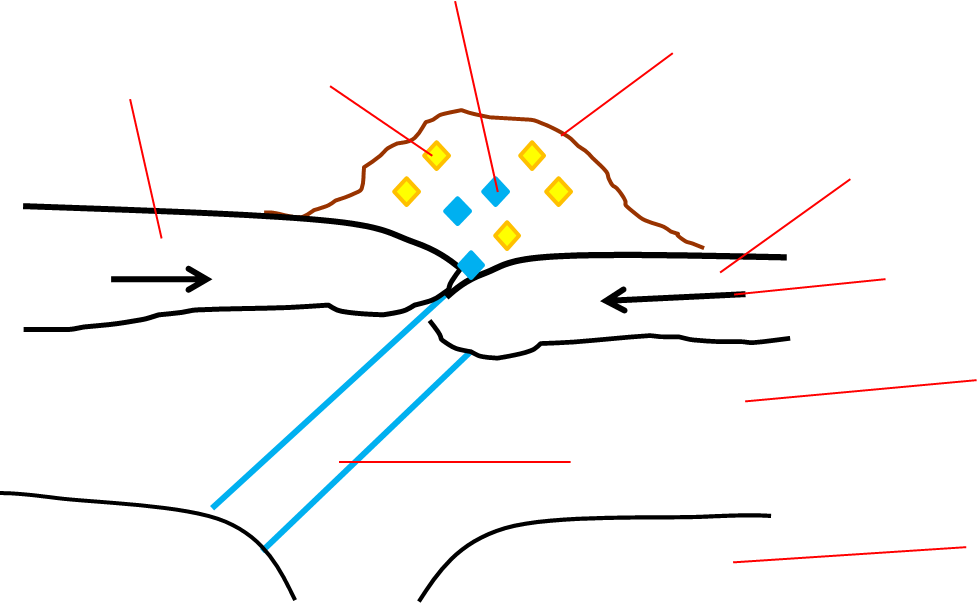
- Aophiolite
- Bbatholith
- CLithosphere
- DAsthenosphere
- Eancient oceanic crust
- Ffold mountains
- Gcontinental crust
- Hcontinental crust
- Idirection of pate movement
- Jform by orogenesis
14Label the diagram of a oceanic-oceanic convergent plate margin.
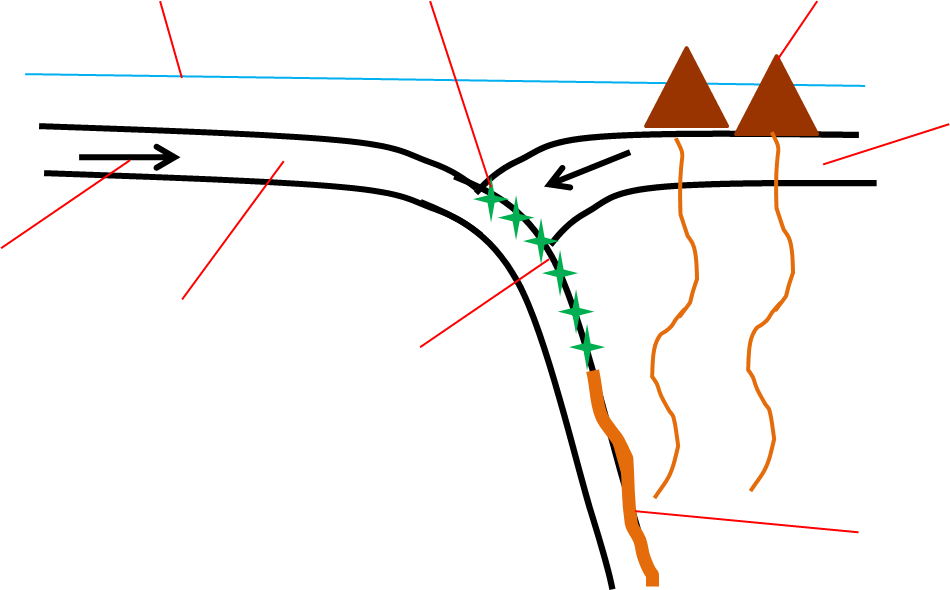
- Asea level
- Bsubducting oceanic crust
- CBenioff zone
- Dpartial melting
- Evolcanic island
- Foceanic crust
- Gdeep sea trench
15Give examples of the different types of plate margins:
Divergent: [blank_start]Mid-Atlantic Ridge[blank_end]
Oceanic-Continental Convergent: [blank_start]Nazca[blank_end] and [blank_start]South American[blank_end]
Continental-Continental Convergent: [blank_start]Indian[blank_end] and [blank_start]Eurasian[blank_end]
Oceanic-Oceanic Convergent: [blank_start]Pacific[blank_end] (subducting) and [blank_start]Philippine[blank_end]
Conservative: [blank_start]Pacific[blank_end] and [blank_start]North American[blank_end]- AMid-Atlantic Ridge
- BNazca
- CSouth American
- DIndian
- EEurasian
- FPacific
- GPhilippine
- HPacific
- INorth American
Información
- Descripción
- Pgs. 24-45
- Autor
- Izzy Backhouse
- Idioma
- English
- Visitas
- 55
- Etiquetas
- Valoración
- Aún sin valoraciones Valora este test