
Test
1.2 Earthquakes
Este test tiene tipos de pregunta que se abren en el reproductor de siempre.
Preguntas del test (29)
1Complete the table on properties of seismic waves.
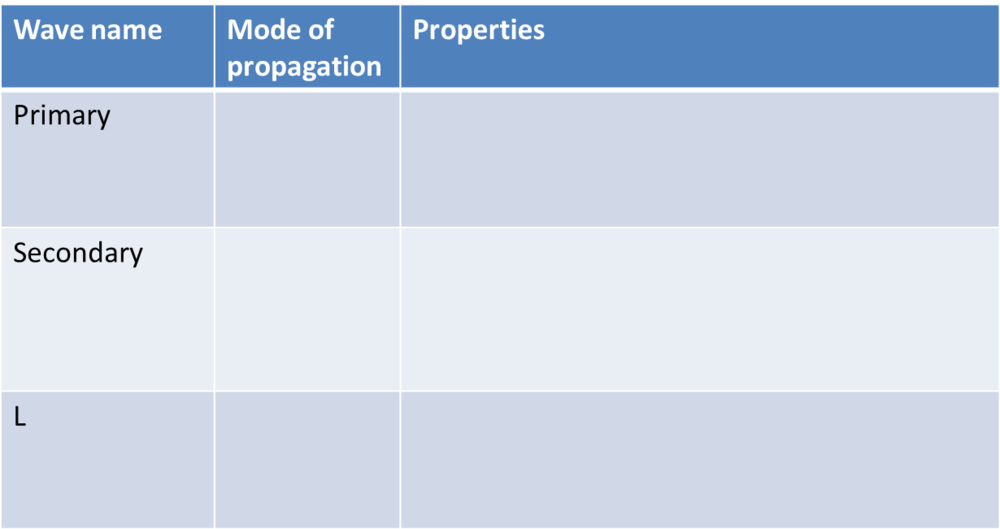
- ALongitudinal
- BTransverse
- CLateral movement
- DCan travel through solids and liquids
- EControlled by incompressibility
- FBody waves
- GCannot pass through liquids
- HControlled by rigidity
- ITravel at 70% of the speed of P waves
- JReflected by Moho
- KLast to arrive
- LSurface wave
- MLarge amplitude
- NLong wavelength
2Complete the table to show how earthquakes are classified by the depth of the focus.
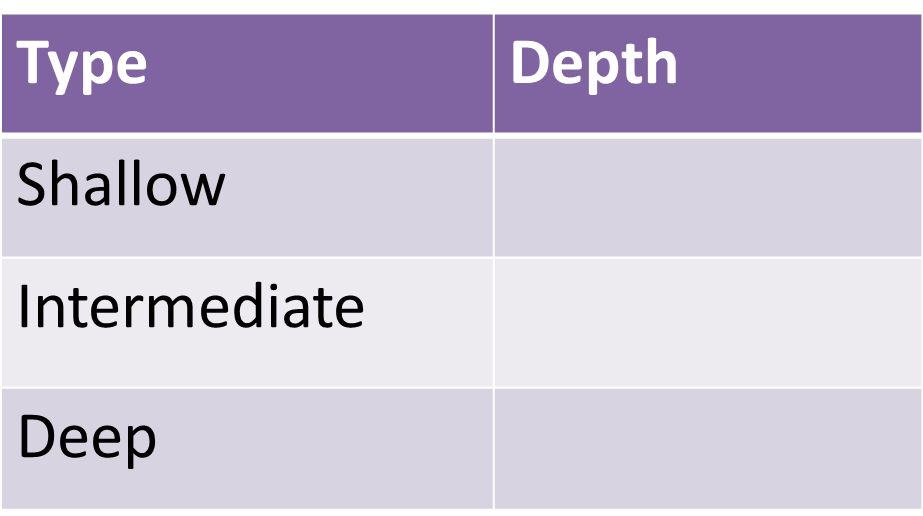
- A0-70km
- B70-300km
- C300-700km
3Earthquakes do not [blank_start]originate[blank_end] at depths greater than 720km because deeper, warm rocks are not [blank_start]brittle[blank_end] enough to [blank_start]fracture[blank_end] so [blank_start]faults[blank_end] do not occur.
- Aoriginate
- Bbrittle
- Cfracture
- Dfaults
4What is the rigidity of a liquid?
- A0
- B12
- C1
- D-6
5The S wave shadow zone is found at:
[blank_start]103[blank_end] degrees to [blank_start]103[blank_end] degrees.
The P wave shadow zone is found at:
[blank_start]103[blank_end] degrees to [blank_start]142[blank_end] degrees.- A103
- B142
- C103
- D103
6Body waves travel through the interior of the Earth.
- AVerdadero
- BFalso
7Surface waves travel just below the Earth's surface.
- AVerdadero
- BFalso
8L waves lose energy slowly with distance away from the epicentre.
- AVerdadero
- BFalso
9Body waves are responsible for damage to buildings.
- AVerdadero
- BFalso
10Focus = The point [blank_start]within[blank_end] the Earth at which the earthquake originates.
[blank_start]Epicentre[blank_end] = the point on the Earth's surface, directly [blank_start]above[blank_end] the focus and shows where the greatest amount of [blank_start]damage[blank_end] is likely to occur.- Awithin
- BEpicentre
- Cabove
- Ddamage
11Isoseismal line = A [blank_start]line[blank_end] on a map which joins up points of equal [blank_start]intensity[blank_end], separating zones of different intensities.
- Aintensity
- Bline
12At the Gutenberg discontinuity P waves slow down and refract from their original path.
- AVerdadero
- BFalso
13S waves can travel through liquids.
- AVerdadero
- BFalso
14Mercalli Scale:
- Measures the [blank_start]intensity[blank_end] of an earthquake based on the [blank_start]effects[blank_end] felt in a particular area.
- It is a [blank_start]12[blank_end] point [blank_start]arbitrary[blank_end] scale.- Aintensity
- Beffects
- C12
- Darbitrary
15Richter Scale:
- Measures the [blank_start]magnitude[blank_end] of an earthquake by recording the [blank_start]amplitude[blank_end] of seismic waves.
- The values are then converted into a [blank_start]logarithmic[blank_end] scale.- Amagnitude
- Bamplitude
- Clogarithmic
16Define the term magnitude.
- AA measure of the amount of strain released by an earthquake.
- BA measure of the damage caused by an earthquake.
17Define the term intensity.
- AA measure of the damage caused by an earthquake.
- BA measure of the amount of strain released by an earthquake.
18Amplitude of L-waves in different types of rock:
Solid, [blank_start]competent[blank_end] rocks allow vibrations to pass through easily.
Waves are transferred with minimal damage to structures.
L wave amplitude is [blank_start]low[blank_end].
[blank_start]Unconsolidated[blank_end] sediment [blank_start]oscillates[blank_end] freely.
L wave amplitude [blank_start]higher[blank_end].
Intensity [blank_start]greater[blank_end] than on consolidated rock.- Acompetent
- BUnconsolidated
- Coscillates
- Dlow
- Ehigher
- Fgreater
19Define: Seismograph
- AA device which receives and records seismic vibrations.
- BA device which receives seismic vibrations and converts them into s signal which can be transmitted and recorded.
- CA paper or electronic record made by a seismograph.
20Define: Seismometer
- AA paper or electronic record made by a seismograph.
- BA device which receives seismic vibrations and converts them into a signal which can be transmitted and recorded.
- CA device which receives and records seismic vibrations.
21Define: Seismogram
- AA device which receives and records seismic vibrations.
- BA device which receives seismic vibrations and converts them into s signal which can be transmitted and recorded.
- CA paper or electronic record made by a seismograph.
22Earthquakes occur in solid, [blank_start]brittle[blank_end], competent rocks as they suddenly [blank_start]fracture[blank_end] and move relative to each other.
The seismic energy [blank_start]released[blank_end] is transmitted through the rocks as seismic [blank_start]waves[blank_end].
Weak incompetent rocks steadily [blank_start]deform[blank_end] under stress by folding or plastic flow. They do not [blank_start]fracture[blank_end] so earthquakes cannot occur.- Abrittle
- Bfracture
- Creleased
- Dwaves
- Edeform
- Ffracture
23How will intensity and damage to buildings change if underlying geology consists of unconsolidated sands?
The intensity will [blank_start]increase[blank_end] as unconsolidated sands [blank_start]absorb[blank_end] the seismic waves, which decreases the wave [blank_start]speed[blank_end] and increases the wave [blank_start]amplitude[blank_end], resulting in greater [blank_start]damage[blank_end] to buildings.- Aincrease
- Babsorb
- Cspeed
- Damplitude
- Edamage
24The [blank_start]amplitude[blank_end] of seismic waves is larger in unconsolidated sediments resulting in greater [blank_start]damage[blank_end] to buildings.
In consolidated sediment the seismic waves are [blank_start]dampened[blank_end].- Aamplitude
- Bdamage
- Cdampened
25Physical effects of earthquakes:
Ground [blank_start]movement[blank_end]
Damage to [blank_start]structures[blank_end]
L[blank_start]iquefaction[blank_end]
Land[blank_start]slips[blank_end]
After[blank_start]shocks[blank_end]
T[blank_start]sunamis[blank_end]- Amovement
- Bstructures
- Ciquefaction
- Dslips
- Eshocks
- Fsunamis
26Social and economic effects of earthquakes:
Infrastructure and c[blank_start]ommunications[blank_end] damaged affects how quickly people can respond to effects of earthquake.
Damaged water pipes can affect supply of clean water and lead to risk of disease spreading.
D[blank_start]eath[blank_end] and i[blank_start]njury[blank_end] of people impacting families.
Loss of p[blank_start]ower[blank_end] supply.- Aeath
- Bnjury
- Cower
- Dommunications
27How do earthquakes cause liquefaction?
- AThe ground vibrates and so behaves like a liquid.
- BThe ground shakes.
- CThe ground collapses due to rise of water.
28How do earthquakes cause tsunamis?
A large [blank_start]volume[blank_end] of water is displaced as a result of the earthquake being at a shallow depth below the sea.- Avolume
29How can the impact of an earthquake be reduced on built structures?
Flexible pipes and electricity [blank_start]cables[blank_end]
- prevents pipes from [blank_start]fracturing[blank_end] / stops [blank_start]fires[blank_end]
Cross-bracing
- [blank_start]strengthens[blank_end] building
Mass on roof of tall buildings / [blank_start]damping[blank_end]
- acts as a counterbalance as the building [blank_start]sways[blank_end]
[blank_start]Pyramid[blank_end] shaped structure
- more stable due to [blank_start]wider[blank_end] base
Base [blank_start]isolation[blank_end]
- [blank_start]absorbs[blank_end] ground vibrations
Reinforced [blank_start]foundations[blank_end]
- provides greater [blank_start]support[blank_end] and firmer base- Acables
- Bfracturing
- Cfires
- Dstrengthens
- Edamping
- Fsways
- GPyramid
- Hwider
- Iisolation
- Jabsorbs
- Kfoundations
- Lsupport
Información
- Descripción
- pgs. 14-23
- Autor
- Izzy Backhouse
- Idioma
- English
- Visitas
- 72
- Historial
- Creado el 7 may 2016 · actualizado el 7 mar 2018
- Etiquetas
- Valoración
- Aún sin valoraciones Valora este test