
Test
Test SIS + RCS
Crea una cuenta gratis para terminar este test
Guarda tu progreso y consulta tu resultado final.
¿Ya tienes cuenta? Inicia sesión
Preguntas del test (41)
1In the Continuous Wave radar transmission method, which of the following target information is/are provided by the Doppler effect?
- ASpeed of the target
- BRelative bearing of the target
- CRange if the frequency is modulated FMCW.
- DPermits to discriminate clutter/moving targets
2A radar set with a PRF of 1,000 pulses per second and an antenna rotation rate of 15 rpm produces what maximum number of pulses per degree?
- A2.7
- B36
- C11.1
3For a Pulsed radar, the maximum unambiguous range depends on:
- AThe pulse repetition frequency
- BThe Doppler shift of the received signal
- CPulse repetition period
- DThe transmitted peak power
4What is the main advantage of HPRF radar:
- AThe ability to detect nose and tail radar targets, also in side lobes clutter.
- BThe ability to detect and track ground targets
- CThe ability to detect high speed targets
5Frequency-modulated radars transmit a wave that continuously changes in frequency about a center frequency. Using frequency modulation, the range to a target is determined by using which of the following methods?
- ABy comparing the velocity of the received energy with the velocity of the transmitted energy.
- BBy measuring the Doppler shift that occurs in the returning signal.
- Cby comparing the magnitude of transmitted pulses with the magnitude of returned pulses
6Airborne Radars require accurate aircraft navigation data for:
- AGenerating the highly accurate clock signals used to generate radio frequency signals
- BCompensating noise in tracking due to own aircraft movements
- CStabilizing the antenna rotation with respect to inertial reference (horizon)
- Dantenna inertial stabilization (horizontal) / Automatic tilt control
- ECompensation of echoes (receiver): reduece noise in tracking
- FSAR calculations: very precise /accureate/low latency data
- GDisplay Ground / north stabilization
7Select which of the following statements is correct
- AThe best radar antenna configuration for covering 360 degrees around the aircraft is nose- mounted
- BThe waveguides are mainly used for conducting high power pulses from the transmitter to the antenna
- CRadars typically use 28 VDC power
8Which of the following radar components allows the use of one antenna for both transmitting and receiving radar energy?
- ASynchronizer
- BMixer
- CDuplexer
- DCirculator
9In a radar without monopulse channels, decreasing the waveguide run between the circulator and the antenna:
- AIncreases the antenna Gain.
- BMakes necessary increasing the waveguide run between circulator and receiver, to compensate
- CReduces only the losses of the received echo
- DReduces the losses in both the Transmitted RF and the Received Echo
- EReduces the losses in the Transmitted RF
- FAllows a better detection range
- GAllows for the same detection range a smaller antenna
10ISAR is a radar mode used mainly:
- AIn fighters, to discriminate very near targets
- BTo detect very big ships when sea state is very low.
- CShips / Surface targets classification
- DTo detect small targets at High Sea States
- EUses ships movement to obtain shape
- Fonly one dimension
11Which of the following flight conditions are optimal for SAR image generation?
- AStraight and level flight, high constant speed, direct to the target
- BOrbit (circular) flight path centered in the target, maximum roll of 5º
- CStraight and level flight, high constant speed, perpendicular to the target.
12In AESA architecture Radars, which of the following statements are true?
- AThe integration is much easier than in classic architecture radars.
- BThe TRM matrix is very demanding in terms of cooling
- CThere is no transmitter, but there is one receiver
13Select the correct answer(s): the waveguide runs ...
- Ashould be always pressurized, using dedicated compressors
- Bmust have a minimum pressure differential with respect to cabin air
- Cshould be designed minimizing the number of joints, bends, and turns, to reduce insertion loss.
- DAdmit structural stress, so they can be used to support other structures in the airframe
14The figures below represent the following situation:
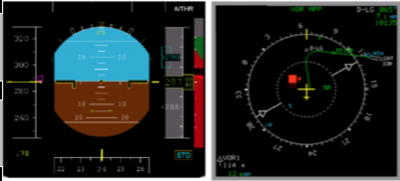
- AThe intruder aircraft represents a threat for our aircraft, it is 1100 feet below us, ascending at less than 500 feet/minute, and our aircraft is performing the correct manoeuvre
- BThe intruder aircraft represents a threat for our aircraft, it is 1100 feet below us, ascending at 1100 feet/minute (any speed greater than 500 feet/minute would be right), and our aircraft is not performing the correct maneuver. (The current vertical speed line is in the red zone).
15This figure represents:
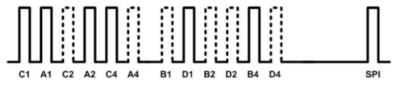
- AA transponder Mode C reply from an aircraft that is flying at 3451 feet.
- BA transponder Mode 3/A reply from an aircraft with a code that is 2211.
- CMode A: 3451 with Ident (or SPI) pulse active
- DMode S response
- EMode C response with altitude XXX
- FMode 3 response
16Which of the following systems need the support of a Transponder
- AAir to Air Refueling Support System (AARSS)
- BAutomatic Dependant Surveillance - Broadcast (ADS-B).
- CAdvanced Surface Movement Guidance and Control Systems (A-SMGCS)
- DTraffic Collision Avoidance System (TCAS/ACAS).
- EEnhanced Traffic Collision Avoidance System (ETCAS)
17What is the most important concept in the theory of operation of the TCAS:
- ATime to-go to the threat.
- BDistance to-go to the threat.
- CTime to-go to the CPA (Closest Point to Approach)
- DDistance to-go to the CPA (Closest Point to Approach)
18If aircraft A has as mode S address AAAAAA and aircraft B has as mode S address BBBBBB. What will happen if the TCAS of each aircraft initially decide at the same time that the correct maneouvre is to climb?
- ABoth TCAS will continue to request the crew to climb but at different rates than initially.
- BTCAS of aircraft B will request the crew to continue with the climb and TCAS of aircraft A will change to request the crew to descend.
- CBoth TCAS will request the crew to descend.
- DThe aircraft B (higher Mode S address) reverse the sense of its maneuver (Descends).
19Which of these are correct codes:
- AMode 3/A: 03
- BMode S: 12345A
- CModo C: 4 dígitos SIN D1
- DModo S: 6 dígitos en HEX
- EModo 1: 2 dígitos (0-7)(0-3)
- FModo 2: 4 dígitos (0-7)(0-7)(0-7)(0-7)
- GModo 3/A: 4 dígitos (0-7)(0-7)(0-7)(0-7)
- HModo 4: 3 pulsos
- IModo 5: como modo S pero crypto
20The TAWS mode 7 provides
- AProtection against descent below minimum height.
- BLanding gear up advisory
- CWindshear Detection and Alerting
- DProtection against altitude loss after take off
21Enhanced GPWS modes are based on:
- AThe use of aircraft inertial navigation system.
- BThe use of aircraft roll attitude signal.
- CThe use current aircraft position and altitude referenced to a terrain elevation database to predict flight path conflicts with terrain elevation and provide graphic display of the conflicting terrain.
22The TAWS computer interfaces with:
- ALanding gear interlock switch to obtain landing gear up-down status.
- BFuel system to compute aircraft weight in order to evaluate aircraft climb performance.
- CRadio altimeter
- DAir Data Computer (Altitude, Airspeed, Verditcal Speed, Temperature).
- EAircraft Sensors (Angle of Attack, Flap position, Landing gear position). TRUE
- FIRS/AHRS. FMS/GPS. ILS/MLS. EFIS. Control Panel. TRUE
23A Controlled Flight Into Terrain (CFIT) accident is:
- AAn accident or incident in which the airplane becomes out of flight crew's control with the result of a crash into ground.
- BAn accident or incident in which the airplane, under the flight crew's control, is intentionally subject to an emergency landing.
- CAn accident or incident in which the airplane, under the flight crew's control, is inadvertently flown into terrain, obstacles, or water without either sufficient or timely flight crew awareness to prevent the event.
24What is the meaning of the basic GPWS alert “TOO LOW, GEAR”:
- AThe aircraft height over terrain is too low to extend the landing gear.
- BThe landing gear cannot be extended, therefore the flight crew need to perform an emergency landing.
- CFor alerting the pilot that the landing gear is not armed when flying with the landing gear unarmed either below 500ft or slower than 159 knots.
25Radio Altitude is used to:
- AProvide height over terrain display in final approach and low level flights (search and rescue, covert operation, etc).
- BCorrect the baro-altitude errors at low altitude
- CProvide height over terrain to other aircraft systems
- DReplace baro-altitude at low altitude
26Radio Altimeter transceiver is installed:
- AAs near as possible from displays output data corruption.
- BAs near as possible from RALT antennas to minimize RF signal losses.
- CAt fix distance from RALT antennas
- DAlways in the main landing gear bay
27Radio Altimeter provides data to:
- ATAWS to provide altitude over terrain for GPWS modes.
- BAudio Management System to provide altitude call-outs to the flight crew.
- CHydraulic data to inhibit landing gear down command.
- DDisplays System to provide radio-altitude data to flight crew
28What is the effect of the Radio Altimeter failure?:
- AIs always catastrophic as the safety of the landing relies on the Radio Altimeter indication.
- BMay be up to catastrophic on Category 3 precision approaches.
- CDepends on the category (minimum decision height) of the approach.
- DThe Radio Altitude is only informative and has not safety effect.
- EThe severity of RA failures depend of the precision approaches category.RA is the source of the decision height.
29Choose in which type of object the contribution to RCS due to creeping wave is more important:
- ACylinder
- BSphere
- CDisk
30Consider a perfect electric conductor (PEC) plane of dimensions 10x10meters at 10GHz. Mark as true or false the following statements:
- AIts RCS is approximately the same than the RCS of a PEC plane of dimensions 20x20 meters at 5 GHz.
- BIts RCS is approximately half of the RCS of a PEC plane of dimensions 20x20 meters at 5 GHz.
- Cts RCS is approximately double of the RCS of a PEC plane of dimensions 20x20 meters at 5 GHz.
- DIts RCS is approximately four times lower the RCS of a PEC plane of dimensions 20x20 meters at 5 GHz.
31Consider a perfect electric conductor (PEC) circular cylinder of radius equal to 1 meter and 10 meters long at 10GHz. Mark as true or false the following statements:
- AIts RCS is approximately double of the RCS of a PEC cylinder of radius equal to 2 meters and 10 meters long at 5GHz.
- BIts RCS is the same than the RCS of a PEC cylinder of radius equal to 2 meters and 10 meters long at 5 GHz.
32Consider a sphere of radius equal to 1 meter at 10GHz. Mark as true or false the following statements:
- AIts RCS is approximately the same than the RCS of a PEC sphere of radius equal to 2 meters at 5GHz.
- BIts RCS is approximately half of the RCS of a PEC sphere of radius equal to 2 meters at 5GHz.
- CIts RCS is approximately a quarter of the RCS of a PEC sphere of radius equal to 2 meters at 5GHz.
33Mark as true or false the following statements relative to the frequency dependence of RCS due to specular scattering (reflection) of several canonical scatterers (assuming optics regime):
- ATrihedral --> f3
- BDihedral -->f3
- CPlate --> f2
- Dsphere --> f
- EStraight edge --> f
- FCurved edge --> f-1
- GCorner --> f-2
- HCircular cylinder --> f2
34Which of these requirements would you place on IFF and/or TCAS antenna installations?
- APlace the equipment as far as possible from the antenna to have appropriate losses and avoid excessive reflections
- BEnsure that VSWR is around 1.5:1
- CHave a correct antenna bonding (around 2.5 mOhms)
- DPlace the equipment as close as possible from the antenna to have appropriate losses and avoid excessive reflections.
35If you have systems such as an IFF or a TCAS installed on an aircraft together with other systems that work in the L-Band frequencies (e.g. DME, TACAN, etc...), what important measure would you take to ensure radio-frequency compatibility?
- AHave a homogeneous human machine interface to ensure the use is compatible.
- BIt is not possible to install all these systems on the same aircraft, there will be too much interference among them.
- CA blanking system enables/disables RF transmission/reception ensuring sufficient RF interoperability of transmitters and receivers
36What is the correct answer to be filled out in each cell of the following table?
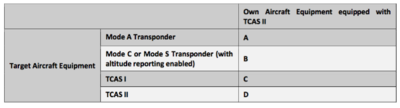
- AA: TA
B: TA and Vertical RA
C: TA and Vertical RA D: TA and Vertical Coordinated RA - BA: TA and Vertical RA
B: TA and Vertical RA
C: TA D: TA and Vertical Coordinated RA - CA: TA
B: TA and Vertical RA
C: TA and Vertical Coordinated RA D: TA and Vertical RA
- AA: TA
B: TA and Vertical RA
37Under what circumstances will a civil transponder reply to a Mode 2 interrogation?
- AWhen it is interrogated at 1090MHz
- BWhen it is interrogated at 1030MHz
- CMode 2 is military
38 What IFF or Transponder Modes are “Squitters” related to?
- AAll civil transponder modes
- BOnly modes 1, 2, C and A
- CCivil mode S
- DADS-B OUT
- EMADS-B Out
39The pulsed primary radar, when using a noncoherent source like a magnetron:
- Aallows the measurement of the Doppler frequency.
- Bhas a range resolution not depending on the signal bandwidth.
- Chas a range resolution depending on the pulse duration.
40Long range surveillance radar works with:
- ARelatively high frequencies and they have a high angular resolution
- BRelatively low frequencies and they have a high angular resolution.
- CRelatively high frequencies and they have a low angular resolution
- DRelatively low frequencies and they have a low angular resolution
41Indicate which is the correct definition of dBsm:
- AdBsm = 10log10(σ)
- BdBsm = 10log10( σ^2)
- CdBsm = 20log10(|σ^1/2|)
- DdBsm = 20 log10(σ)
- EDiscipline and Bondage Sadism and Masochism
Información
- Descripción
- MASI 1516 Surveillance, Identification Systems and RCS (SIS+RCS) Test sobre Test SIS + RCS, creado por jorge7993 el 10/06/2016.
- Autor
- jorge7993
- Idioma
- Español
- Visitas
- 138
- Etiquetas
- Valoración
- 5,0 de 5 · 6 valoraciones Valora este test