
Test
Horses
Crea una cuenta gratis para terminar este test
Guarda tu progreso y consulta tu resultado final.
¿Ya tienes cuenta? Inicia sesión
Preguntas del test (47)
1Which of the following is TRUE?
- Awhen the horse is walking past you, you are watching for a head bob
- Bwhen the horse is walking toward you, you are watching the hips and pelvis
- Cwhen the horse is walking away, you are watching for fetlock drop
- Dit is important that the horse is always walking in a straight line
2Which of the following tend to have acute onset? Check all that apply.
- Atendon injuries
- Bligament injuries
- Cfractures
- Ddegenerative problems
3Effusion is fluid in a synovial structure. Edema is fluid in tissue.
- AVerdadero
- BFalso
4Which of the following is FALSE?
- Aworn heels predispose for navicular disease
- Bhaving a steep angle to the foot means the horse is club footed and may develop suspensory problems
- Cif the coronary band is higher on one side of the heel it indicates weight bearing toward that side of the foot
- Dhaving a less steep angle to the front feet indicates that the horse is bearing too much weight in the front limbs
5Having a post legged stance predisposes a horse to flexor tendon issues.
- AVerdadero
- BFalso
6A dropped hip could be due to muscle atrophy or a fractured hip.
- AVerdadero
- BFalso
7Which of the following is FALSE?
- Ahorses will only flex their neck away from you if they are having cervical vertebral issues
- Bhigh lameness is uncommon
- Ca hot splint bone area means there is active inflammation, the horse will respond to palpation of the swelling
- Da foot may feel hot if it is covered by the bedding/hay/etc. in the stall
8By placing the leg in this position, the tendons are relaxed. This make it easier to tell the difference between the superficial and deep digital flexors. However, it makes it a little more difficult to palpate the suspensory.
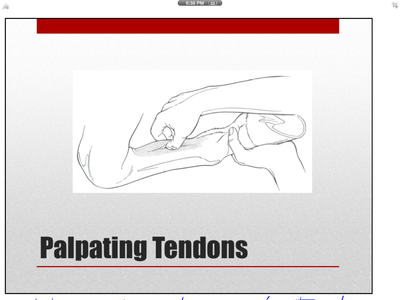
- AVerdadero
- BFalso
9What is a positive Churchill test?
- Aaduction of limb, means proximal hock pain
- Babduction of limb, means proximal hock pain
- Caduction of limb, means distal hock pain
- Dabduction of limb, means distal hock pain
10Which of the following is CORRECT?
- AGrade 1 lameness: lameness not perceptible under any circumstance
- BGrade 2 lameness: lameness is consistently observable
- CGrade 3 lameness: lameness is obvious at a walk
- DGrade 5 lameness: lameness produces minimal weight bearing in motion and/or at rest or a complete inability to move
11Which of the following are watched for ONLY with hind limb lameness? Check all that apply. (Please don't curse me too much)
- Apelvic hike- up on lame
- Barc of flight of foot
- Caltered flight path of foot
- Dlength of stride
- Eangles of joint flexion
- Fdrifting away from lame limb
12It is best to focus on specific landmarks while observing a horse walk past you.
- AVerdadero
- BFalso
13When a horse is lame the fetlock drop will be deeper.
- AVerdadero
- BFalso
14During a carpal flexion test hold for 30 seconds, a normal horse's fetlock will contact the caudal surface of the radius (or the heel bulb will touch the elbow). If this is not the case, there is decreased range of motion.
- AVerdadero
- BFalso
15Which of the following is FALSE?
- Aupper forelimb flexion: this test is better for elbow issues than shoulder issues
- Bdigital flexion in hindlimb: must try to keep foot close to the ground to limit amount of hock and stifle flexion
- Cupper hind limb flexion: hold for 90 seconds, keep leg underneath the horse to help the horse maintain balance
- Dhock extension test: tries to exacerbate pressure on hock, usually the horse will not tolerate for more than 1 minute so you can substitute multiple short times of extension in place of a single long time period
16Which of the following is TRUE about the navicular wedge test?
- Astretches the back of the leg
- Bincreases pressure on navicular
- Cuse for 60 seconds
- Dcan also use it at the medial and lateral sides to check the collateral ligaments
- EAll of the above are true
17What is the correct order of sensations lost?
- Acold, warmth, touch, pressure, pain
- Bpressure, touch, pain, cold, warmth
- Cpain, cold, warmth, touch, pressure
- Dtouch, pressure, cold, warmth, pain
18Which of the following structures is NOT blocked by the palmar digital nerve block?
- Asole
- Bhoof wall
- Cnavicular bone
- Dinsertion of the deep digital flexor tendon
19Which of the following is a common lameness that can be isolated by the palmar digital nerve block? (Remember that further diagnosis is required for a definitive diagnosis)
- AP3 wing fractures
- Blow ring bone
- Claminitis
- Dluxation of pastern joint
20The structures blocked by the abaxial sesamoid block are dorsal hoof wall, coronary band, coffin joint, pastern joint, sesamoidian ligaments.
- AVerdadero
- BFalso
21Which of the following blocks requires sterile preparation of the skin because of the high likelihood of the needle to enter a joint space?
- Alow 4-point
- Bhigh 4-point
- Cwheat
- Dtibial and peroneal
22It is ok to do the tibial and peroneal blocks to both hindlimbs.
- AVerdadero
- BFalso
23Which of the following are correct? Check all that apply.
- Avalgus- lateral deviation of limb distal to site of pathology
- Bvalgus- medial deviation of limb distal to site of pathology
- CVarus- medial deviation of limb distal to site of patholgy
- Dvarus- lateral deviation of limb distal to site of pathology
24Which of the following is FALSE regarding etiology of angular limb deformity?
- Aincomplete ossification of cuboidal bones
- Blaxity of periarticular structures (usually in one joint)
- Cunbalanced nutrition (trace mineral balance, crib feeding)
- Dexcessive exercise/trauma (microfractures)
25To determine if a horse has a valgus or varus deformity you should stand perpendicular to the horse's midline.
- AVerdadero
- BFalso
26If manipulation leads to straightening of the limb, the deformity is due to perinatal causes.
- AVerdadero
- BFalso
27Which of the following is FALSE about management strategy of limb deformities?
- Astall rest is a good conservative therapy option for periarticular laxity
- Btransphyseal bridging is used for growth acceleration
- Csplints/casts are used for incomplete ossification
- Dhoof trimming is a conservative therapy that may help
28Which of the following is TRUE regarding hoof trimming as management of angular limb deformity?
- Atrim the medial side for a valgus deformity
- Btrim the lateral side for a varus deformity
- Ctrim flat if both valgus and varus deformities are in the same limb
- DAll of the above are true
29Which of the following are true of periosteal transection and elevation? Check all that apply.
- Ashort side surgery
- Blong side surgery
- Ccan't over correct
- Dcan overcorrect
- Erequires second procedure
- Fdoesn't require second procedure
- Gused in more aggressive cases
30Which of the following is CORRECT?
- Aosteoarthritis- chronic disease of the joint which may or may not involve inflammation
- Bosteoarthopathy- disorder of movable joints characterized by degeneration and loss of articular cartilage
- Costeoarthrosis- any disease of the joints and bones
- Ddegenerative joint disease- any disease state inducing degeneration of a joint
31Which of the following is FALSE about mechanisms of OA?
- ATheory #1- defective cartilage with abnormal biomechanical properties, assumes normal mechanical forces are encountered by the joint
- BTheory #2- abnormal change in subchondral bone (cartilage doing all the work b/c the bone cartilage interface is more stiff)
- CTheory #3- normal cartilage exposed to abnormal forces (seen in joint incongruity secondary to trauma, altered chondrocyte metabolism)
- DAll of the above are true
32The synovial membrane regulates inflammatory cell access. It also secretes anabolic and catabolic enzymes (prostaglandins, cytokines, MMPs).
- AVerdadero
- BFalso
33Which of the following is FALSE about "primary" synovitis/capsulitis?
- Acan be secondary to chip fragment debris/mediators or OCD
- Brepair is by fibrosis and results in acute decreased range of motion that resolves after a few months
- Cinvolves biomechanical damage due to continuum of repetitive trauma or a single incident
- Dmediators released from the affected joint's cartilage or bone will alter the metabolism of the synoviocytes
34Which of the following is NOT seen histologically with synovitis?
- Aedema
- Bhyperplasia of intimal cell lining
- Chypervascular
- DMMPs
35Chondrocytes release the same mediators as the synovium.
- AVerdadero
- BFalso
36Which of the following is FALSE about matrix metalloproteinases?
- Asecreated by synoviocytes and chondrocytes
- Bcapable of breaking down extracellular matrix and fluid components
- Cthey are all "bad guys"
- DMMPs are secreted as inactive protein
37Which of the following is FALSE about matrix metalloproteinases?
- Asecreated by synoviocytes and chondrocytes
- Bcapable of breaking down extracellular matrix and fluid components
- Cthey are all "bad guys"
- DMMPs are secreted as inactive protein
38ADAM stands for A Disintegrin And Metalloproteinase.
- AVerdadero
- BFalso
39Which of the following cytokines are modulatory? Check all that apply.
- AIL-1
- BTNF-alpha
- CIL-4
- DIL-10
- EIL-13
40Which of the following is FALSE regarding the IL-1 family?
- AIL-1 alpha amplifies the inflammatory process by stimulating an increase in monocyte infiltration
- BMonocytes produce IL-1 beta
- CIL-1 beta up regulates the production of IRAP as a positive feedback to make more IL-1 alpha
- Dmatrix metalloproteinases are inhibited by IL-1s
41Anabolic cytokines include insulin-like growth factor and transforming growth factor. These promote chondrocyte production of prostaglandins and type 2 collagen.
- AVerdadero
- BFalso
42Which of the following is FALSE?
- Anitric oxide degrades hyaluronan and collagen, IL-1 promotes its production
- BPGE-2 is associated with synovitis and pain
- CIRAP is a naturally occurring inhibitor derived from the animal's own body
- Dtissue inhibitors of metalloproteinases (TIMPs) bind 1:1 with MMPs forming inactive complexes, research is very promising
43Which of the following is FALSE regarding therapy?
- Acold therapy is more useful in acute injury
- Bphenylbutazone seems better in the treatment of orthopedic issues, banamine seems better for visceral pain
- Ccorticosteroids are effective for OA treatment with intra-articular administration as well as systemic administration
- Dif give a horse carprofen make sure it is the horse formulation, not the dog formulation
44Which of the following whole body doses of the common corticosteroids is INCORRECT?
- ATA (triamcinolone acetate) <18 mg
- BMPA (methylprednisolone acetate) <20 mg
- Cbetamethasone <30 mg
45Post-injection flare and joint sepsis are easily distinguished from each other.
- AVerdadero
- BFalso
46IA polysulfated glycosaminoglycans (adequan) makes it easier for an infection to develop by reducing the number of bacteria needed to induce an infection.
- AVerdadero
- BFalso
47What is my favorite flavor of ice cream?
- Astrawberry
- Bchocolate
- Ccookie dough
- Dmoose tracks
Información
- Descripción
- (Exam 3) Musculoskeletal Test sobre Horses, creado por karahm el 09/03/2014.
- Autor
- karahm
- Idioma
- English
- Visitas
- 155
- Etiquetas
- Valoración
- Aún sin valoraciones Valora este test