
Test
Chapter 7
Crea una cuenta gratis para terminar este test
Guarda tu progreso y consulta tu resultado final.
¿Ya tienes cuenta? Inicia sesión
Preguntas del test (19)
1Stars with masses below a certain threshold produce most of their energy via the proton-proton chain. What is that threshold?
- A0.01 solar masses
- B0.1 solar masses
- C1.1 solar masses
- D11 solar masses
2Which of the following is considered to be the best explanation for the missing solar neutrinos?
- AThe Sun is fusing helium but not hydrogen
- BNuclear reactions do not produce neutrinos as fast as theory predicts
- CThe Sun may contain matter we haven't yet identified
- DNeutrinos may oscillate between three different flavours
3How did observations at the Sudbury Neutrino Observatory solve the solar neutrino problem?
- AThey showed that the “missing neutrinos” had changed into a different type
- BThey showed that other experiments had miscounted the number of solar neutrinos
- CThey showed that models for the number of neutrinos produced by the Sun were wrong
- DThey showed that neutrinos were not escaping from the core of the Sun
4Why does the main sequence have a limit at the lower end?
- ALow mass stars form from the interstellar medium very rarely
- BLow mass objects are composed primarily of solids, not gases
- CThe lower limit represents a star with zero radius
- DA minimum temperature is required for hydrogen nuclear fusion to take place
5Why is there a main sequence mass-luminosity relation?
- Abecause helium fusion produces carbon
- Bbecause more massive stars support their larger weight by making more energy
- Cbecause the helium flash occurs in degenerate matter
- Dbecause all stars on the main sequence have about the same radius
6What is the approximate mass of the lowest mass object that can initiate the thermonuclear fusion of hydrogen?
- A0.08 solar mass
- B1 solar mass
- C8 solar masses
- D80 solar masses
7Which of the following is most similar in size to a brown dwarf?
- Athe planet Jupiter
- Ba red dwarf
- Ca white dwarf
- Da Bok globule
8Which of the following are star-like objects that contain less than 0.08 solar masses and will never raise their core temperatures high enough that the proton-proton chain can begin?
- Abrown dwarfs
- BHerbig-Haro objects
- CBok globules
- DT Tauri stars
9What would happen if the nuclear reactions in a star began to produce too much energy?
- AThe star would shrink
- BThe star would expand
- CThe star would collapse
- DNothing would happen
10How much of its lifetime does the average star spend on the main sequence?
- A1%
- B10%
- C20%
- D90%
11The lower edge of the main-sequence band represents the location in the H-R diagram at which stars begin their lives as main-sequence stars. What is it called?
- Athe zero-age main sequence
- Bthe birth line
- Cthe Coulomb barrier
- Dthe evolutionary track
12On the H-R diagram, the line indicates the location of the main sequence. Which of the four labeled locations on the H-R diagram indicates a luminosity and temperature similar to that of a T Tauri star?
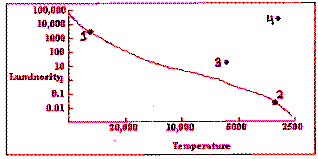
- A1
- B2
- C3
- D4
13Refer to the H-R diagram. Which point represents a star in which the proton-proton chain is occurring?
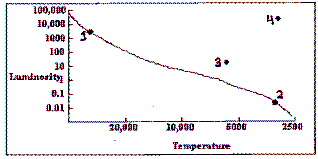
- A1
- B2
- C3
- D4
14The Sun has an expected main-sequence lifetime of about 10^10 years. What is the lifetime on the main sequence of a 2 solar mass star?
- A1.8×10^6 years
- B1.8×10^9 years
- C1.8×10^10 years
- D1.8×10^11 years
15What type of star is our Sun?
- Aintermediate-mass star
- Byellow giant
- Clow-mass star
- Dhigh-mass star
16What is the lifetime of a 10 solar mass star on the main sequence?
- A3.2×10^7 years
- B1×10^9 years
- C1×10^11 years
- D3.2×10^12 years
17What characteristic of a star primarily determines its location on the main sequence?
- Aage
- Bdistance from the galactic centre
- Cmass
- Dradius
18In which option below are the stellar types sorted from shortest to longest main-sequence lifetime?
- AO, A, K, M
- BA, B, F, G
- CK, F, B, O
- DB, A, M, G
19Consider two stars of the same mass: star 1 has just moved on to the main sequence, and star 2 is about to leave it. How are these two stars different?
- AStar 2 has more helium in its core and a hotter surface
- BStar 2 has more helium in its core and a cooler surface
- CStar 1 is more luminous and has a hotter surface
- DStar 1 is more luminous and has a cooler surface
Información
- Descripción
- Astronomy
- Autor
- Ryan Tram
- Idioma
- English
- Visitas
- 630
- Historial
- Creado el 10 dic 2016 · actualizado el 18 ene 2017
- Etiquetas
- Valoración
- 5,0 de 5 · 1 valoración Valora este test