
Test
Physics Theory #1
Preguntas del test (40)
1What is the phase of electromagnetic wave (E=E0 cos(ωt-kr))?
- ACosine’s argument
- BMultiplication of frequency and radius-vector
- CValue of cosine function
- DRHS of this equation
- ENo right answer
2Energy of electromagnetic wave is:
- AProportional to cross product of electric and magnetic field vectors
- BProportional to relation of electric field vector to magnetic field vector
- CProportional to the vector addition of electric and magnetic field vectors
- DProportional to dot product of electric and magnetic field vectors
- EProportional to the vector subtraction of electric and magnetic field vectors
3The speed of light is given by the value of
- A1

- B2
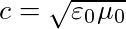
- C3
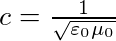
- D4

- E5
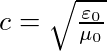
- A1
4Maxwell’s equation can be written in the form shown below. If magnetic charge exists and if it is conserved, which of these equations will have to be changed?
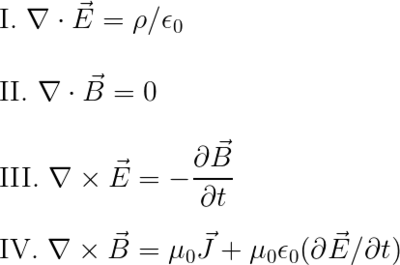
- AI
- BII
- CIII
- DIV
5What is the direction of the Poynting vector in the picture
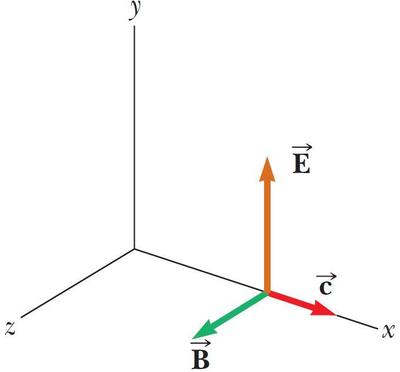
- AAlong negative y axis
- BAlong positive z axis
- CAlong positive x axis
- DAlong negative x axis
- EAlong negative z axis
6What is NOT true about electric and magnetic fields?
- AThe electric field and magnetic field each satisfy a wave equation
- BThe electric and magnetic fields are perpendicular to each other
- CThe electric and magnetic fields perpendicular to the direction of wave propagation
- DThe magnitudes of electric and magnetic fields in electromagnetic wave are related by the expression E/B = c
- EThe electric and magnetic fields does not vary with time for an electromagnetic wave
7Color of electromagnetic radiation is defined by
- AAmplitude
- BFrequency
- CPhase
- DSpeed
- EIntensity
8What is it visible light?
- AElectromagnetic waves with wavelengths from 4*10^-7 until 8*10^-7 m in vacuum
- BAll electromagnetic waves
- CElectromagnetic waves with wavelengths from 2*10^-9 until 9*10^-7 m in vacuum
- DElectromagnetic waves with wavelengths from 4*10^-7 until 1*10^-3 m in vacuum
- ENo right answer
9Which wave below has the longest wavelength?
- AInfrared waves
- BRadio waves
- CUltra violet waves
- DX-rays
10A sheet of paper will not act as a mirror because paper
- ARefracts light
- BAbsorbs light
- CReflects light
- DDiffuses light
11Which of the following is not true about light?
- ALight needs a medium to travel in
- BThe speed of light is different in different media
- CLight takes about 8 minutes to travel from the sun to the earth
- DIt is a form of energy
12When light reflects from a surface, there is a change in its
- ASpeed
- BWavelength
- CFrequency
- DAll of these
- ENone of these
13Light will almost travel from one place to another along a path of least
- AExpense
- BDistance
- CEffort
- DComplication
- ETime
14Which of these electromagnetic waves has the shortest wavelength?
- AUltraviolet waves
- BInfrared waves
- CRadio waves
- DLight waves
- EX-rays
15Determining the speed of light became a critical experiment for the wave and particle theories of light because
- AThe wave theory assumes the speed of light is instantaneous
- BRectilinear propagation only works if the speed of light is very fast
- CThe wave theory predicted light would move slower in a denser medium, while the particle theory predicted the opposite
- DThe particle theory predicted light would move slower in a denser medium, while the wave theory predicted the opposite
16Which experiment is it? The speed of light was eventually measured when astronomer measured the time it took light to travel from planet to Earth.
- AGalileo’s experiment
- BRoemer’s experiment
- CFizeau’s experiment
- DKepler’s experiment
- ENewton’s experiment
17A spherical, concave mirror is shown in the figure above. The focal point F and the location of the object O are indicated. At what point will the image located?
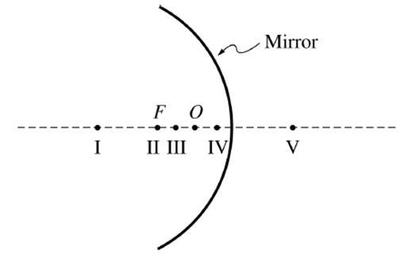
- AI
- BII
- CIII
- DIV
- EV
18In which figure ray for converging lens is drawn correctly?
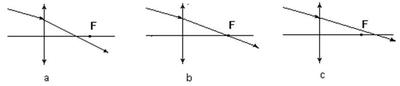
- Aa and b
- Ba and c
- COnly a
- DOnly b
- ENo right answer
19If the incident ray is precisely at the critical angle, the refracted ray is ______ to the boundary at the point of incidence.
- ATangent
- BNormal
- CSine curve
- DCosine curve
20Rainbow appears because of
- ARefraction and dispersion of sun rays in rain drops
- BDiffraction of sun rays in rain drops
- CReflection of sun rays from rain drops
- DRefraction and dispersion of sun rays in snowflake
- EInterference of sun rays with each other
21In order to observe interference in light waves, the following conditions must be met:
- ASource must be coherent
- BSource must be of single wavelength
- CPath difference does not depend on phase difference
- DAmplitude of the two waves should be the same
- EWavelength and size of slit should be of same order
22Wave interference can be constructive if
- ATwo waves are “in phase”
- BTwo waves are “out of phase”
- CTheir phase difference is π/2 rad
- DTwo waves are spherical
23Increasing the wavelengths in a double-slit experiment has what effect on the position of maxima on a screen at fixed distance?
- ANone
- BMaxima get closer together
- CMaxima get farther apart
- DMaxima get cancelled by minima
- EMaxima pass minima on the screen
24In a single slit diffraction experiment, the width of the slit through which light passes is increased. What happens to the central bright fringe?
- AIt becomes wider
- BIt becomes narrower
- CIt stays the same
- DNone of the other answers is correct
25Match every formula with its description:
1) dsinθ = mλ
2) dsinθ = (m + 1/2)λ- A1 - Constructive interference for double-slit experiment
- B1 - Destructive interference for double-slit experiment
- C2 - Constructive interference for double-slit experiment
- D2 - Destructive interference for double-slit experiment
26Match every formula with its description:
1) 2t = (m + 1/2)λn
2) 2t = mλn- A1 - Destructive interference in thin films
- B1 - Constructive interference in thin films
- C2 - Destructive interference in thin films
- D2 - Constructive interference in thin films
27Match figures of diffraction patterns of two points sources with their description:
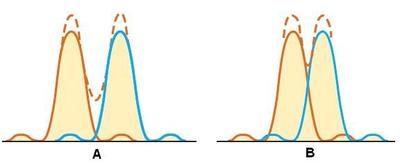
- AA - Patterns are well resolved
- BB - Patterns are well resolved
- CB - Patterns are just resolved
- DA - Patterns are just resolved
28What is not true about the Fresnel diffraction?
- ADiffraction is occurring near the aperture
- Ba/R ≥ 1, if a is size of aperture, R is distance between aperture and observation points
- CIntensity distribution of Fresnel diffraction

- DIn Fresnel diffraction, distance between n-th zone and observation points P is equal to b + n(λ/2), where b is distance between source and point P
29What is false about doing a double-slit experiment with sound and light:
- AThe sources must be coherent for the interference pattern to be observed
- BThey both produce a pattern of high and low intensity (loud and quiet) at some distance away from the double-slit
- CThey both work best with a single-frequency source
- DThe slits for sound must be extremely close together when compared to light
30Transmitted light has maximum intensity if transmission axes of polaroids are
- AAligned with each other
- BAt an angle of 45 degree with each other
- CPerpendicular to each other
- DOptical active and at angle of 30 degree with each other
31What is true about the polarizing angle?
- AThe angle of incidence at which this polarization occurs
- BThe angle of reflection at which this polarization occurs
- CThe polarizing angle is called Brewster’s angle
- DThe polarizing angle can be defined by Malus’s law
32Light from any ordinary source (such as a flame) is usually:
- APlane polarized
- BCircularly polarized
- CUnpolarized
- DElliptically polarized
- EMonochromatic
33The SI standard of time is based on
- AThe daily rotation of the earth
- BThe frequency of light emitted by Kr86
- CThe yearly revolution of the earth about the sun
- DNone of these
34A nanosecond is
- A10^9s
- B10^-9 s
- C10^-10 s
- D10^-11 s
- E10^-16 s
35The SI standard of length is based on:
- AThe distance from the north pole to the equator along a meridian passing through Paris
- BWavelength of light emitted by Hg198
- CWavelength of light emitted by Kr86
- DA precision meter stick in Paris
- EThe speed of light
36Which of the following is closest to a yard in length?
- A0.01m
- B0.1m
- C1m
- D100m
- E1000m
37There is no SI base unit for area because
- AWe live in a three (not a two) dimensional world
- BAn area has no thickness; hence no physical standard can be built
- CIt is impossible to express square feet in terms of meters
- DArea can be expressed in terms of square meters
- EArea is not an important physical quantity
38The SI base unit for mass is:
- Agram
- Bpound
- Ckilogram
- Dounce
- Ekilopound
39A gram is:
- A10^-3 kg
- B10^−6 kg
- C1 kg
- D103 kg
- E106 kg
40Which of the following weighs about a pound?
- A0.05 kg
- B0.5 kg
- C5 kg
- D50 kg
- E500 kg
Información
- Descripción
- Physics theory quiz
- Autor
- Hanzo Conard
- Idioma
- English
- Visitas
- 20
- Historial
- Creado el 24 ene 2017 · actualizado el 24 ene 2017
- Etiquetas
- Valoración
- Aún sin valoraciones Valora este test