
Metal Hardware (Mod.3 Sect.2 Part 3)
Diapositivas del conjunto (4)
-
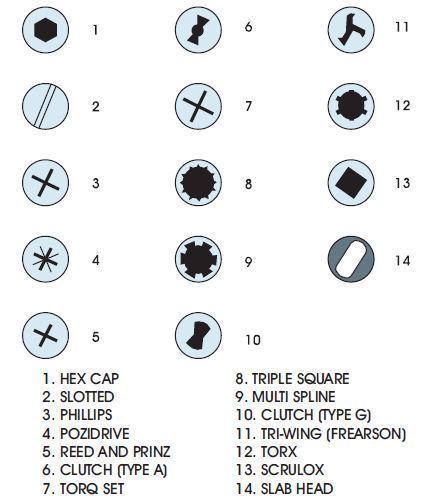
- A common error made by nonprofessional people is to try to tighten or loosen a screw with a screwdriver that doesn’t fit the slot. That usually results in screw heads with damaged slots. It’s not just the fact that they look unprofessional. If the screw head is damaged, it’s likely to be difficult to reuse the screw during disassembly and reassembly. Remember, your workmanship identifies your attitude toward your work.
- Pie de imagen: Be familiar with these types of screw heads.
-
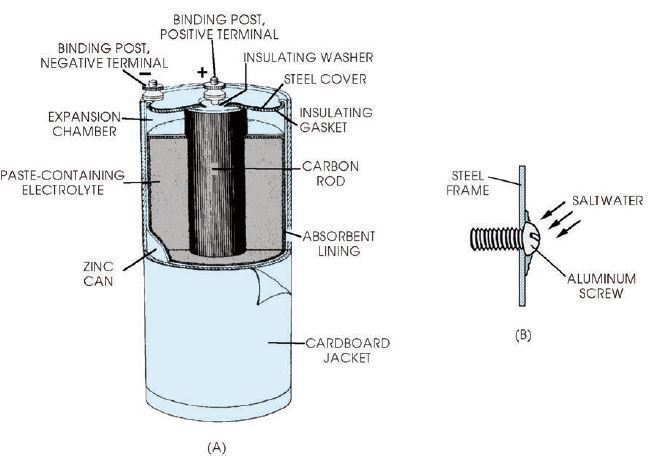
- Pie de imagen: (A) Here’s the basic construction of a primary dry cell. In (B), you can see the conditions that combine to cause galvanic action to occur.
- This figure shows the basic construction of a dry cell. This is the basic construction of a cell sometimes used in flashlights. The dissimilar materials are carbon and zinc. They’re in contact with a potassium chloride electrolyte. An electrolyte is the liquid or paste that supports the cell or battery action.
- Figure B shows how the theory of battery and cell action supports galvanic action. In this case, an aluminum screw is used to fasten steel surfaces together.
- The voltage generated causes a galvanic current to flow. As the cur rent flows, one of the metals goes into solution and a highly destructive action takes place. Eventually the galvanic action will destroy one of the metals.
-
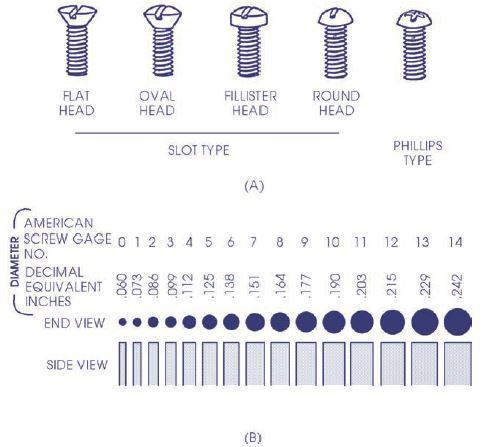
- Pie de imagen: (A) The Most Of ten Used Screws, and (B) A Comparison of Standard Screw Wire Stock
- This figure shows the types of screws used most often. The round head slotted screw and the round-head Phillips are the most popular. The screws shown in figure 5 are fabricated from standard screw wire stock. Sizes of standard screw wire are also shown in Figure B.
- Screws are identified by a two-number code. Examples are 6-32 and 8-40. The first number refers to the size of the standard screw wire used for making the screw. The second number tells the number of threads per inch. There’s only one nut or threaded hole that will accept a screw with a two-number identification code. For example, a 6-40 screw will almost fit a nut made for a 6-32 screw. Almost isn’t good enough. Someone with an electric screwdriver may turn the screw with enough power to drive the screw partway into the nut before it wedges.
-
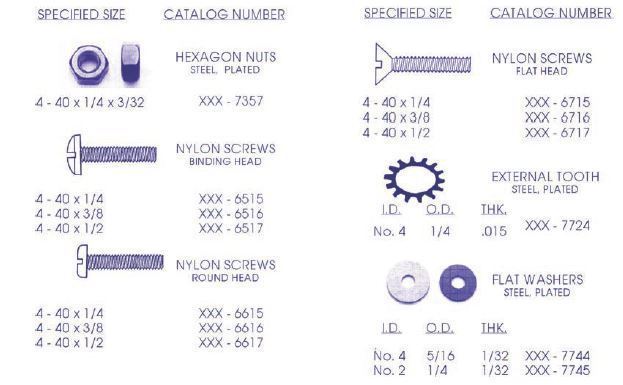
- Pie de imagen: This is how screws are identified in a catalog. The standard screw wire size is stated first, followed by the threads per inch and the overall or threaded-section length.
- The length of the thread on a screw is important information for ordering screws. This figure shows how the length is determined. If you’re measuring to determine the number of threads per inch, count the number of threads and divide by the length of the threaded section.