
Risk & Crisis Management
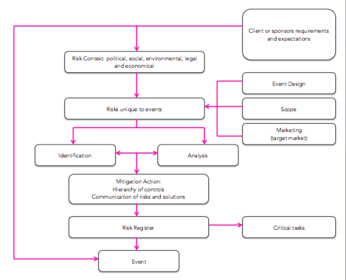
Diapositivas del conjunto (7)
-
- Alcohol Risk Management
- - segregate drinking areas
- - assign security to prevent underage drinking, handle rowdy customers, and regulate the flow of people
- - check parking lots and other areas to prevent illegal consumption
- - serve alcohol only with food
- - employ marketing methods to position the event as a peaceful, leisure opportunity and discourage unwanted segments.
- - event
- managers have a right to screen customers, confiscate illegal substances of any
- kind and deal with the intoxicated.
- - require
- patrons to show proof of age
- - reduce
- the amount served
- - reduce
- the hours
- - responsible
- Serving of Alcohol courses must be a prerequisite for servers
- - free
- soft drinks may be offered to ‘designated drivers’
- - price
- control is effective tool for demarketing
- - paper
- cups are less dangerous
- - advise
- patrons of all regulations and policies through clear signs
- Administration
- - ensure contracts are in place: venue, vendors, suppliers, performers, staff etc...
- - ensure licences and permits are secured: local council and/or government
- Crowd Management
- - crowd flow: entry/exit queues & gates, mosh pit management (concerts, music festivals), toilet queues
- - alcohol & drugs: overindulgence, illegal activity, underage drinking, improper application of RSA, use of glass ware
- - noise control: local community & attendees complaints
- - security: inadequate systems, improper responses, poor onsite communication
-
- Target Markets
- - different cultures: together has the possibility to cause problems
- - numerous market segments: many different habits and expectations, various levels of acceptable behaviour, clashes between segments
- - every event will offend some segment of the overall market (1992 celebration of 500th anniversary of the discovery of America offended native Americans, Bicentennial celebrations in Australia offended aborigines, etc)
- Venue
- - emergency response: accessibility and capability for numerous types of emergencies
- - temporary onsite related risks
- Weather
- - need for adequate provisions in case of bad weather (indoor areas, marquees, tents, poncho sales)
- - appropriate systems in place if event needs to be called off due to weather conditions (fire danger: WA Racing The Planet - Turia Pitt)
-
- Quality Control
- - often difficult because of the occasional or one-time nature of many events
- - Poor quality poses financial risks and could exacerbate other problems, especially with regard to dissatisfied customers
- Financial Controls
- - essential to preventing losses
- - many events cannot be produced without acceptance of some degree of financial risk
- - mega events in particular entail major financial risks and failures can be spectacular.
- Volunteers
- - training is often inadequate
- - risks involved as they are face of the event when working and if not properly familiar with proceedings/expectations etc... could shine in bad light
- Visibility
- - bigger the event, the more the media coverage
- - greater chance of risk for marketing/pr departments
- - media attracted to unsavoury elements of event
- - high-visibility can draw attention of terrorism, crime etc...
- Financial Risk Management
- - determine who is allowed to access cash and bank accounts, and who is
- to be issued a credit facility
- - take steps to reduce cash, require prepayment or credit cards
- - keep video or photographic records of the inventory lists, especially
- for the expensive equipment
- - formulate clear policies on what staff and volunteers can claim as
- expenses, and procedures for reimbursement
- - personally control credit arrangements
- - ticket stubs with consecutive numbers must be retained.
- - unsold tickets
- must be saved for tax audits
- - control complimentary tickets
- - procedures for reselling and refunds
- - if a tax receipt is issued for donations, ensure receipts have the
- authorised signatures
-
-
- 1. minimise
- liability and financial loss
- 2. reduce
- insurance premiums which risk is transferred to another party
- 3. maintain
- a safe environment for employees & spectators
-
- May lead to loss of life or serious injury
- Incident will lead to outside attention through media
- Will cause serious disruption to event/facility
- Examples
- - fire
- - explosion
- - major
- accident
- - vehicle, theme park ride, attack by person or animal
- - food
- poisoning
- - flood
- - robbery
- or theft
- - bomb
- explosion / hoax
- Action Required
- 1. Tackle Emergency/Crisis
- - evacuation
- - closure
- 2. Handle Media
- - designated spokesperson
- - professional public relations
- Responsibilities
- - operator
- is required to ensure that if an incident occurs, they have taken all possible care to reduce the seriousness of the
- incident
- - legal
- obligation: Duty of Care, Workplace Health & Safety requirements, other
- similar legislation
- - documented procedures must be in
- place, which adequately demonstrate that the impact of the incident is minimised
-
- contains the response to the impact of a risk and involves a decision procedure, chain of command and a set of related actions.
- you're presented with a risk and how you would help reduce/solve the likelihood of it happening
- EXAMPLE
- attendace is higher than expected causing congestion at the front gate. Those who will be affected are the volunteers and staff at the front gate as well as the public. So as a contingency plan you will have the staff and volunteers trained to either go out to the lines and get their tickets, speeding up the lines or simply open up another gate
Información
- Descripción
- risk and crisis management related to event operations
- Creado por
- denni.egan
- Visitas
- 66
- Etiquetas
- Valoración