
Fichas
Addition Polymers
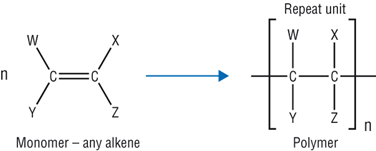
Fichas del conjunto (18)
- 1Complete the sentences: The double bonds in alkenes can open up and join together to make ____________. The individual, small alkenes are called ____________. This is ___________ polymerisation.The double bonds in alkenes can open up and join together to make POLYMERS. The individual, small alkenes are called MONOMERS. This is ADDITION polymerisation.
- 2What is the notation for repeating units of a polymer?
- 3Polymers are very unreactive. Why might that be advantageous?Food doesn't react with PTFE coating on pans
Plastic windows don't rot
Plastic crates can be left out in the rain
Etc. - 4Polymers are very unreactive. Why might this be disadvantageous?Most polymers aren't biodegradable, so they're really difficult to dispose of
- 5What are the 3 ways by which plastics can be disposed?Burying waste plastic
Recycling plastics
Burning waste plastic - 6Where are waste plastics usually buried?In landfills
- 7Burying waste plastic in landfills is generally used when the plastic is...Difficult to separate from other waste
Not in sufficient quantities to make separation financially worthwhile
Too difficult technically to recycle - 8What are the disadvantages of burying waste plastic in landfills?The amount of waste we generate is becoming more and more of a problem, and the amount of free space for landfills is decreasing. Therefore, there is a need to reduce landfill as much as possible
- 9Why should we recycle plastics?Because many plastics are made from non-renewable oil fractions, it makes sense to recycle plastics as much as possible
- 10Describe two ways in which plastics can be recycledAfter sorting into different types, plastics can be:
Melted and remoulded
Cracked into monomers which can be used as an organic feedstock to make more plastics or other chemicals - 11What are the advantages of burning waste plastic?The heat can be used to generate electricity
- 12What are the disadvantages of burning waste plastic?Toxic gases may be produced
- 13How can the process of burning waste plastic be controlled to reduce toxic gases?Waste gases from the combustion are passed through scrubbers which can neutralise gases (e.g. HCl) by allowing them to react with a base
- 14What can biodegradable polymers be made out from?Starch (from maize and other plants)
The hydrocarbon isoprene (2-methyl-1,3-butadiene) - 15What are the advantages of using renewable raw materials?Renewable raw materials aren't going to run out like oil.
When polymers biodegrade, CO₂ is produced. If your polymer is plant-based, then the CO₂ released is the same CO₂ absorbed by the plant when it grew. BUT! With an oil-based biodegradable polymer, carbon is transferred from the oil to the atmosphere.
Over their 'lifetime' some plant-based polymers save energy compared to oil-based plastics - 16What are the disadvantages of using renewable raw materials?Whatever raw materials you use, at the moment the energy for making polymers usually come from fossil fuels.
Biodegradable polymers still need the right conditions before they'll decompose, therefore you'll need to collect and separate the biodegradable from the non-biodegradable.
At the moment, they're more expensive than oil-based equivalents - 17Describe the use of polyethene with starch grainsPlastic sheeting used to protect plants from the frost can be made from polyethene with starch grains embedded in it
Over time, the starch is broken down by microorganisms and the remaining polyethene crumbles into dust. There is no need to collect and dispose of the old sheeting. - 18What other things could scientists to make processes involving polymers more environmentally-friendly?Continuing to develop photodegradable polymers
Developing better techniques for cracking polymers so that recycling becomes more efficient
Finding new ways of making polymers from plant-based substances to reduce the use of finite raw materials
Using processes with higher atom economy to reduce waste
Developing new, more efficient ways of sorting and recycling polymers
Información
- Descripción
- El usuario ha eliminado su información de asignaturas Fichas sobre Addition Polymers, creado por Usuario eliminado el 12/03/2018.
- Creado por
- Usuario eliminado
- Visitas
- 8
- Historial
-
- Creado por Yinka F · 7 mar 2018
- Copiado por Yinka F · 12 mar 2018
- Valoración