
Fichas
Introduction to Ecology

Fichas del conjunto (66)
- 1Biological definitions of ecology?"the total relations of the animal and plant to both its organic and inorganic environment"
"The structure and function of nature"
"The scientific study of the distribution and abundance of organisms" - 2What does ecology derive from historically?systematics, natural history, geology, geography and mathematics
- 3Important historical figures in ecology?Linaeus published first universal classification system in 1735 for animals.
Gilbert White published The Natural History of Selbourne in 1789 which showed detailed observations of animal life and links between species - 4More historical figures in ecology?Alexander von Humboldt travelled through Latin America in 1799-1804 and described the geology, climatology and natural history as well as noting interractions between animals and plants and abiotic factors.
Thomas Malthus (1798) wrote a book about the interaction between population and resources - 5Yet more historical figures in ecology?Darwin's Origin of the Species was essential for understanding adaptation to the environment and competition for resources.
Ernst Haeckel (1866) first used the word 'ecology' derived from greek for 'home science'.
Eugenius Warming introduced concept of plant succession - 6What is adaptation?To survive, an individual organism must change to their environment so as to fit their habitat. It involves natural selection and fitness of genotype.
- 7What is the basis of adaptation?Ability of organisms to reproduce and leave the greatest number of descendants, better match of characteristics suited their environment will leave more descendants
- 8What is an ecotype?A group of individuals whose characteristics are suited for their environment in which they are found
- 9What factors are known to affect adaptations?Climate, food quality, pH, salinity, etc. Presence or absence of these factors influence the type of interactions and competition between individuals of the same species and also between different species.
- 10What is a population?groups of individuals of the same species occupying a particular space at a particular time, under a specific set of environmental conditions.
- 11Ecological niche definition:"Functional role and position of an organism in its community"
"Organism's place in the biotic environment and its relation to food and its enemies"
"different environmental conditions needed by species to maintain a viable population" - 12What is a fundamental niche?A set of optimal environmental conditions for a given species which has neither competition or predation
- 13What is a realised niche?The actual set of environmental conditions under which a species exists
- 14Best way to remember the difference between a habitat and a niche?A habitat is the organism's address but the niche is it's profession
- 15How to work out population density?
- 16What is natality?The reproductive output (births) of a population
- 17Difference between immigration and emigration?Immigration is organisms moving into an area but emigration is organisms moving out of the area.
- 18What are life tables?They bring together the natality and mortality rates of a species into a single table
- 19What is intraspecific competition?-Limited supply of the same resource
-Members of the same trophic level competing
-Effects of competition on any individual is greater so there is a greater number of competitors (density dependant interaction) - 20What is interspecific competition?This occurs between two different species that have a habitat overlap. They often compete over the same limited resource.
- 21What is the competitive exclusion principle?Two competing species coexist in a stable environment as a result of niche differentiation. No such differentiation or precluded by habitat, then one species will eliminate of exclude the other
- 22Summary of competing species?Competing species can coexist together only if they avoid an overlap of niche
- 23What is environmental heterogeneity?Interspecific competition models assume a stable environment but weak competitors can coexist with strong ones due to heterogeneity. Weak competitors can hide but they must be good colonisers.
- 24What are r-selected species?Have rapid reproductive rates (lots of insects)
- 25What are k-selected species?Tend to stabilise at around the carrying capacity (most mammals)
- 26What are unpredictable gaps?They are patches that appear and disappear quickly, caused by fire, heavy rainfall, land slides or trees falling. They are suitable for colonisers to then utilise the habitat quickly until other competitors invade.
- 27What are ephemeral patches?Environments which exist only for a very short period of time like a dung heap or puddle
- 28What is aggregated distribution?Weak and strong competitors coexist by promoting intraspecific competition as the regulator limiting population size
- 29What are true predators?they kill their prey immediately after attacking them and consume many prey individuals throughout their life
- 30What are grazers?Predators that attack large numbers of prey but only remove part of each prey individuals
- 31What are parasites?Predators that consume parts of their prey or hosts and only attack one or a few individuals in their life time
- 32What are parasitoids?Insect predators that lay their eggs on other arthropods within which the larvae develop and consume their host
- 33What is an ecological community?An assemblage of populations of plants, animals, bacteria and fungi that live in an environment and interact with one another, forming a distinctive living system with its own composition, structure, environmental relation, developments and functions
- 34How can communities be physically identified?A community is defined by its type of habitat, such as a lake or decaying carcass
- 35How can communities be identified taxonomically?Defining a community by one or more conspicuous species that dominate the community by sheer biomass
- 36How can a community be identified statistically?Defining communities by sets of species whose abundance is highly correlated either positively or negatively over space and time, identified using multivariate statistics to ID the community
- 37How can communities be identified interactively?Defined by a subset of species whose interactions have direct influence over the abundance, eg, keystone species
- 38What are sharp boundaries on community edges of ecological communities?Human made by forest clear cutting or other similar methods
- 39What are diffuse boundaries in the same respect?The community will change gradually along an environmental gradient
- 40What are mosaic boundaries?Patches which are irregularly positions in the environment
- 41What is a guild?A collection of species using the same resources in a smilar way, but which are not taxonomically related. Eg, birds, rodents and insects all eat seeds but aren't related
- 42What is a taxocene?A set of taxonomically related species in a community, eg, finches in woodlands or gulls on cliffs
- 43What is a trophic level?Subsets of species that acquire energy in a similar way. Primary producers, or plants, herbivores, primary carnivores and decomposers are a trophic level each
- 44What is a food chain/webA subset defined by the feeding relation between species which includes trophic levels such as plants
- 45What is diversity?The number of species present in a community at any one time (including migrants)
- 46What is species richness?The number of species who are true residents of an area (permanant residents)
- 47What is species evenness?The relative number of individuals of each species present (5 species with equal numbers of individuals is more even even 5 species where one species accounts for around 95% of individuals)
- 48What is heterogeneity?Incorporates richness and evenness, a higher number of species and relatively equal abundance of individuals
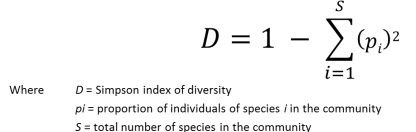
- 49What is the Simpson's Diversity Index?
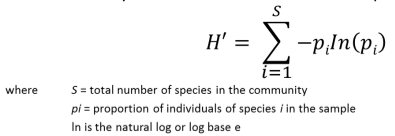
- 50What is the Shannon Index or Shannon-Weaver index of Diversity?
- 51What is history as a casual factor of diversity, richness and heterogeneityThe biotic changes which have occurred to a community over evolutionary/ecological time
- 52What is habitat heterogeneity?The complexity of habitats, competition can exclude weaker species or might have caused niche differentiation
- 53What is predation?The consumption in whole or in part of an organism by another and to enhance diversity the predator must eat dominant prey species
- 54What is climate and climatic variability?Promotes speciation through specialisation. Stability allows finer adaptations of niches and more species
- 55What is productivity?Greater the productivity the greater the diversity?
- 56What is diversity in terms of diversity, richness and heterogeneity?It can affect community species diversity by creating opening or removing individuals from a community
- 57What is succession?Ordered progression of structure and composition change in communities toward and eventual unchanging climax community
- 58What is primary succession?Succession from a site without any vegetation like land affected by volcanoes or glaciers
- 59What is secondary succession?Change on a site of existing vegetation as a result of disturbance like fires, storms or agriculture cleaning
- 60What is degradative succession?Localised and over a short period of time
- 61What is autogenic succession?Cause by biological processes, like increased shading by a tree modifying the conditions or resources
- 62What is allogenic succession?Caused by external physical changes such as changes in pH, soil composition, water chemistry etc
- 63What is monoclimax?The end point of all successions, independant of their starting point and the only determining factor is climate
- 64What is polyclimax?States many climax states could be present, determining factors include soil moisture, soil nutrients, topography, animal activity and fire
- 65What is the climax pattern hypothesis?Communities are adapted to a variety of environmental conditions including climate, fire, biotic factors, soil conditions, etc. They are varying gradually along environmental gradients.
- 66Why is climax of succession rare?Some form of natural (fire or storms) or anthropogenic (grading, slash and burn) disruption would impede full succession sequence. Micro successions are formed because the disturbances cause mosaic of gaps with different succession sequences.
Información
- Descripción
- Ecological Concepts and Plant Sciences Fichas sobre Introduction to Ecology, creado por Emma Lloyd el 17/04/2018.
- Creado por
- Emma Lloyd
- Visitas
- 13
- Valoración