
Fichas
Chapter 9 Magnets and currents

Fichas del conjunto (25)
- 1Properties of magnets?-Has a magnetic field around it
-Has two opposite pole (N and S)
-Will attract magnetic materials by inducing magnetism in them
-Will exert little or no force on a non magnetic material - 22 of the same pole will? 2 opposite poles will?Like poles repel, unlike poles attract
the closer the poles the greater the force between them - 3How can you make a magnet?BEST WAY is to use electricity
-Stroke the iron with a magnet (this makes all the domains follow the magnet)
-Hammer the metal (the domains turn the same way) - 4How do you demagnetize something?BEST WAY is to use alternating current
-Hammer the object
-Heat up the object - 5Properties of soft iron?Soft iron is easy to magnetize but loses its magnetism very easily
- 6How can field lines be shown?Field lines can be shown using iron filings sprinkled over a piece of magnet on top of a magnet
- 7How can field lines be shown around a magnet?-The field lines run from the N to the S
-The magnetic field is strongest where the the lines are closest together - 8What is the rule for field direction?The direction of the magnetic field produced by a current is given by the right hand grip rule.

- 9How can you make a magnetic field stronger?-Add more coils
-Increase the current
-wrap the coil around a soft iron core - 10What is a long coil of wire called?A long coil is called a SOLENOID
- 11How could you change the poles?-Turn the coils the other way
-Reverse the current - 12What is an electromagnet and how is is different form a normal magnet?An electromagnet is coils with a current flowing through them. Unlike an ordinary magnet, an electromagnet can be switched on and off.
- 13What is a magnetic relay?A magnetic relay is a switch operated by an electromagnet. With a relay a small switch can be used to turn on a much more powerful circuit.
- 14How does a magnetic relay work?When the switch in the input circuit is closed a current flows through the electromagnet. This pulls the iron armature towards it, which closes the contacts. As a result a current flows through the motor.
- 15What is Fleming's left-hand rule?If you hold the thumb and first two fingers of your left hand at right angles, and point the fingers as shown, the thumb gives the direction of the force

- 16How does a simple dc motor work?The coil can rotate between the poles of the magnet, The communicator rotates with the coil. The brushes keep the coil connected to the battery

- 17How can the turning effect on the coil be increased?-Increasing the current
-Using a stronger magnet
-Increasing the number of turns in the coil
-Increasing the area of the coil - 18How do you induce a current in a coil?You move a magnet into a coil. This cause a voltage to be induced in the coil. The magnetic fields are moving
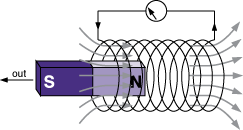
- 19How can the induced voltage be increased?-moving the magnet faster
-using a stronger magnet
-increasing the number of turns on the coil - 20What is a transformer?A transformer can be used to increase or decrease AC voltages

- 21How does a transformer work?When alternating current flows through the Primary coil, it sets up an alternating magnetic field in the core and secondary coil. This induces an alternating voltage in the output coil.
- 22What is the turns ratio

- 23What is a step up transformer?Step up transformers have more turns on the output coil than on the input coil, so their output voltage is more than the input voltage. Step up transformers are used in power stations.
- 24What is a step down transformer?Step down transformers have fewer turns on the output coil than on the input coil so the output voltage is less than the input voltage. In battery chargers, computers and other electrical equipment they are used to reduce the voltage of the AC mains
- 25What is the equation for power through a transformer?Input voltage x input current=
output voltage x output current
V1xI1=V2xI2
Información
- Descripción
- Cambridge IGCSE and GCSE (Physics) Science Fichas sobre Chapter 9 Magnets and currents, creado por Millie Berrett el 31/10/2014.
- Creado por
- Millie Berrett
- Visitas
- 82
- Etiquetas
- Valoración