
Fichas
C&B [058] Hypertension - the action of therapeutics
Fichas del conjunto (63)
- 1What 2 things is sympathetic activity an important determinant of?Vasoconstrictor tone
and therefore resistance to blood flow (BP=COxTPR) - 2Above what value is blood pressure deemed high?If greater than 140/90 mmHg
- 3What pressure is blood pressure?Pressure exerted on artery walls
by circulating blood - 4Definition of HypertensionThere is no absolute definition of hypertension as risk is proportional to BP.
Treatment of people with BP >140/90 mmHg appears to reduce morbidity and mortality. - 5Lifestyle Factors contributing to Hypertensiondietary
high alcohol intake
obesity
physical inactivity - 6Gene factors?Genetic predisposition
- 7Secondary causes of hypertensionrenal – parenchymal, renal artery stenosis
endocrine diseases – excess steroid hormones, phaeochromocytoma
coarctation
drugs - steroids, contraceptive pill - 8Pathophysiology of hypertensionMost (~ 95%) hypertension is ESSENTIAL HYPERTENSION – unidentified cause
Remainder SECONDARY; e.g., due to kidney disease - 9Diagnosing Hypertension perferably? Whats not recommended?Preferably 24 hour ambulatory monitoring
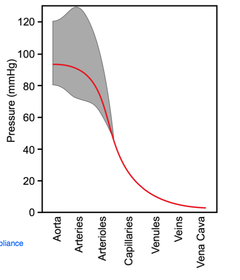
In clinic repeat readings often used; not recommended - 10Profile of blood pressures through the systemic circulation
- 11What is the normal pulse value? Symptoms of hypertension?130/70 normal pulse value
hypertension isn’t much above that
hypertension asymptomatic
bad - lead to many problems - 12Age range: Hypertension sufferersage range 45-55
= 30% M + 25% F have hypertension - 13Risk/Consequences of Hypertension I• Atherosclerosis: cerebral infarct, ischaemic heart disease
• Heart: pressure overload leading to left ventricular hypertrophy and heart failure
• Renal failure - 14Risk II• Cerebral haemorrhage
• Retinopathy
• Aortic dilatation: risk of aortic dissection and aortic regurgitation - 15Key Scientific Principle involving BPPrinciple:
Arterial blood pressure (BP) is determined by cardiac output (CO) and total peripheral resistance (TPR)
BP=COxTPR - 16Key Scientific Principle involving stroke volumeStroke volume is influenced by:
inotropic state of the heart
venous return (preload)
afterload - 17Key Scientific Principle involving Inotropic stateInotropic state is influenced by:
neural and humoral factors;
e.g., sympathetic (noradrenaline) and adrenal medulla (mainly adrenaline) - 18Key Scientific Principle involving Venous return (preload)Venous return (preload)
at rest
is mainly influenced by:
blood volume (effective circulating volume),venous compliance
gravity. - 19Key Scientific Principle about HRHeart rate is influenced by:
neural and humoral factors;
e.g., parasympathetic (acetylcholine), sympathetic (noradrenaline) adrenal medulla (mainly adrenaline) - 20What is TPR influenced by?Total peripheral resistance is influenced by:
state of contraction of vascular smooth muscle in walls of resistance vessels – determined by local, circulating and nervous factors - 21Other things hypertension can lead to- increased stroke risk / anneurysm
- renal failure
- retinal damage
- coronary thrombosis
- left ventricular hypertrophy - 22Functions and diameters of the blood vessels diagram
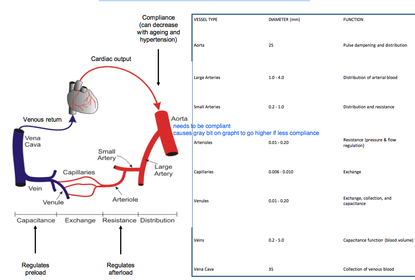
- 23Classifying HypertensionPrimary / Essential Hypertension
and
2dary hypertension: identifiable cause + usually treatable - 24Cause of primary hypertensionusually no obvious cause
Advise patients to make lifestyle changes - 25Causes of 2dary hypertension: PhaechromecytomaPhaechromecytoma: tumour of adrenal medulla
treat with surgery +/or blockers adrenoreceptor - 26Causes of Secondary hypertension involving adrenal cortexTumour of adrenal cortex:
- releasing too much aldosterone +/- cotrisol
- treat w. surgery or blockers - 27Causes of Secondary hypertension involving aortaNarrowing of aorta:
- decreased compliance
- need compliance to take pressure
- correct w. surgery, angioplasty - 28Targets for therapeutic interventions involving nervous control of cardiac output and peripheral resistanceSympathetic/Parasympathetic: drugs that influence neurotransmission directly or have a modulatory action
Three targets: central nervous system transmission, ganglionic transmission and neuroeffector transmission - 29Targets for therapeutic interventions involving humoral control of cardiac output and peripheral resistanceCirculating hormones and paracrine signalling
drugs: affecting synthesis of , antagonise or mimic the action of endogenous hormone or paracrine signalling e.g., at the effector or nervous pathway regulating the effector - 30Target for therapeutic intervention involving excitation-contraction couplingDrugs that reduce the ability of an effector to respond to incoming signals
On vascular smooth muscle such drugs would cause relaxation and a consequent decrease in TPR and/or an increase in venous capacitance. - 31Blood volume: a target for therapeutic interventionsDrugs that influence renal function
and thereby influence whole body water and sodium content
and therefore affect circulating blood volume. - 32Sites of action for antihypertensive drugs diagram
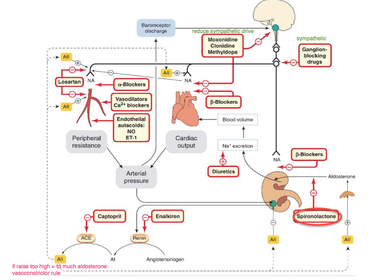
- 33Drugs affecting Sympathetic Nervous System have a target of?> adrenoreceptors
found by alquist in 1947:
2 types of them = alpha + beta
> catecholamines inc noradernaline : adrenaline + isoprenaline are structural modifications of this structure - 34Alpha and beta receptors: Give order of the 3 adrenaline hormones they each recogniseα-receptors: noradrenaline>adrenaline>isoprenaline
β-receptors: isoprenaline>adrenaline>noradrenaline - 35What does isoprenaline cause?vasodilation + increase heart rate - inotropic efefct
big drop in diastolic - 36Noradrenaline?Vasoconstriction
- 37Schematic representation of cardiovascular effects of intravenous adrenaline, noradrenaline or isoprenaline
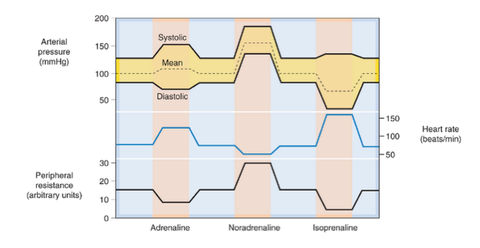
- 38What do the drugs that target sympathetic nervous system do?1. regulate heart rate + force of contraction : influence CO
2. regulate resistance of aterioles into capillary beds = TPR - 39What are the beta receptors sub classified into? What do each do?Beta 3: mediates lipolysis
Beta 2: bronchodilation + vasodilation
Beta 1: chronotropy + inotropy - 40What do drugs that affect Renin-Angiotensin - Aldosterone System influence?influence venous return and blood volume and TPR (as angiotensin is a vasoconstrictor)
- 41Basis of Renin-Aldosterone Angiotensin Systemdecreased glomerular filtration
= juxtoglomerular apparatus releases renin
= makes angiotensin and
aldosterone release - cause Na retention
+ H2O retenion = increase blood vloume - 42Diagram: What do Ace inhibitors target? What angiotensin II AT1 subtype receptor antagonists target?
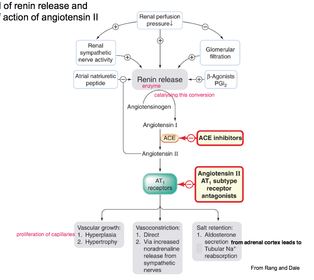
- 43ACE diagram
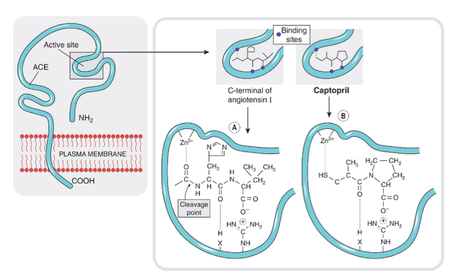
- 442 aldosterone analogues
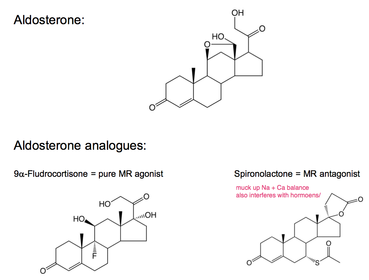
- 45What are the miscellaneous agents that target sty to do with Ca2+?Ca2+ Channel Blockers: cardiac muscle + smooth muscle depending on Ca2+ coming through membrane
Heart and / or smooth muscle: w. dihydropyridines e.g. Nifedipine ACTING ON SMOOTH MUSCLE - 46ctd. What does VERAPANIL and diltazem act on ?VERAPANIL acting on heart
diltazem act on both cardiac + smooth muscle - 473 types of miscellaneous agents?Ca2+ Channel Blockers
K+ Channel Activators
Nitric Oxide donors - 48K+ Channel Activators e.g. minoxidilminoxidil -> active subhated metzbolite
serious side effects: can cause water retention - 49What do nitric oxide donors do? Nitroprusside?Nitric Oxide Donors
liberate NO in tissue
e.g. Nitroprusside - produce cyanide in sun? - 50Common antihypertensive drugs and their adverse effects Thiazide diuretics (e.g. bendroflumetiazide)

- 51Common antihypertensive drugs and their adverse effects ACE inhibitors (e.g. enapril, captopril)
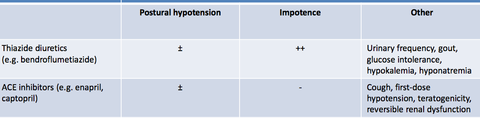
- 52Common antihypertensive drugs and their adverse effects AT1 antagonists (e.g. losartan

- 53Common antihypertensive drugs and their adverse effects Ca2+ channel antagonists (e.g. nifedipine)Impotence
Ankle Odema - 54Common antihypertensive drugs and their adverse effects β-adrenoreceptor antagonists (e.g. metoprolol, propranolol)Impotence
Bronchospasm, fatigue, cold extremities, bradycardia - 55Common antihypertensive drugs and their adverse effects α-adrenoreceptor antagonists (e.g. doxazosin)Postural Hypotension
First dose hypotension - 56Common antihypertensive drugs and their adverse effects K+ Channel activators (e.g. minoxidil)Postural Hypotension
-
Salt & water retention, tachycardia, hirsutism - 57Common antihypertensive drugs and their adverse effects NO donor (e.g. nitroprusside)Postural Hypotension
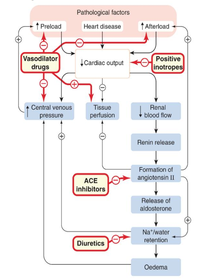
Accumulation of toxic thiocyanate - 58Pathogenesis and treatment of heart failure
- 59What do alpha-adrenoceptor blocking drugs and prazosin target?Resistance vessels, through antagonising sympathetic effects
- 60What do calcium channel blockers and amlodipine target?Resistance vessels acting on excitation-contraction coupling
- 61What do drugs affecting the renin-angiotensin system – angiotensin-converting enzyme inhibitors and ramipril do?block the synthesis of a hormone that can act directly on vascular smooth muscle
enhance sympathetic transmission - 62What do drugs affecting the renin-angiotensin system – angiotensin II receptor antagonists and losartan potassium do?blocks the action of the hormone described above by blocking its action at its receptor
- 63What do beta-adrenoceptor blocking drugs and atenolol target?Heart
through antagonising the effect of sympathetic activity
to cause a reduced cardiac output by reducing stroke volume and/or heart rate.
Información
- Descripción
- Fichas sobre C&B [058] Hypertension - the action of therapeutics, creado por jyghowes el 22/02/2015.
- Creado por
- jyghowes
- Visitas
- 4
- Valoración