
Fichas
AQA GCSE Additional Science Physics
Fichas del conjunto (33)
- 1Difference between ac and dcAC = Alternating current. Current constantly changes direction.
DC = Direct current. Current flows in one direction only. - 2Mains frequency and Mains voltage50Hz
and
230V - 3What are plugs made of? What are wires made of? What are pins made of?Plastic (good electrical insulator, prevents anyone touching it from receiving an electric shock)
Copper (good electrical conductor, bends easily)
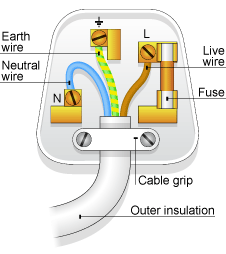
Brass (good conductor, doesn't rust/oxidise) - 4Diagram of a PlugbLue = Left
bRown = Right
sTriped = Top - 5How to determine the frequency of an a.c. supply1
__________
time taken for 1 cycle - 6How do fuses work? How does an RCCB work?Contains a thin wire that will melt if current through them is too high. (should always be in series with live wire between live wire and appliance. When fuse blows, appliance is cut off from live wire."
Electromagnet switch that switches a circuit off by detecting a difference between current in live and neutral wires. - 7Comparison of RCCB and FuseRCCB can switch a current off faster. Safer.
RCCB can be reset, whereas a fuse will simply melt when a high current flows through it. - 8Why do appliances with plastic cases not need earthing?Plastic is an insulator so cannot become live.
- 9How Earth wire protects userIf fault occurs and connects live wire to case
Earth wire carries current from case back down Earth wire.
Big current flows and melts fuse. - 10What is an isotope?An element with the same proton number but a different neutron number.
- 11Natural Sources of Background RadiationCosmic rays
Rock e.g. granite
Food and drink - 12Artificial Sources of Background RadiationNuclear weapons testing
X-rays
Medical scanners - 13Nature of alpha radiation Nature of beta radiation Nature of gamma radiation2 protons and 2 neutrons (same as helium nucleus)
Electron
Electromagnetic radiation - 14Charge of alpha radiation Charge of beta radiation Charge of gamma radiation+2
-1
0 - 15fastest type of radiationGamma, then beta, then alpha
- 16Most penetrating type of radiation?Gamma, then beta, then alpha
- 17Which type of radiation is the most ionising?Alpha, then beta, then gamma
- 18Uses of radiationAlpha:
Smoke alarms
Controlling paper thickness
Beta:
Controlling foil thickness
Gamma:
Medical tracers
Sterilise surgical equipment
Kill cancer cells (radiotherapy) - 19Plum pudding model of nucleus and why it was rejectedNo nucleus
Mass is spread out
+ve charge spread out
Embedded electrons
Couldn't explain why some alpha particles were scattered through large angles. - 20Nuclear model of nucleus and why it was accepted.There's a nucleus where the charge and mass are concentrated.
Electrons orbit nucleus.
Correctly explained why, in Geiger and Marsden's experiment, some alpha particles were scattered through large angles. Explains radioactivity in terms of changes that happen to an unstable nucleus when it emits radiation. Predicted existence of neutron, which was later discovered. - 21What happens in alpha particle emission?Nucleus emits an alpha particle and forms a new nucleus.
- 22What happens in beta particle emission?A neutron in the nucleus changes into a proton.
A beta particle is created in the nucleus and instantly emitted. - 23What is a half-life?The time it takes for half the radioactive nuclei to decay
- 24What is nuclear fission? Where does it occur and with which substances?The splitting up of a nucleus into 2 approximately equal fragments, releasing 2 or more neutrons.
Occurs in nuclear power stations with uranium-235 and plutonium-239 - 25What is nuclear fusion? Where does it occur?The joining together of light nuclei (e.g. hydrogen) to create heavier nuclei, which gives out a lot of energy.
Occurs in stars. - 26What happens in a nuclear reactor?Core contains nuclear fuel rods made of uranium-235 or plutonium-239
Generates heat.
Water is heated and turns to steam.
Steam goes through heat exchanger.
Heats more, water, which turns into steam, which turns turbines to generate electricity. - 27What to do if a fuse blows/RCCB trips when a mains appliance is in useSwitch appliance off and don't use until it's been checked by a qualified electrician.
- 28What to do if an appliance overheats and/or you get a distinctive burning smell from itSwitch it off, don't use it until it's been checked by a qualified electrician
- 29What is radon gas and why is is dangerous?An alpha-emitting isotope that seeps into houses through the ground.
- 30How do people who work in jobs involving the use of ionising radiation stay safe?Wear personal radiation monitors to ensure they're not exposed to too much ionising radiation.
- 31Dangers of RadiationAlpha particles are highly ionising and can cause cancer. (not very penetrating so damage cells unless it gets into the body)
Beta and gamma are more penetrating so can get through your skin - 32In deflection, why is an alpha particle deflected much less than a beta particle?Its mass is about 8000 times that of a beta particle
- 33What is ionisation?When radiation can knock electrons out of atoms, the atoms become charged because they lose electrons.
Información
- Descripción
- AS Level Science Fichas sobre AQA GCSE Additional Science Physics, creado por Charlie Murray el 10/05/2015.
- Creado por
- Charlie Murray
- Visitas
- 69
- Etiquetas
- Valoración