
Fichas
PRN2110 EXAM REVISION
Fichas del conjunto (86)
- 1Definition [ PRIA ]The deliberate, planned and sustained effort to establish and maintain mutual understanding between an organisation (or individual) and its
(or their) publics
[ PRIA ] - 2Another defination... [ Grunig & Hunt ]The management of communication between an organisation and it's publics.
[ Grunig & Hunt ] - 3Why are there more than 500 definitions?• PR is a hybrid profession
• broad & changing scope of PR
• relatively new discipline - less understood
• overlap business areas e.g. HR, Mktg
• role titles differ greatly
• technological advances - 4PR is performed at different levels:• societal
• governmental
• organisational
• program or project level
• individual - 5PR enables...‘mediated communication’
(as substitute for face2face)
helps orgs est/maintain stakeholder relationships based on mutual understanding by facilitating feedback - 6PR characteristics• communications
• mutual understanding
• sustainable relationships
• ongoing conversation/feedback
• deliberate & planned - 7How and why PR is usedTo build an organisation's reputation, increase awareness of a product or service, enhance credibility of an organisation, carry out a campaign to meet a specific objective, build the reputation of an individual.
- 8How PR benefits an organisation• establishes trust/transparency
• mitigates risk
• establishes/maintains relationships
• facilitates comms & mutual understanding
•creates loyalty
• improves reputation - 9PR techniques include:• Employee comms • Media relations • Stakeholder relations • Issues and crisis mgmt • Investor and financial relations • Community relations • Govt relations • Mktg comms and sponsorship
- 10The role of PR practitioners• communication technicians
• boundary spanners (org/media)
• solve communication problems
• initiate communication activities
• respond to issues, seek media coverage, prepare events - 11Some PR practitioners tasks include:• research/track PR & org performance
• present strategies & plans to mgmt
• implement comms strategies (incl media relations)
• counsel, train & prepare media spokespeople
• write & edit corporate materials.
• manage websites & SM campaigns.
• Plan/manage events, displays, conferences, site visits, open
days, exhibitions, etc. - 12Common misconceptions• PR is publicity
• PR is a subset of marketing
• PR is cheap
• PR is about press releases
• PR is spin - 13PR today• sometimes struggles for respect
• relatively new discipline
• often tensions between PR, advertising & journalism - 14How communication technology impacts PR practice• always on/connected = mobile
• proliferation of communication channels
• accessibility & speed of info
• greater reliance on 'mediated comms' - 15History• Gutenburg printing press (1493)
• French Revolution: first use of propaganda via newspaper, pamphlets, songs (1787-1799)
• Industrial Reveloution: railway (1830-60s), telegraph (1832), telephone (1876)
= more effective (speed & distance) distribution of info/messages - 16Use of PR throughout history• promote war
• lobby for political causes
• support political parties
• promote religion
• sell products
• fundraise
• publicise events & people - 174 models of PR
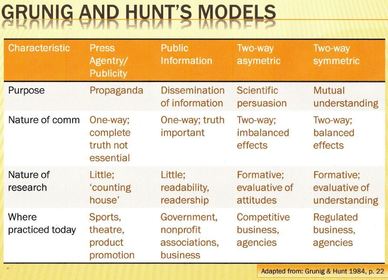
- 18PR Models [ Grunig & Hunt ]4 distinct approaches to PR:
1. press agentry / publicity
2. public information
3. two-way asymmetric
4. two-way symmetirc - 19Press agentry / publicity [ PT Barnum ]• one way communication
• truth not essential (not ethical)
• using news stories/events to gain media & public attention (propaganda)
• use of persuasion/manipulation to influence audience actions (to suit org)
• used in sports, theatre & product promotion - 20PT Barnum (1810-1891) [ Press agentry / publicity ]• press agent, showman
• 19th century growth in newspapers due to rail expansion
• Advertisers given free ‘puffs’ and advertorials
• First use of press agents - 21PT Barnum said..."There is a sucker born every minute."
- 22Public information [ Ivy Lee ]• one way communication to distribute org info e.g. press releases
• truth & accuracy important
• lack of feedback
• focus on providing information rather than persuasion
• used in govt, NFP & business - 23Ivy Lee (1877-1934) [ public Information ]• often called the father of PR
• consultant to high profile clients e.g. Rockefellers
• practice built on the idea of providing truthful public information. - 24Ivy Lee said..."Tell the truth, because sooner or later the public will find out anyway. And
if the public doesn't like what you are doing, change your policies and bring them into line with what people want“ - 25Two-way asymmetric [ Edward Bernays ]• two-way comms (imbalanced)
• comms to influence/persuade
• feedback used to improve message for org's benefit
• used in competitive business - 26Edward Bernays (1891-‐1995) [ two-way asymmetrical ]• 'father of spin'
• used news (and propaganda) as tools
• feedback used to make
message more effective (to better serve org interest)
• created 'Torches of Liberty' campaign - 27Two-way symmetric [ James Grunig ]• 'excellence model'• two-way comms (balanced)
• equal exchange of info & feedback
• used to establish relationships based on mutual understanding
• used in community based orgs - 28James Grunig (1942 - present) [ two-way symmetrical ]• developed in 1980's
• equal exchange of info & feedback
• sees org as fluid with its environment
• atmosphere of give and take to achieve consensus or collaboration
• 'excellence model' - 29PR is the ________ , ________ and ________ effort to establish and maintain ________ understanding between an ________ and its ________.deliberate, planned and sustained
mutual
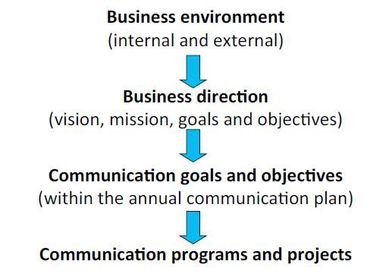
organisation, publics/stakeholders - 30Where communication fits
- 31What is a communication plan?written document outlining most effective way to use communication to solve a problem or meet org needs
- 32PR planning process
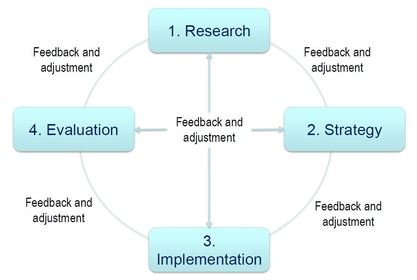
- 334 stages of the PR planning process1. RESEARCH: systematic effort to investigate facts about a problem or issue
2. STRATEGY: plan of action to achieve particular goal
3. IMPLEMENTATION: execution & actions to achieve goals
4. EVALUATION: determine value or importance of activity - 34Define researchsystemic effort to investigate facts about a specific problem or issue
- 352 types of researchFORMATIVE: input to comms planning e.g. stakeholder & situational analyses to determine current situation & desired future situation
EVALUATIVE: measures effectiveness of PR program/outcomes
• quant & qual methods used for both
• conducted as part of continuous process (feedback & adj) - 36Research methods• quantitative: secondary sources, based on numbers e.g. surveys, media monitoring
• qualitative: primary sources e.g. focus groups, interviews - 37Define strategyplan of action designed to achieve a particular goal
• overarching idea, concept or approach
• 'game plan' - 38What is implementation?• what needs to be done & what needs to be said
• must be based on robust strategy & research
• support org goals
• ensure chosen channels are relevant to TA segments - 39What is evaluation?assessing the relative value or importance of activity undertaken
(conducted at each stage of PR cycle) - 40Define stakeholderany person, group or org who can impact or is impacted by the org
e.g. employees, customers, NGOs, govt, communities, local residents, shareholders, suppliers, etc. - 41Define stakeholder segmentationdividing target audience based common characteristics
e.g. primary/secondary, demographics, psycographics, geographic, attitudes & behaviors - 42Stakeholder analysis steps1. identify groups
2. segment
3. diagnose (e.g. supportive, unsupportive)
4. develop comms strategy (messages & channels) - 43Stakeholder analysis criteria• how affected - pos/negatively
• current org/stakeholder relationship
• level of impact/influence
• does project align w/their existing beliefs - 44Define stakeholder relationship managementprocess of influencing stakeholder attitudes, decisions & actions for mutual benefit.
- 45What are PR goals?• end points towards which effort is directed
• broad, relatively abstract, difficult to quantify
• accomplishing goals = org success - 46What are PR objectives?• subset of goals - objective is one step to achieving desired goal
• process or results - process obj. support results obj.
• are factual & measurable
• SMART (specific, measurable, agreed, realistic, timed) - 47Sample objectivesPROCESS (action): To finish writing 15 pg brochure copy for client approval by 31 May 15
RESULTS (outcome): To achieve 70% employee support for new corp structure through PR comms by Nov 5 as measured by survey - 48Define tacticsactions taken at an operational level to implement strategy
e.g. events, media kits, email - 49Define messagekey ideas you want your audience to think about
- 50Message content should:• outline program, policy, product or service being communicated
• benefit i.e. WIIFM
• call to action
• be consistent across stakeholder groups & channels
• be tailored to segments (framing) - 51Define framingtailoring a message to suit/make relevant to an audience segment
• use of selection & salience (emphasis)
• can influence how audience percieves message - 52What is cognitive bias?how people seek & interpret info as compared w/existing beliefs
• occurs on an unconscious level e.g. loss aversion
• understanding bias can help tailor messages - 53Define measurementdetermine/quantify effectiveness of activity using numbers
- 54Measurement helps:• quantify project success against objectives
• provide data for future planning 'lessons learnt'
• justify budget allocation & ROI - 55What is a Gantt chart?project mgmt tool used to plan activity/tasks and required effort
e.g. days, resources & dependencies - 56Define propagandainformation, especially of a biased or misleading nature, used to promote a political cause or point of view.
- 57PR communication channels include:• interpersonal comms
• org channels e.g. intranet, newsletter
• news media
• advertising
• promotional merch - 58What is media relations?working with the media e.g. journalists to obtain positive coverage for org e.g. via press releases
(also called publicity) - 59Media relations (publicity) characteristics:• communication of information through via news media
• less control over what is being said
• more credibility through 3rd party endorsement (journalist)
• tool to influence & change behavior
• should be planned & strategic - 60Publicity/media relations is used to:• cut through clutter
• create conversation
• attract media interest & coverage
e.g. Tourism Queensland 'Best job in the world' campaign - 61What is uncontrolled media?messages that do not originate from the org which the org has no control over
e.g. news media: because journalist determines what would interest viewers/readers/audience and how message is portrayed - 62What is controlled media?messages that originate from the org which org has direct control
e.g. advertising, internet (email & website), social media (has controlled & uncontrolled elements) - 633 categories of mass media:PRINT: newspaper, books, mags
AUDIO: radio
VISUAL: tv, cinema - 64What is 3rd party endorsement?SOLICITED or UNSOLICITED recommendation or testimonial from an entity other than the manufacturer and seller of a product or service
- 653 types of 3rd party endorsement:1. expert e.g. doctor, scientist
2. celebrity e.g. Tiger Woods/Nike/Tag Heuer
3. journalist e.g. media coverage - 66Why and how is 3rd party endorsement used ?• provide information/persuade audience to buy a product, support an issue, or vote for a candidate
• appears independent/more credible
• more cost effective than paid advertising - 67What is ethics?• 'doing the right thing'
• honesty, openness, loyalty, respect
• subjective, less clear cut than morals
• learned as part of upbringing & culture - 685 ethical ( & potentially conflicting) considerations:1. duty to self
2. duty to employer
3. duty to client
4. duty to profession
5. duty to society - 69What is the PRIA code of ethics?• 15 point code (+ law)
• provides practitioners with a guiding framework for ethical practice
• PRIA membership voluntary
• PRIA code not enforceable - 70Why do we need a PR code of ethics?• avoid deception
• disclose conflicts of interest
• balance responsibilities & public interest
• strive for 'best-practice PR' - 71Risks of unethical practice include:• loss of public trust
• erosion of org reputation
• whistle blowing
• legal ramifications - 722 ethical theoriesTHEOLOGICAL: for the greater good - ends justifies means
DEONTOLOGICAL: doing the right thing regardless of consequences - 73Ethcal principles test: TARESTrustfulness (of message)
Authenticity (of org)
Respect (for audience)
Equity (fairness of the appeal)
Socially responsible (for the common good) - 74Define riskchance of something happening that will impact business objectives
RISK = magnitude ($) x chance of event happening - 75Risk is a continuum:concern (about a risk) > problem > issue > crisis
an ISSUE could significantly impact an org's operations
a CRISIS could threaten an org's existence - 76Define risk managementidentifying, minimising & preventing accidental loss through precautionary measures
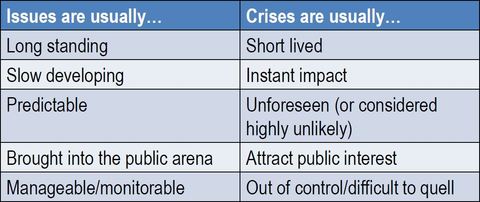
- 77ISSUE vs CRISIS
- 78Define issuewhen a gap between stakeholder expectations & org actions exist (also called 'legitimacy gap')
- 79What is a legitimacy gap?when there is a gap between an org's actions & stakeholder expectations (issue)
- 80What is issues management?• identifies issues & potential issues
•environmental scanning of trends, events & developments that the org has influence over which would affect org if unaddressed - 81Issues management helps...• identify issues & potential issues
• address issues before they potentially become crises - 82Define crisisa major (but rare) event that threatens an org's existence or financial survival
• can be SUDDEN or SMOLDER (majority)
• larger the crisis = longer public remembers
• orgs with good stakeholder relationships recover quicker
• employees critical - loyalty, support, avoid rumors - 83Characteristics of a crisis:• unexpected & unpredictable
• poses a threat
• potentially hazardous
• requires immediate, rapid action
• mgmt has limited control over
• of interest to general public & media - 84Crisis examples• Malaysia airlines (MH370 & MH17)
• FIFA corruption allegations
• Nepal earthquakes
• GFC - collapse of US banks/govt bailout - 85Crisis origins can be:• ECONOMIC e.g. recession
• INFORMATIONAL e.g. Sony email leaks
• PHYSICAL e.g. BP oil spill
• HR e.g. employee sabotage
• REPUTATION e.g. FIFA corruption
• PSYCHOPATHIC ACTS e.g. tampering, terrorism
• NATURAL DISASTERS e.g. floods - 86Define crisis managementto prevent or lessen the damage a crisis can cause the org & its stakeholders
Información
- Descripción
- University Undergraduate PRN2110 Foundations of Public Relations Fichas sobre PRN2110 EXAM REVISION, creado por Denise Siddons el 06/06/2015.
- Creado por
- Denise Siddons
- Visitas
- 110
- Etiquetas
- Valoración