
Fichas
CGA-Vorlesung
Fichas del conjunto (74)
- 1What do you mean by "rendering the pipeline"Sequences of step in OpenGL to render objects
- 2What do you mean by "transformation"?to position objects,
to shape objects,
to change viewing positions - 3What do you mean by "light and material"light: from which point will the object be illuminated
material: the object is made of which material - 4What do you mean by "texture"how the surface looks like
- 5What do you mean by "ray-tracing"?is a technique for generating an image by tracing the path of light through pixels in an image plane and simulating the effects of its encounters with virtual objects.
- 6What is the world largest conference for Computer Graphics?ACM Siggraph Conference
- 7What is a primitive (graphic elements)?-Vertices (corner of a polygon)
-Edges
-Faces
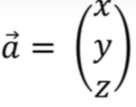
-Orientation - 8How does a vector look like?
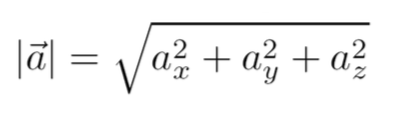
- 9how do you calculate the length of a vector?
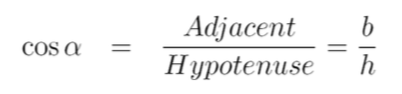
- 10What is cos a?
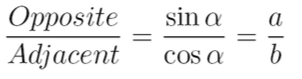
- 11What is sin a?

- 12what is tan a?
- 13How do you calculate the Dot product? (Sklarprodukt)

- 14Is there a connection between the dot product and the normalized vector?YES
dot product is the orthogonal projection onto a normalized vector - 15When is the dot product > 0?vectors point in same direction (angle <90°)
- 16When is the dot product < 0?vector point in opposite directions (angle > 90°)
- 17how do you calculate the cross product?
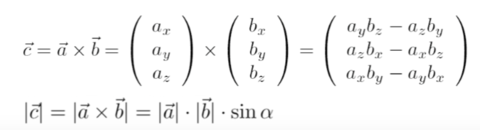
- 18What is the different between C and C->?C is a point
C-> is a Vector i.e a direction - 19How does the unit circle look like?
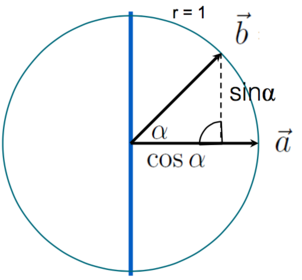
- 20If there is only one vector given and there is asked for 2 unknown vectors in addition? How can you solve this problem?1. Given vector * any other vector = new vector
2. Given vector * new vector = first unknown vector
3. given vector * first unknown vector = second unknown vector - 21How does a left-handed coordinate system look like?
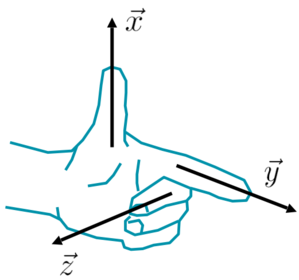
- 22How does a right-handed coordinate system look like?
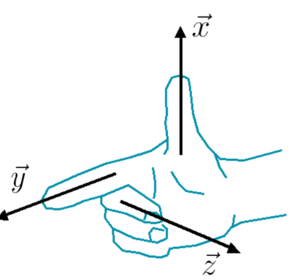
- 23What is the orthonormal basis?- all vectors are orthogonal to each other
- length of each vector is 1
-Cartesian /Euclidian coordinate system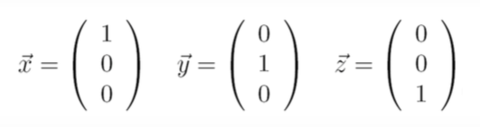
- 24What is a basis?axis in the coordinate system
- 25How du you define "rasterization"?Mapping of a vectorial scene description to a raster image (e.g for display on screen)
- 26What are the steps of a rasterization?1. Scene description
2. Rasterization algorithm
3. Raster image - 27What is scene description?to find a suitable mathematical description of you scene
- 28What is a primitive? Of what does a primitive consist?Vertices
Edges
Faces
Orientation
Normal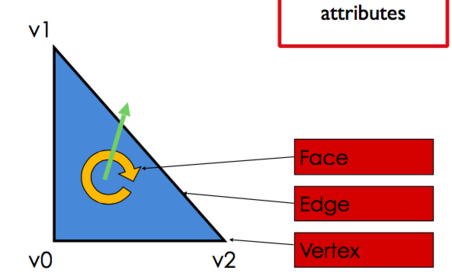
- 29What can you do with Object in the World Space?Translation (=Verschiebung)
Rotation
Scaling - 30What is translation?
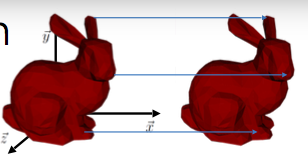
- 31What is a rotation?
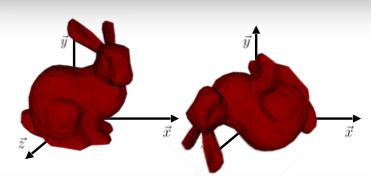
- 32What is scaling?
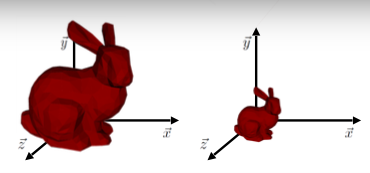
- 33Is it allowed to do more than one transformation at a single vertex (=Eckpunkt)?YES, can be concatenated
- 34Is the origin of the coordinate system relevant for the final image?No, the image is the same
- 35What are the rules for the intercept theorem (Strahlensatz)?
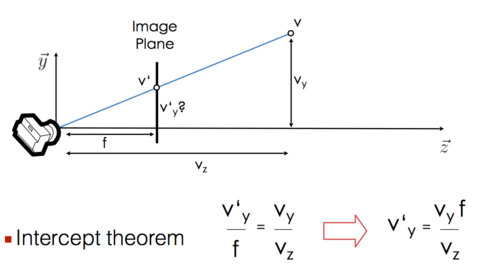
- 36How to mapping to screen coordinates?

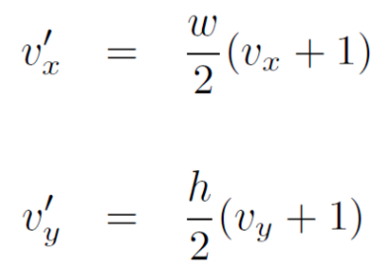
- 37For what is the z-Buffer good?in order to know which triangle is in front and which one behind
- 38Who founded Open GL? And when?1992
Mark Segal and Kurt Akeley - 39For what do we use Open GL?rendering 3D objects
- 40How do the OpenGL Rendering Pipeline look like?
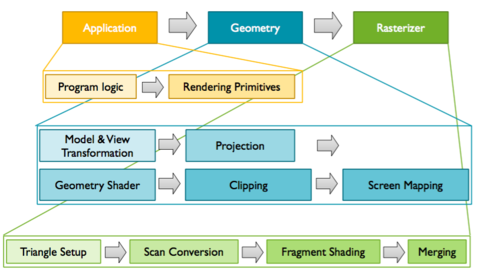
- 41—-CPU
-Application program
-Send primitives to GPU
-evoke primitives already on GPU, i.e start rendering call
- 42-Model transformation
* Object space to world space
* "Move objects"
-View transformation
*World space to camera space
*Camera at origin looking along negative z-Axis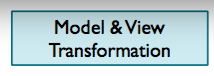
- 43—-Projection
*Camera space to normalized device space
*parallel or perspective projection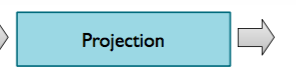
- 44—-Geometry Shader
*creates new geometry
*tesselation (=Mosaik)
*layered rendering
*saves bandwidth from CPU to GPU by creating geometry on the GPU on-the-fly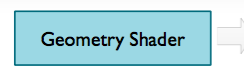
- 45—-Clippinng
*Remove all primitive outside the viewing volume
*clip all primtives to normalized device space
- 46—-Screen Mapping
*Map primitives to screen/pixel coordinates
- 47—Triangle Setup
-precomputation stage for drawing the triangles on screen
- e.g differentials and other date for the triangle's surface
-fixed-functionally in hardware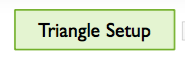
- 48—Scan Conversion
- generates a fragment for each part covered by a triangle
- data is interpolated among the three triangle's vertices, e.g color, depth, ..
-fixed functionally in hardware
- 49—Fragment Shading
-takes interpolated data
-creates output color
-fully programmable
- 50—Merging
- combines output of fragment shading with current color buffer (aka. frame buffer)
-opacity (alpha test)
-resolves visibility (depth buffer)
-raster operations (stencil buffer)
*only configurable
- 51What are the two main components of Open GL?Vertex Buffer Object (VBO)
Vertex Array Objects (VAO) - 52What is VBO?Memory buffer storing the data needed for rendering on the GPU
- 53What is VAO?Description of HOW vertex attributes are stored n a vertex buffer object
-number of coordinates per vertex
-are they floats, ints, double?? - 54Is the memory of CPU and GPU separate or not?YES, it is
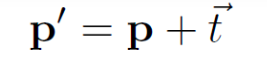
- 55How do you move a triangle in 3D? (maths)
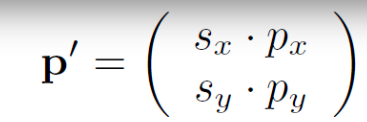
- 56How do you scale a 2D-object? (maths)
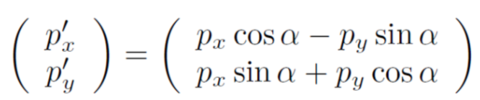
- 57How do you rotate a 2D-Object around the origin? (maths)
- 58how to rotate around the midpoint? (maths)1. Translate midpoint to origin
2. Rotate by a
3. Translate back - 59Post-Multiplication (standard)p' = A * p
- 60Pre- Multiplication
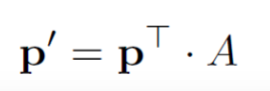
- 61Associative law ok?YES
- 62Commutative law ok?no
- 63how do you do a positive rotation of a 3D object?
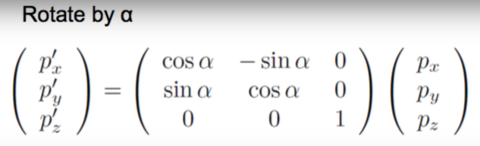
- 64how do you do a negative rotation of a 3D object?
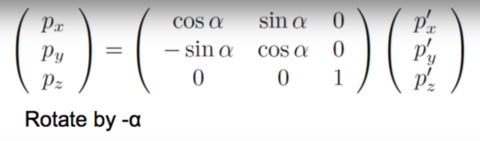
- 65how do the matrix looks like when you rotate around the x axes?
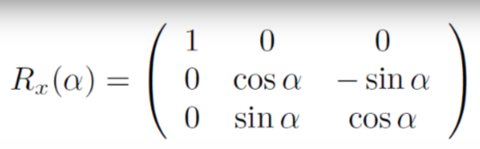
- 66how do the matrix looks like when you rotate around the y axis?
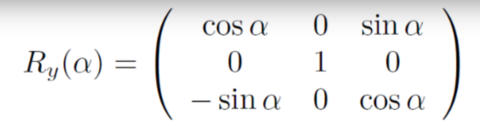
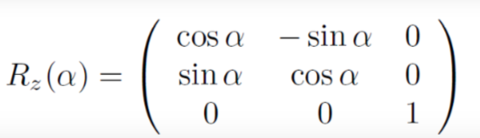
- 67how do the matrix looks like when you rotate around the z -axis?
- 68Can you to a 3d translation with a 3x3 matrix?NO
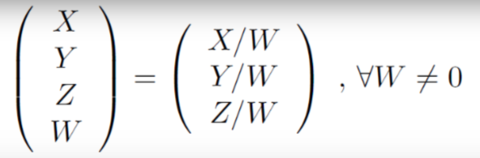
- 69What are the homogeneous coordinates?w can be any number, except of 0
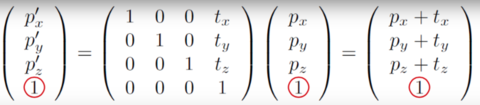
- 70Translation of a point
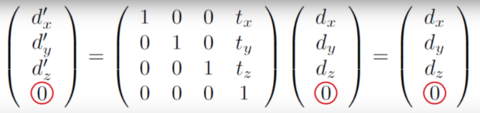
- 71Translation of a Vector
- 72How to do a translation in Java?Matrix4f translate (Vector3f t);
- 73How to scale in java?Matrix4f scale (Vector3f s);
- 74how to rotate in java?Matrix4f rotate (float angleInRadians, Vector3f r);
Información
- Descripción
- Fichas sobre CGA-Vorlesung, creado por Semra Müller el 09/10/2015.
- Creado por
- Semra Müller
- Visitas
- 14
- Valoración