
Fichas
Week 4 - Functional & Integrated Cross Functional Systems
Fichas del conjunto (39)
- 1To appreciate how information systems support managers, you must first understand the manager's job. All managers perform 3 basic roles, these are:– Interpersonal roles: figurehead, leader, liaison
– Informational roles: monitor, disseminator, spokesperson, analyzer
– Decisional roles: entrepreneur, disturbance handler, resource allocator,
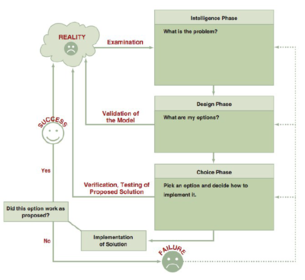
negotiator - 2Process and Phases of Decision Making (chart)
- 3Why do managers need IT support? list at least 2 of these reasons.– The number of alternatives is constantly increasing, due to innovations in
technology, improved communications, the development of global markets, and
the use of the Internet and e-business.
– Most decisions must be made under time pressure. It often is not possible to
manually process information fast enough to be effective.
– Due to increased uncertainty in the decision environment, decisions are
becoming more complex
– It often is necessary to rapidly access remote information, consult with experts,
or conduct a group decision-making session, all without incurring large expenses
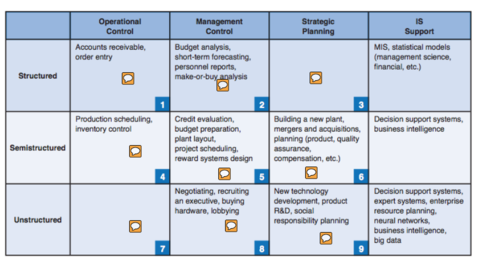
● These trends create major difficulties for decision makers - 4What is the Decision Matrix?The three primary classes of problem structure and the three broad
categories of the nature of decisions can be combined in a decision-support
matrix. - 5What does the Decision Matrix consist of?– Consists of nine cells, (see next card)
● Lower-level managers usually perform tasks in cells 1, 2, and 4
● The tasks in cells 3, 5, and 7 are usually the responsibility of middle managers and
professional staff
● Tasks in cells 6, 8, and 9 are generally carried out by senior executives - 6The Decision Matrix
- 7Each department or functional area within an organization has its own collection of information systems. Each of these FAI's support a particular functional area in the organisation. How?By increasing it internal efficiency and effectiveness.
- 8Examples of FAI's include:● accounting IS
● finance IS
● production/operations management (POM) IS
● marketing IS
● human resources IS
* FAI's often convey information in a variety of reports
* FAI's access data from the corporate databases - 9What are the 5 components of every IS?

- 10What does a FAI concentrate on?ONE functional area or SINGLE department
- 11They become "Islands of Automation". What does this mean?– They work independently from each other
– They are as effective as independent functions
– Are inefficient working in cooperation with other processes across entire business
● Typically each FAIS will have data, procedures and people who only support
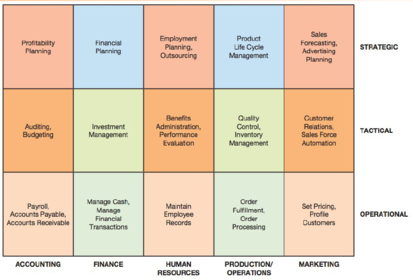
ONE functional area - 12Functional Areas and Information Systems
- 13Functional Areas & Types of IS Systems

- 14What is a Transaction?A transaction is any business event that generates data worthy of being
captured and stored in a database. - 155 Examples of Transactions?– a product manufactured
– a service sold
– a person hired
– a payroll check generated
– when you are checking out of a supermarket, each time the cashier swipes an
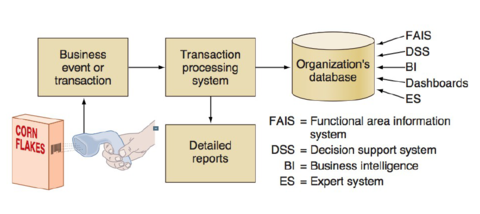
item across the bar code reader is one transaction - 16What is a Transaction Process System? (TPS)A transaction processing system (TPS) supports the monitoring, collection,
storage, and processing of data from the organization’s basic business
transactions
– each of which generates data - 17What does a TPS do?Collects data continuously and provides the input data for the corporate databases.
- 18Why are TPS's critical to the success of any enterprise?because they support core operations.
- 19In the modern business world, TPS's are inputs. Examples are:– functional area information systems
– business intelligence systems
– business operations
● customer relationship management
● knowledge management
● e-commerce - 20What do TPS's have to do efficiently?- Handle both high volumes of data and large variations in those volumes.
- They must avoid errors and downtime, record results accurately and securely and maintain privacy and security. - 21Transaction Processing Systems (Chart)
- 22Examples of TPS Complexities? name at least 2. *These and similar issues explain why organisation spend millions of dollars on expensive mainframe computers.● When more than one person or application program can access the database at the
same time, the database has to be protected from errors resulting from overlapping
updates.
● When processing a transaction involves more than one computer, the database and all
users must be protected against inconsistencies arising from a failure of any
component at any time.
● It must be possible to reverse a transaction in its entirety if it turns out to have been
entered in error or if goods returned.
● It is frequently important to preserve an audit trail, in fact, for certain transactions an
audit trail may be legally required. - 23What do TPS do?● Provide managers with reports or with on-line access to the organisation’s
current performance and historical records.
– Depend on underlying TPS for their data (the inputs).
– The basic transaction data from TPS are compressed and are usually presented
in long reports that are produced on a regular schedule. - 24What functions does this primarily serve?The functions of planning, controlling and decision making at the middle management level.
- Oriented almost exclusively to internal, not external events
- Concentrates on operations in one functional area. - 25TPS v MIS (TPS Report)● Each salesperson would receive a report showing a summary of
transactions with each of their clients.
● The salesperson would have some idea about how their sales are going and
try to target certain customers (a form of CRM) - 26TPS v MIS (MIS report)An MIS Report
● A manager would get a summary of
sales for a region
● They examine the report and take
action on some matter such as
employ more staff or train staff in a
certain region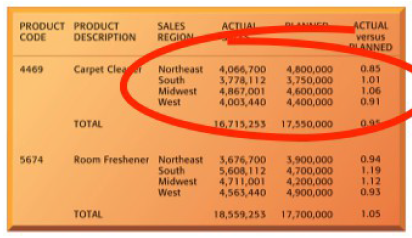
- 27What are Executive Support Systems for?- Support strategic planning
- Unpredictable (unstructured) decisions - 28ESS are taylor-made systems to meet needs. They are used to:– Monitor performance
– Track competitors
– Spot problems
– Identify opportunities
– Forecast trends - 29What are Traditional Functional systems?● Separate systems (now called silos)
● Built over a long period of time
● Support discrete business processes and functions
● Rarely include vendors (suppliers) and customers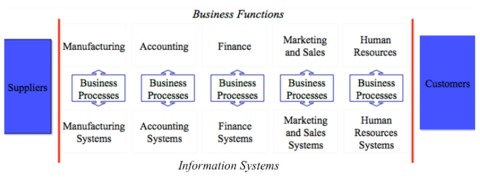
- 30What are problems relating to Functional Processes and Systems? Name at least 3.● Data is duplicated because each functional application has its own database
● Business processes disjointed because supporting applications separated
● Difficult for activities to reconcile data and increases chances of errors
● Lack of integrated enterprise information
● Inefficiency
● Increased costs due to duplicated data, disjointed systems, limited
information, and inefficiencies. - 31There is a growing organisational need to integrate functions and business processes to improve:- Organisational Control
- Coordination
- Responsiveness - 32How is this done?By allowing data and information to flow more freely between different parts of the organisation.
- 33This is more than just linking the systems together. This changes...The processes (or the way things are done) as well.
- 34In regards to Business Process redesign, organisations should:- Not automate or improve functional systems
- Should create new business processes
*This came from the idea (recall porter) That IS should support linkages across departments and activities between businesses. - 35Cross-department systems operate across departmental boundaries. This is for:Increased functionality.
- 36Process-based systems support complete business processes. This means that:- Integrated processing systems are more efficient
- Needs clear line of authority. - 37Why are Enterprise Resource Planning systems designed?To correct a lack of communication among the functional area of IS.
- 38How do ERP systems resolve this problem?By tightly integrating the functional area IS via a common database.
* For this reason, experts credit ERP systems with greatly increasing organizational productivity. - 39—
Información
- Descripción
- • Management Decision Making • Functional Information Systems • Integrated Cross-Functional Information Systems Integrated Cross-Functional Information Systems Applications
- Creado por
- jenniferelkhoury
- Visitas
- 32
- Valoración