
Fichas
Quantum Mechanics
Fichas del conjunto (27)
- 1Quantum MechanicsQuantum Mechanics
- 2What is the superposition principle?"The linear composition of simpler wavefunctions"
If |a1> and |a2> are linearly independent states, then |u>=c1|a1>+c2|a2> is also a state of the system.
The set of kets|ai> are said to be complete, if we can construct any state |u> from them. - 3What is linearity?An operator A is said to be linear if:

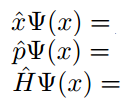
- 4All Physical Observables have corresponding operators, which are:
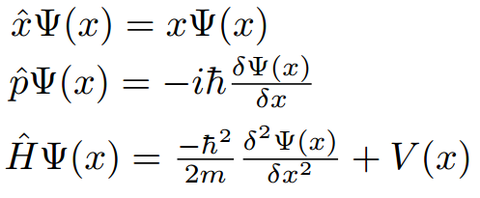
- 5What is the relationship between the Hamiltonian and the energy?The Hamiltonian is the operator corresponding to the total energy of the system.
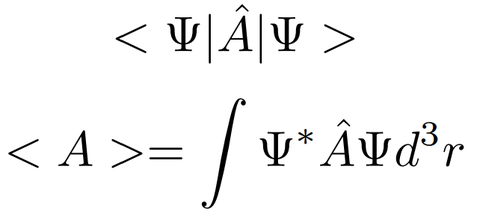
- 6Define ExpectationThis is used to relate a physical observable to the quantum calculation. The probability of finding a specific state in a mixed eigenstate. The modulus squared is the probability.
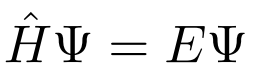
- 7EigenFunction"What is measured".
When an operator acts on the eigenfunction it gives us the eigenvalue and eigenfunction. - 8Eigenvalue"The result of the measurement, this is the only physical observable"
- 9Eigenstate"The state at which the operator is exactly the eigenvalue with no uncertainty"
- 10Eigenvector"An eigenfunction is an eigenvector which is also a function"
- 11If the wavefunction is not an eigenfunciton of the operator what happens to the measurement?A measurement of the operator may give different eigenvalues with different probabilities each time.
- 12When is an operator said to be Hermitian?Hermitian operators have real eigenvalues.
When it obeys the relationship:
- 13Describe CommutationWhen 2 operators commute, their observable are simultaneously and precisely observable.

- 14Define the Identity OperatorNot all operators have inverses, those that do are called nonsingular.

- 15If A|u>=w> What transformsThis operator is called the adjoint of A, and if equal they are hermitian or self adjoined.
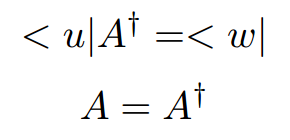
- 16Rule One"The Linear Super Position Principle"
Multiplying a vector by a complex number changes the magnitude but not the direction. - 17Rule Two"An isolated quantum state evolves continuously and casually in time"
- 18Rule Three"Each observable of a system is associated with a Hermitian operator on a Hilbert space of the system. Eigenstates of each observable form a complete set".
- 19Rule FourThe result of any given measurement of an observable is an eigenvalue of the corresponding hermitian operator.
- 20Rule FiveThe expectation of A is the average number of measurements of A.
- 21Rule SixThe Probability amplitude and the probability is the modulus of this squared.
- 22Rule Seven"The collapse reduction postulate"
A wave function—initially in a superposition of several eigenstates—appears to reduce to a single eigenstate by "observation". - 23Which two rules are incompatible?Rule 2 and Rule 7
- 24When are two observables said to be compatible?If the operators representing them have a common set of eigenfunctions.
If one quantity is measured then the system will be left in an eigenfunction of that observable.
A measurement of the other observable will leave the system in the same state. - 25What can be concluded about these two hermitian operators: [A,B]=iCC is also a hermitian operator.
As A and B do not commute they will not have simultaneous eigenstates - 26Ehrenfest's TheoremThe expectation value of any time independent operator is constant if the operator commutes with the Hamiltonian.
- 27—
Información
- Descripción
- Masters Physics Fichas sobre Quantum Mechanics, creado por emmalmillar el 03/12/2015.
- Creado por
- emmalmillar
- Visitas
- 338
- Valoración