
Fichas
Thrombosis
Fichas del conjunto (84)
- 1What is thrombosis?Pathological process - uses tools normally used for vessel healing.
- 2How is the coagulation cascade activated? What is the final product?1) Proteolytic activation of a number of enzymes.
2) Fibrin - 3What is fibrin?Network which stabilises the hemostatic plug - physically stops the bleeding
- 4Define thrombosisFormation of a solid mass from constituents of the blood within the living circulation. Can form in any vessel and the heart.
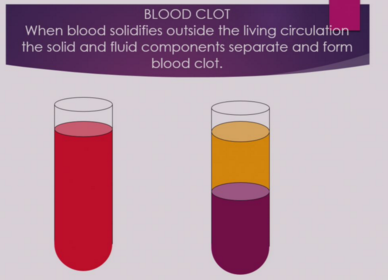
- 5What is the key difference between a blood clot and a thrombus?Thrombus forms in the living situation.
- 6How can you tell the difference between a blood clot and a thrombus post mortem?After death blood can separate out - corpuscular part accumulates on vessel. Blood clot is very elastic and very easy to remove.
- 7—Solid = platelets (fragments of cells)
Liquid = Serum and protein content - 8What is the physiological response to vascular injury?Hemostasis - hemostatic plug to stop the bleeding
- 9What is the key difference between hemostatic plugs and thrombosis?Thrombosis isn't as finely regulated.
- 10What is hemostasis split into?Primary and secondary
- 11What are the stages of primary hemostasis?1) Vasoconstriction - reflex neurogenic mechanism + endothelin stimulation
2) Endothelial injury exposes thrombogenic extracellular matrix (ECM) - prothrombotic effect
3) ECM facilitates platelet adherence, activation and aggregation - 12What is the point of the first stage?Reduce blood flow to the injury site and reduce the size of the injury/hole. Last a very short period of time.
- 13What are the stages of secondary hemostasis.Removal of endothelial layer exposes superficial layer of coagulation factors.
1) Coagulation cascade to produce fibrin
2) Permanent plug - 14What prevents thrombotic effects under normal circumstances? (3)1) Endothelial layer prevents coagulation factors being exposed
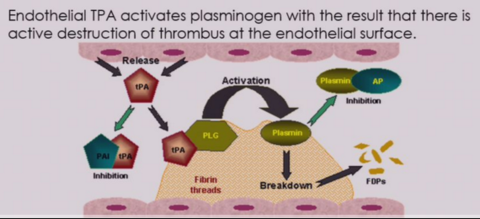
2) Endothelial cells release t-PA (tissue plasminogen activator) which causes fibrinolysis
3) Thrombomodulin block the coagulation cascade - 15Where do thrombi occur?Arterial circulation (central to periphery) and venous circulation (periphery to central)
- 16What is a key difference between arterial and venous circulation?Much higher pressure - walls are contracting.
- 17How do thrombi in arterial circulation appear? What are they associated with? Capillaries?1) Small and pale, composed of platelet and fibrin in arteries with fast flow. Associated with atherosclerosis
2) Tiny, predominantly composed of platelet in capillaries. - 18Where is atherosclerosis commonly found? What does it result from?1) Elderly population
2) Progressive damage to vascular wall with accumulation of lipids underneath the endothelium. Predominantly arterial. - 19Describe venous circulation thrombi.1) Large and red, fibrin-rich, red blood cell rich in very low-pressure venous system.
- 20What are the sites of deep vein thrombosis? What is different about the sites?Axillary
Subclavian
Portal
Mesenteric
Cerebral
Pelvic
- Increased risk of thrombosis. - 21Describe a thrombusCellular and serum phases - striated series of alternating layers of cell poor and cell rich.
- 22What are the layers of thrombus called?Lines of Zahn.
- 23—1) Cell poor = fibrin
2) Cell rich = red blood and white cells.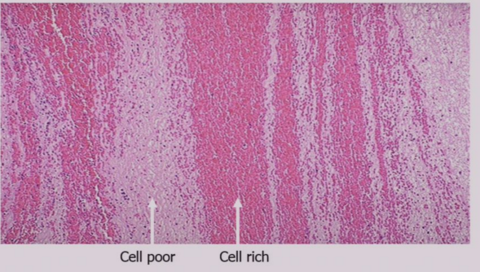
- 24—Lung parenchyma - alveoli, very little space in vessel not occluded by thrombus
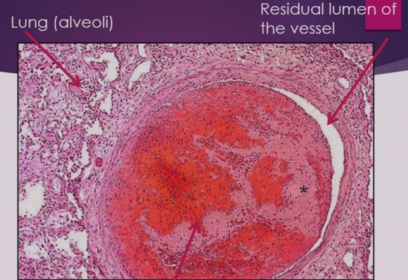
- 25What are the components of Virchow's Triad? (ie what are the factors which lead to thrombosis)1) Abnormality in/altered vessel wall (endothelial integrity)
2) Abnormal coagulative quality of the blood
3) Abnormal blood flow - 26What happens if you change the vessel wall (increase irregularity) ie reduce smoothness of lining?1) Loss of endothelial integrity - increased risk of thrombosis due to atheroma.
- 27What is an atheroma?Degeneration of the walls of arteries caused by the accumulation of fatty deposits and scar tissue leading to restriction of the circulation and a risk of thrombosis.
- 28How do you reduce the interaction of platelets with the vessel wall?Increase regularity of blood flow - more laminar than turbulent.
- 29How do changes in blood flow lead to thrombosis?Disturbances of blood flow allows large numbers of platelets to come into contact with endothelium
- 30What are coagulation factors intrinsic to?The blood itself.
- 31How do changes in coagulative qualities of the blood result in increased risk of thrombosis?Alteration in coagulability of the blood by increasing no. platelets or decreasing serum results in increased dysregulation of coagulation - more intrinsic factors and more platelet interaction with vessel walls.
- 32What are the two coagulation pathways?1) Intrinsic - all the enzymes which progressively activate each other are included in the blood
2) Extrinsic - Factors associated with the endothelial - 33What can causes changes in coagulative qualities in the blood? (4) What do they result in?1) Genetic
2) Pregnancy (post partum)
3) Surgery
4) Major Injury
Increased platelet count - increased coagulation factors - increased risk of thrombosis. - 34How does intact endothelium prevent thrombosis? (4)1) Express sulphates mucopolysaccharides (heparin and heparin like molecules)
2) Expressing tissue plasminogen activator (TPA)
3) Synthesizing prostacyclin (PG12)
4) Prevents the exposure of subendothelial ECM and exposure of coagulation factors. - 35What is the role of heparin/heparin like molecule expression?Disrupt coagulation cascade at various time points. Heparin like molecules degrade thrombin
- 36What is the role of TPA?Degrades fibrin network
- 37What is the role of PGl2?1) Vasodilation - Enlarge caliber of vessel making blood flow more laminar
2) Antagonises aggregation of platelets. - 38What do sulphated mucopolysaccharides (heparin and heparin-like molecules) coat and what do they carry?Coat endothelial cell surface - carry a large negative charge.
- 39What do sulphated mucopolysaccharides activate? Give an example.1) Antithrombotic enzymes
2) Antithrombin 3 - 40What is the role heparin? What is this trying to achieve?1) Activates antithrombin 3 - binds, induces conformational change which results in a hundred fold increase in activity. Degrades thrombin.
2) Prevent formation of fibrin - 41What is the role of TPA?1) Converts plasminogen (usually circulating inactivated) into plasmin which destroys thrombus. Removes fibrin if heparin is unsuccessful.
- 42—X
- 43When do endothelial cells generate PGl2? How is this offset?1) When damaged.
2) Platelet produces other prostaglandins with opposing effects. - 44What is the most common cause of thrombi?Changes in vessel wall - atherosclerosis
- 45—Fatty deposits and atheroma - dark red = thrombi stuck to walls.
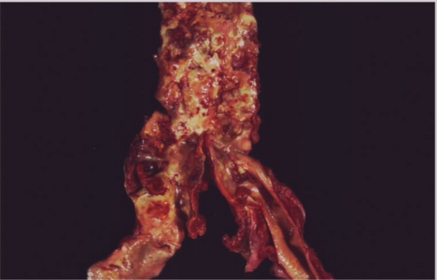
- 46What does 'changes in blood constituents' refer to?Increased platelets (increased coagulation factors), increased activity of coagulation factors and fibrin concentration.
- 47What are platelets?Circulating anuclear fragments of cytoplasm of megakaryocytes (largest cell found in the bone marrow, multi-nucleated with large cytoplasm). Each megakaryocytes can produce 2000-4000 platelets
- 48What causes platelet concentration to increase? What does this result in?1) Injury
2) Increased risk of thrombosis - 49What is the normal concentration of platelets? Abnormal?1) 200-400 X 10^9/L
2) 900-1200 X 10^9/L - 50What is the diameter of a platelet? Life span?1) 3um
2) 10 day life splan - 51What do platelets contain?1) Alpha granules
2) Dense bodies - unique to platelets - 52What do alpha granules contain? (3)1) Coagulation factors
2) Platelet derived growth factor (PDGF)
3) Fibrinogen (proto - fibrin) - 53What do dense bodies contain?1) Adenine nucleotides (ADP)
2) 5 Hydroxytryptamine (Serotonin)
3) Calcium - 54How does PGl2 interact with platelets?Prevents them from adhering to vessel walls and releasing granules.
- 55What does granule release result in?Further activation of platelets (conformational change and activation of other downstream factors of the clotting cascade)
- 56Describe the steps of platelet activation. (3)1) Adhesion: Rapid adherence to collagen exposed by endothelial damage
2) Platelet Release Reaction: Degranulation of platelets
3) Platelet Aggregation: Platelets rapidly clump together to cover the area of endothelial cell loss - change shape to fit the hole better. - 57What mediates platelet aggregation?ADP and Ca2+
- 58What do platelets generate which opposes PGl2?Thromboxane (TXA2) - constricts vessels and aggregates platelets.
- 59What do prostaglandin and thromboxane derive from? What enzyme is used to produce them?1) Arachidonic acid and eicosapentaenoic acid
2) Cyclo-oxygenase - 60What are the products from arachidonic acid? Eicosapentaenoic acid?1) PGl2 and TXA2
2) TXA3 and PGl3 - 61What is the key difference between the products of arachidonic acid and eicosapentaenoic acid?TXA3 (Thromboxane 3) has little or no pro-thrombotic effect compared to TXA2 - TXA3 decreases risk of thrombosis. PGl3 still has much as an effect as PGl2
- 62—X
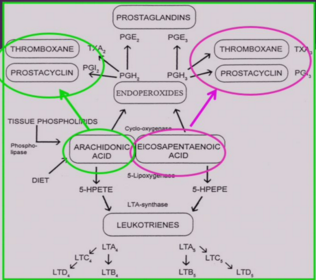
- 63What diet can decrease risk of thrombosis?Diet which increases EPE (Eicosapentaenoic acid). Oily fish and primrose oil have anti-thrombotic effect by increase the proportion of TXA3 to TXA2.
- 64What is the second part of virchow's triad?Coagulative qualities of blood
- 65What does increasing the coagulation factors result in? What are the two coagulation pathways?Sequential activation of the clotting factors leading to enormous amplification of the initial signal.
Extrinsic and in - 66What is the control factor for coagulation?Anticoagulation - enhances the action of antithrombin 3 by adding heparin. Also reduces number of coagulation factors.
- 67—Two pathways - both result in fibrin, interlink. Result from factors released by damaged endothelium or from platelet cells themselves.
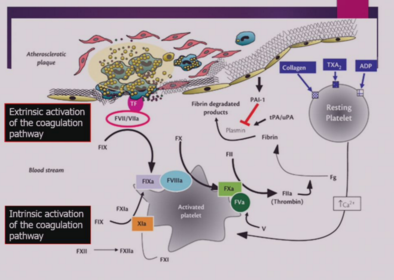
- 68What are the different ways of preventing fibrin formation?1) tPA converts plasminogen to plasmin to degrade fibrin
2) Antithrombin factors/heparin prevent the conversion of thrombin at many levels. - 69—X
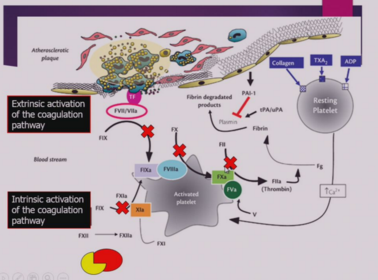
- 70What is the genetic abnormality which results in a factor which is more resistant to degradation?Factor V (Leiden factor) - 2-15% of caucasians have genetic heterozygous factor which means their coagulation is more resistant to degradation by protein C. Harder to degrade this factor.
- 71What are the risks associated with this abnormality?1) Heterozygous - slight increase of thrombosis risk (roughly 5 fold).
2) Homozygous - 50X higher risk - 72What number of people who involved in a thrombotic event had a factor V abnormality?50%
- 73What other disorder can result in an increased thrombotic risk? Where is it prevelant?Homocystinuria - cystathionine beta synthase (CBS) deficiency. Inherited disorder of the metabolism of the amino acid methionine. South Eastern population.
- 74How can you decrease the risk of thrombosis after surgery?1) Mobilisation of patient soon after surgery
2) Treat with heparin - 75Why do you see turbulence in blood?1) Vessel changes in size
2) Bifurcate to a different angle
3) Blood is a complex fluid - 76Describe laminar flow1) Minimal mixing between layers
2) Cellular component of the blood moves in the fast flowing lower pressure zone in the centre of the vessel - platelets have less contact with endothelium - 77—X
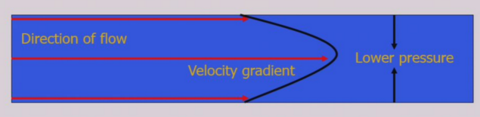
- 78What does turbulent flow result in? What is likely to cause an increase in turbulent flow?1) Increased platelet contact with vessel wall
2) Atherosclerosis (vessel damage), specific anatomical locations (sites of bifurcation) are more likely to have turbulent flow and platelet-vessel interaction. - 79What are the most common arterial sites of thrombosis? What are the risk factors particularly in the arteries?1) Atheromatous plaque - coronary arteries and aorta
2) Endocardium - mural thrombus.
Atherosclerosis and vasculitis - 80Why do (mural) thrombi form in the heart?Generally turbulent flow but mural thrombi also form following myocardial infarction, infection (endocarditis) and malformation.
- 81Where do thrombi in the venous circulation form?1) Deep veins the leg
2) Pelvic veins
Can occur in surface varicose veins but have less of a systemic/dangerous effect - 82What is one of the secondary dangerous things which result from a thrombus?Embolism
- 83What are the possible events following a thrombus?1) Dissolve - physiological factors work in the first few hours (only) to clear thrombus
2) Occlusion of vessel - can damage downstream tissue depending on location
3) Keeps growing in direction of heart
4) Embolism - fragments of thrombus breaks off - 84What are the differences in arterial and venous thrombi?1) Arterial thrombi move to periphery ie the brain, limbs etc
2) Venous thrombi move from the periphery to the centre can occlude lungs and heart.
Información
- Descripción
- Fichas sobre Thrombosis, creado por Anna Hogarth el 16/04/2016.
- Creado por
- Anna Hogarth
- Visitas
- 25
- Etiquetas
- Valoración