
Fichas
Study Questions Flashcards
Fichas del conjunto (34)
- 1What is Light?Radiant Energy that is capable of exciting the retina and producing a Visual sensation
- 2Describe the difference between photometric and radiometric measurement-Photometric measures the effects of visible light.
-Radiometry measures electromagnetic radiance including visible light. - 3Describe the relationship between Energy, Work and PowerEnergy: Joules (J) The capacity to do Work
Work: energy transformed into a movement rate
Power: Watts (W) Rate at which work is done - 4What is the difference between Luminance and Illuminance?-Illuminance is the density of visible flux per unit area.
-Luminance is the photometric measure of the Luminous intensity of visible radiation, light, traveling in a given direction (light intensity on a surface) - 5What is Luminous Intensity?luminous intensity is a measure of the wavelength-weighted power emitted by a light source in a particular direction per unit solid angle, based on the luminosity function, a standardized model of the sensitivity of the human eye
- 6What is a Candela?Candela is the SI base unit of luminous intensity
- 7How do we measure Lumens and Lux?- Lumens is the measure of photometric power. Luminous energy (flux)
- Lux is the measuring of luminous flux per unit area - 8What is the Inverse Square Law?The Energy Twice as far from the source is spread over 4X the area, hence 1/4 the intensity
- 9How do we differentiate between the quantity and the quality of light?Quality of light considers the visual comfort of the system (glare), while quantity refers to the standards amount of light need for a space.
- 10How are Illuminance levels and illuminance categories used?They are used establish quantitative lighting system design criteria. To differentiate the difference in the required light for a space.
- 11What is Color Temperature? How is it measured?The temperature to which a blackbody must be heated to radiate a light similar in color to the color of the source in question. It is measured through the color radiance based off of heat. (Kelvin)
- 12How does wavelength affect color?Changes in the wavelength affect how the retina visualizes it. The relative energy of an illuminant at a particular wavelength determines the saturation and brilliance with which we see color. (pg 632)
- 13How is a “candela curve” plotted?Using data of how light travels from a fixed point in reference to specific angles.
- 14What are Luminous and Diffuse Transmittance?Luminous Transmittance: the ratio of the total transmitted light to the total incident light.
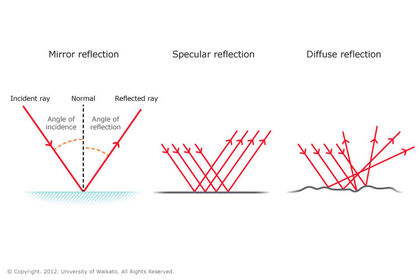
Diffuse Transmittance: - 15Describe the different categories of Reflectance? How do material finishes alter these?Diffuse Reflectance , spread reflectance, and specular Reflectance. The texture of the material can change the angle of reflectance. (Polished surface: specular, Rough surface: spread, Matte surface: diffuse)
- 16What is the Angle of Incidence and how does it affect the perceived transparency of glazing?The angle of incidence is the angle in relation to the normal on the surface.
On a glazed surface some of the light is transmitted through the surface, while some is reflected off. - 17What is the difference between specular and diffuse reflection?
- 18What is Glare?Glare: Visual condition in which there is excessive contrast or an inappropriate distribution of light sources that disturbs the observer or limits the ability to distinguish details and objects.
- 19How can Glare it be controlled?Material Reflection
Material Color
Luminaire Location
Architecture - 20How do we refer to Glare caused by light sources in the field of vision?Glare produced depends on the source's position in the field of vision. So the farther the source is moved from the direct line of vision, the better. (pg 613)
- 21What are “veiling reflections”?(Similar to glare) Light reflection from an object or task that obscures details.
Whys my desk so bright! (pg 615) - 22What is “daylight factor” and how it is measured?Daylight Factor is the ratio of indoor illuminance (Ei) to available outdoor illuminance (Eo). It is the Average ;
((Ei)/(Eo)) * 100 = DF - 23How does the Kunsthaus in Bregenz, Austria by Peter Zumthor control daylight?By using etched glazing on all four facades, causing the light to refract before entering the building and always transmitted horizontally.
- 24What are the two architectural methods that Le Corbusier uses to Control daylight in the Harvard University Carpenter Center in Cambridge, MA?Le Corbusier changes the orientation of the different facades and their curvature to direct natural daylight into the building. The Deep Sunshades are also used to protect the glazing.
- 25Name four of the most common type of lampFluorescence
Incandescence
Gas-discharge
LED (Light Emitting Diode) - 26What is the difference between fluorescence and Incandescence?Incandescence's utilize a heated filament, while florescence's utilize mercury within an argon or krypton gas.
- 27Give an example of a mono-frequency lamp.?
- 28What is the purpose of a ballast used in conjunction with a fluorescent lamp?Prevent overheating by limiting the lamp's electrical current
- 29Through what process does an LED produce light?Light is produced by the electroluminescence of a semi-conductor. the protons are emitted when an electrical field/current comes into contact with the semi-conductor.
- 30What is a luminaire? How is it different from a lamp?Luminaire is a fixture that contains the lamp, its electrical connection and any other control mechanism. Lamp only refers to the amount of light that the lamp or light source produces. Luminaire lumens references the total amount of light that is emitted by the luminaire.
- 31What are the 6 factors that determine how a luminaire Distributes light?1. shape
2. Aperture size
3. Aperture location
4. Optics (if applicable)
5. Materials and finishes
6. Mounting position or angle - 32Draw a diagram of the light produced by: direct light, indirect light, semi-direct up-light and a direct-indirect light.Direct-indirect is an equal distribution of the direct and indirect.
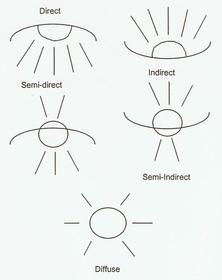
- 33What is the coloring rendering index?Is comprising a color temperature that establishes the reference standard and a number that indicates how closely the illuminant approaches the standard. The standard is always the daylight at that color temperature (pg. 635)
- 34—
Información
- Descripción
- 300 Arch Fichas sobre Study Questions Flashcards, creado por Justine Bradley el 28/02/2017.
- Creado por
- Justine Bradley
- Visitas
- 21
- Valoración