
Fichas
HLA01 - Finance & Accounting Exam A

Fichas del conjunto (58)
- 1The 4 types of firms are...1. Sole Proprietorship
2. Limited Partnerships
3. Limited Liability Companies (LLC)
4. Corporations - 2What are sole proprietorships?- Most common type of firm
- Owned and run by one person
- Very small and easy to create
- no separation between firm and owner
- life of company is limited to life of owner
- owner has unlimited liability for firm's debt - 3What is a partnership (as type of firm)?- sole proprietorship with more than one owner
- all partners personally liable for firm's debt
- ends with death or withdrawal of any of the partners - 4What is a limited partnership (as type of firm)?- two types of owners:
General Partner and Limited Partner
- Limited partner can't lose more than his initial investment
- death of limited partner doesn't end the life of the partnership, ha has no managerial duties - 5An "LLC" is...- Limited Liability Company
- Can be private or public
- Owners have limited liability for firm's debt - 6Corporations are...- legal entity, separate from its owner
- owners aren't liable for debt, contracts etc
- more costly to set up a corporation than any other type of firm (because it is a legal act)
- owned by shareholders - 7Where is the difference between "S-Corporations" and "C-Corporations"? (In the USA)C-Corporations: Shareholders pay tax twice (once when the company pays tax, once when the shareholders pay tax on their profits from the ownership
S-Corporations:
Only taxed once, maximum 100 Shareholders, all US Citizens - 8What is the role of a board of directors?Within a corporation...
- monitor performance
- sets policy
- ultimate decision-making authority
The board is elected by Shareholders - 9What is the role of a CEO (in contrast to the board of directors)?Day-to-Day decision making
CEO can also sit in the board of directors - 10What are agency problems?Conflicts arising from different interests of managers and shareholders.
- 11What are the two options in case of corporate bankruptcy?Reorganization and Liquidation
- 12What are accruals?Expenses or revenues that have already occured, but haven't been recorded yet. (Nebenkostennachzahlung)
- 13What are deferrals?Recorded expenses or revenues that still affect next accounting period (Miete im Voraus bezahlt)
- 14What is a prepayment?A payment paid in this period, for a benefit received in the next period.
(=Deferred Expense) - 15What is deferred revenue?Money received in this period for a service rendered in the following period
- 16What is an accrued expense?A benefit used in this period which will be invoiced in the next period
- 17What is an accrued revenue?A service rendered this period which can only be invoiced in the next period.
- 18What is a provision?- future cash out-flow as result of past event
- amount or timing is uncertain
- reliably estimate can be made - 19What is a contingent Liability?A possible obligation, dependent on future events that can't be controlled
OR
a present obligation that can't be recognized because the size can't be measured precizely
ITS NOT RECOGNIZED IN THE BS (but mentioned in the notes) - 20How do you create a provision (in the Balance sheet)?DEDUCT from Profit,
ADD same amount as provision in Liability - 21How do you use a provision? (on the Balance sheet)DEDUCT from Cash Assets,
DEDUCT from Provisions in Liabilities - 22How do you reverse a provision? (on the balance sheet)ADD to profit (equity)
DEDUCT from provision account (liabilities) - 23What is asset impairment?An adjustment of the net book value of an asset because the real value is lower.
- 24How do you account for an impairment?DEDUCT impairment loss from Asset value,
DEDUCT same amount from equity - 25What are bad and doubtful debt?Bad debt: Company A owes you 100€ but for sure won't pay it back
Doubtful debt: Company B might not be able to pay back 100€ - 26How do you account for Bad Debt?DEDUCT from asset receivables,
DEDUCT from profit (equity) - 27How do you account for doubtful debt?DEDUCT valuation allowance from assets,
DEDUCT same amount from profit of the year - 28What are hidden reserves?Unnecessary provsions for not existing obligations, impairments to lower current profits and "use" them in later periods
- 29What is the definition of a competitive market?A market at which a product can be bought and sold at the same price.
- 30What is the definition of the market interest rate?A market interest rate is the exchange rate at which we can exchange money today for money in the future.
(=1,00€ today buys 1,07€ in one year if the interest rate is 7%) - 31How do you calculate present and future values?FV=PV*interest rate
(107=100*1,07)
PV=FV/interest rate
(100=107/1,07) - 32What is arbitrage?Arbitrage is the process of trading to take advantage of equivalent goods that have different prices in different competitive markets.
- 33What is a normal market?A normal market is a competitive market with no arbitrage opportunities.
- 34What is the separation principle?The separation principle states that security transactions in a normal market don't create or destroy value.
- 35What is value additivity?Value additivity implies that the value of a portfolio is equal to the sum of its parts.
- 36What is worth more? Money today or money in one year?Money today is worth more than money in one year.
- 37How do you calculate the present value of a perpetuity? (Perpetual=never ending)PV of Perpetuity
=Constant Cashflow/interest rate - 38How do you calcuate the present value of an annuity? (annuity=yearly payment)
- 39How do you calculate the Future Value of an annuity? (annuity=yearly payments)
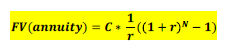
- 40How do you calculte the PV of a growing perpetuity?

- 41What is the internal rate of return?The IRR is the average percentage return on the investment. The other way around: it is the discount rate at which the investment has zro NPV.
- 42What is capital budget?It is a list of projects that the company plans to undertake.
- 43What is capital budgeting?Capital budgeting is the process of analyzing alternative investments and deciding which ones to accept.
- 44What are incremental earnings?Incremental earnings are the amount by which an investment is expected to change the profit of the company.
- 45When calculating incremental earnings, what needs special attention?Espenses for long term assets aren't recorded as expenses. Instead, their depreciation is regarded in the calculation of incremental earnings.
Also, interest expenses aren't regarded. - 46What are project externalities?Project externalities are indirect effects of a project on the companies profits. For example, if Ben&Jerries launches a new flavor, that might shortly decrese the consumption of existing flavours.
- 47What is cannibalization? (In business terms)Cannibalization is an example of project externalities. It means that the introduction of one product reduces the consumption of another product of the same company.
- 48Should fixed overhead costs be included in the calculation of incremental earnings?No. FIXED overhead don't change, depending on the investment takes place or not. So, they're irrelevant for calculating incremental earnings.
- 49Should the costs for (already executed) R&D be included in the calculation of incremental earnings?No. Sunk costs are irrelevat for decision making.
- 50What is the free cash flow of a project?Free cash flow is the incremental effect of a project onto the available cash of a company.
- 51Where are the differences between calculating free cash flow and incremental earnings of a project?Capital expenses aren't included in the calculations of incremental earnings, but they are included in the free cash flow. Depreciation isn't though.
- 52What is the Net Working Capital?NWC=Current Assets-Current Liabilities
NWC=Cash+Inventory+Receivables-Payables - 53What is the trade credit?qTrade credit is the difference between receivables and payables.
- 54What is a sensitivity analysis?Sensitivity analysis shows how the NPV varies with a change in one of the assumptions, holding the other assumptions constant.
E.g. sales price - 55What is a scenario analysis?Scenario analysis considers the effect on a project of changing multiple parameters simultaneously.
- 56What is the unlevered Net Income?(Revenues-Costs-Depreciation) * (1-t)
=(Revenues less cost, less depreciation) after tax - 57How do you calculate the Free Cash Flow?FCF=Unlevered Net Income+Depreciation-CapEx-Change in NWC
OR
FCF=(Revenues-Costs)*(1-t)-CapEx-Change in NWC+(t*Depreciation) - 58—
Información
- Descripción
- Fontys International Business School, Semester 3 Finance and Accounting (after 2015)
- Creado por
- Cara Czech · mar 2017
- Actualizado
- 29 mar 2017
- Visitas
- 48
- Etiquetas
- Valoración