
19329112
Description

Flashcards by Karla Rosas, updated more than 1 year ago

|
Created by Karla Rosas
over 6 years ago
|
|
| Question | Answer |
| PRESENT PROGRESSIVE The present progressive is formed by combining the verb “to be” with the present participle. | The present participle is merely the “-ing” form of a verb. I am studying. I am studying with María. |
| In English, present progressive can be used to describe what is happening now, or what will happen in the future. I am studying now. I am studying with María tonight. | Present progressive is only used to describe an action that is in the process of taking place. It is not used for future actions. I am studying now. (use present progressive) I am studying with María tonight. (do not use present progressive) |
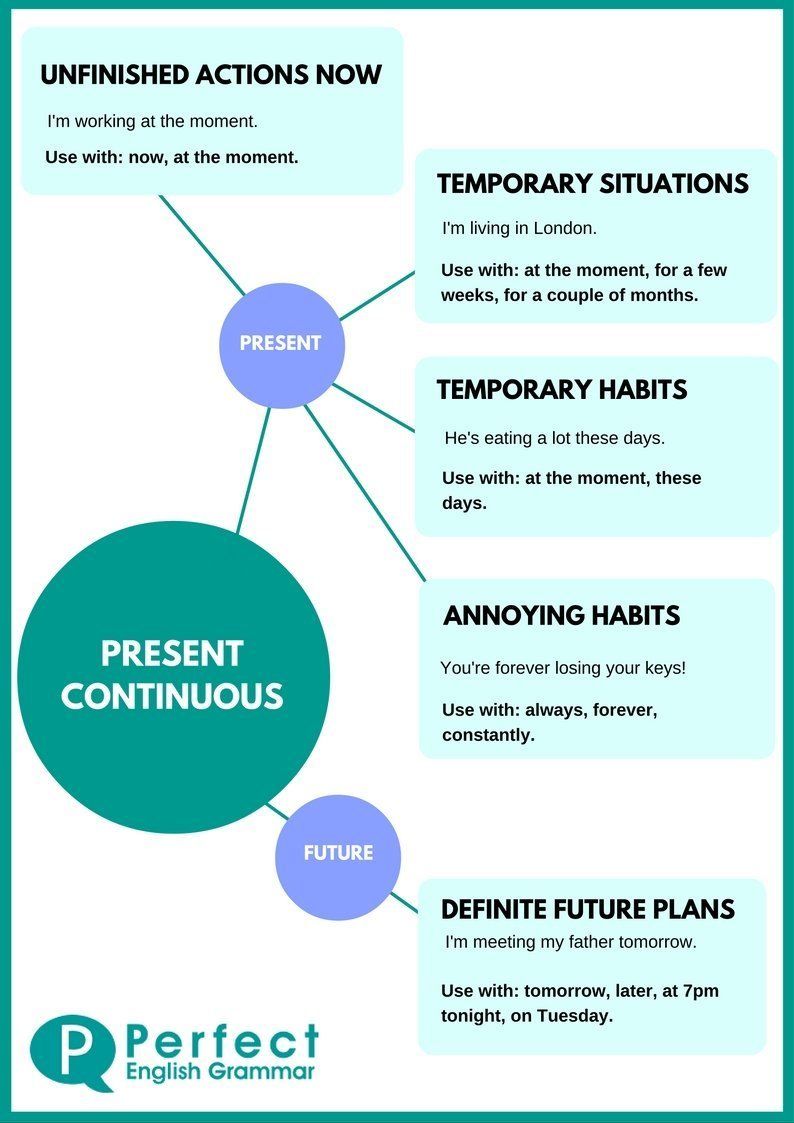
| First, we use the present continuous for things that are happening at the moment of speaking. These things usually last for quite a short time and they are not finished when we are talking about them. -I'm working at the moment. -Please call back as we are eating dinner now. -Julie is sleeping. | We can also use this tense for other kinds of temporary situations, even if the action isn't happening at this moment. John's working in a bar until he finds a job in his field. (He might not be working now.) I'm reading a really great book. She's staying with her friend for a week. |
| We can use the present continuous for temporary or new habits. We often use this with expressions like 'these days' or 'at the moment'. +He's eating a lot these days. +She's swimming every morning (she didn't use to do this). +You're smoking too much. | Another present continuous use is for habits that are not regular, but that happen very often. In this case we usually use an adverb like 'always', 'forever' or 'constantly'. Often, we use the present continuous in this way to talk about an annoying habit. +You're forever losing your keys! +She's constantly missing the train. +Lucy's always smiling! |
| Future Uses The next use is for definite future arrangements (with a future time word). In this case we have already made a plan and we are pretty sure that the event will happen in the future. +I'm meeting my father tomorrow. +We're going to the beach at the weekend. +I'm leaving at three. |
Want to create your own Flashcards for free with GoConqr? Learn more.