
12285756
Description

Flashcards by daniel upton, updated more than 1 year ago

|
Created by daniel upton
over 8 years ago
|
|
| Question | Answer |
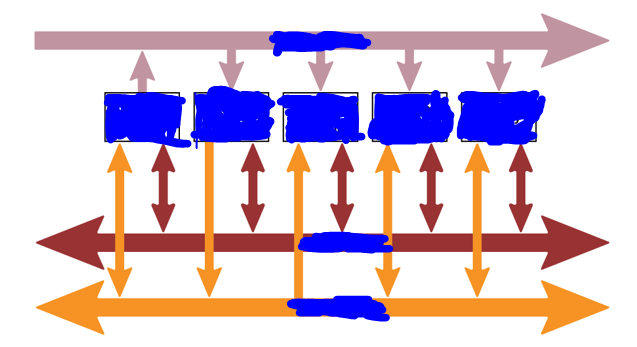
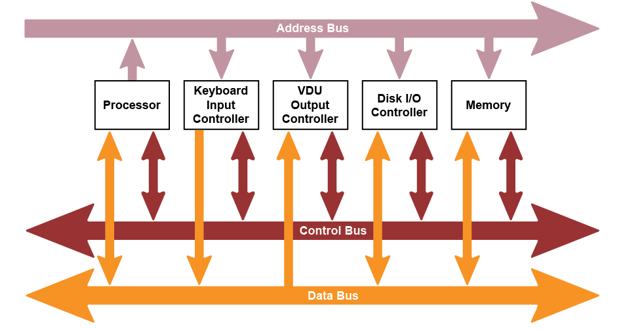
| What does the control bus do? | The control bus is used to send control signals between each I/O controller and the processor, as well as between the processor and memory |
| What does the address bus? | The address bus sends memory addresses from the processor to CPU components |
| What does the data bus do? | The data bus sends data and instructions between CPU components |
| General purpose registers | Really fast where data is stored temporarilly |
| Arithmetic logic unit | The problem solving part of the processor. This component performs arithmetic, logical and shift operations |
| control unit | The part of the processor that coordinates the activity of all other components |
| Program counter | Holds the memory address of the next instruction to be executed |
| Current instruction register | Holds the current instruction |
| Memory address register | Holds the address in memory where the processor is required to fetch or store data from or to |
| Memory buffer register | temporarily holds data moving between the processor and main memory |
| What is inside the cpu? | processor, cache, keyboard input controller, VDU Output controller and (Disk) I/O controller |
| What does an I/O Controller do? | An I/O controller for each device acts as an interface between the device and the computer.The controller converts the signals received from a peripheral device into a format the computer can process, and vice versa. It receives I/O requests from the CPU, and then sends device-specific control signals to the device it is controlling. It also manages the data flow to and from the device, freeing the CPU to get on with other tasks |
| What are device drivers? | The software that interacts directly with the I/O controller |
| What does memory read, memory write, bus request, bus grant and clock do? | Memory read: causes data from the addressed location to be placed on the data bus Memory write: causes data on the data bus to be written into the addressed location Bus request: indicates that a device is requesting use of the data bus Bus grant: indicates that the CPU has granted access to the data bus Clock: used to synchronise operations |
| What is a bus? | Buses in a computer consist of a series of wires that transfer data signals between internal components They typically consist of 8, 16, 32 or 64 lines |
| What is memory divided up into? | Words |
| What are the usual lengths of words | 8, 16, 32, 64 bits |
| What is the stored program concept? | computers are designed to allow data and instructions to be stored Machine code instructions are loaded into main memory to be executed by the processor The instructions are fetched one at a time and executed immediately by the processor in a sequential order |
| What is von Neumann architecture? | Instructions and data are stored in a common main memory and transferred using a single shared bus |
| what is Harvard architecture? | the data and instructions are seperated into separate memories using different buses |
| Why do most general purpose computers use von Neumann architecture? | Cost and programming complexity |
| What is used to synchronise the operations of the processor components? | A series of regular ON/OFF signals |
| What does the status register do? | Status register (SR) – holds information about the current state of operations. It is used to set flags (e.g. carry or overflow) or to detect error conditions |
| What are the steps of the fetch-execute cycle? | Address of next instruction transferred from PC to MAR PC incremented by 1 Instruction stored in location addressed by MAR is transferred to MBR Instruction in CIR is decoded Additional data if required by the instruction is fetched from memory This data is passed to the registers Instruction is executed by the ALU Registers are used to store intermediate data or results The result is stored in the accumulator or general purpose register or memory. |
| Name all the levels of cache | Level 1, level 2 and level 3 |
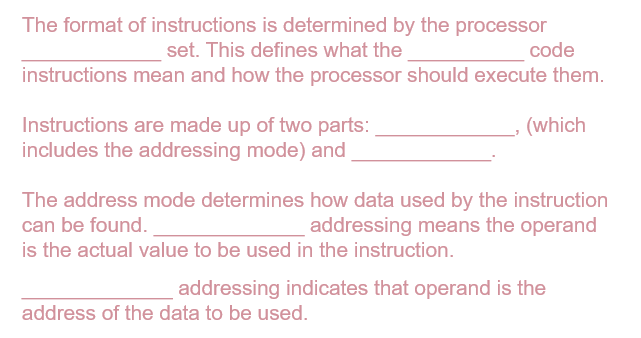
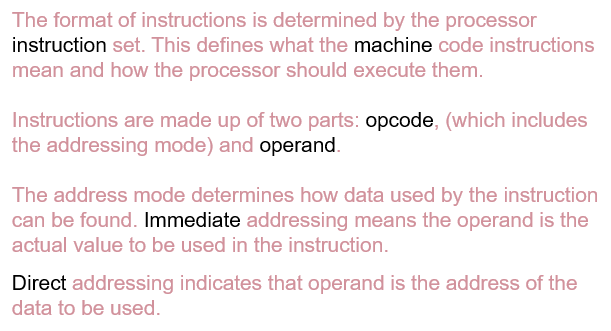
| What is an instruction set? | An instruction set describes the commands a processor can perform |
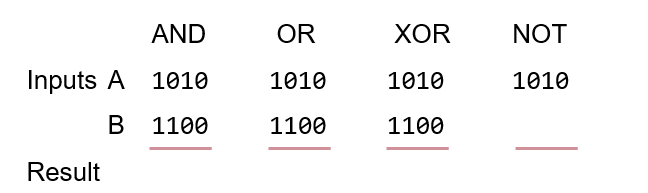
| Name the different types of instructions | Data transfer such as LOAD, STORE Arithmetic operations such as ADD, SUBTRACT Comparison operations to compare two values Logical operations such as AND, OR, NOT Branch – conditional and unconditional Shift operations – shift bits left or right in a register |
| what is machine code | A computer programming language consisting of binary or hexadecimal instructions which a computer can respond to directly. |
| What is in the op code | the actual command the processor needs to carry out, eg. ADD, SUB, etc. the addressing mode – specifies whether the operand is the actual data, the memory address where the data is held, or a register |
| What is the operand? | one or more items of data (which can be values, memory addresses or registers) that are to be used in the instruction |
| What is the addressing mode | (typically two bits) specifies which of the above describes the data |
| What is immediate addressing? | The operand is the actual value to be used in the instruction |
| What is direct addressing? | The operand in this case is the address of the location in memory of the data to be used |
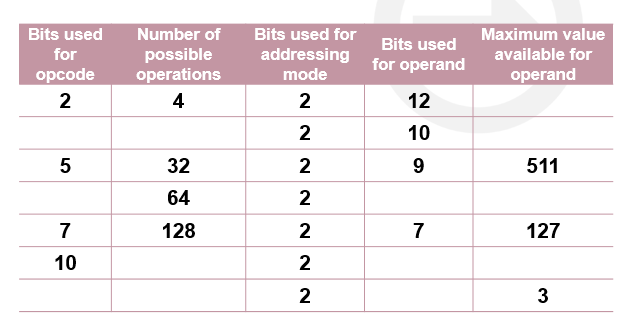
| 4095 4,16,1023 6,8,256 1024,4,15 12,9096,2 | |
| What is assembly code? | Assembly code is a low level language that uses mnemonics to represent instructions. |
| What is used in assembly language rather than if statements? | Compare and branch |
| What does branch do? | Does an instruction or do it if a certain condition is met |
| How do you loop in assembly language? | LOOP INPUT R0 ;input a number ADD R1,R1,R0 ;add number to R1 CMP R0, #0 ;compare number with 0 BNE LOOP ;branch if not zero |
| AND = 1000 OR = 1110 XOR = 0110 NOT = 0101 | |
| What does a shift operation do? | Moves the bits either left or right by an amount of bits |
| What are the two types of Barcode readers? | Universal Product Code version ‘A’(UPC-A) / European Article Number(EAN) and code 128 |
| What is (UPC-A)/(EAN) used for? | retail and warehousing |
| What is code 128 used for? | Transport and shipment tracking |
| What is the difference between code 128 and (EAN)/(UPC-A) | code 128 can represent letters and number whilst (UPC-A)/(EAN) can only represent numeric digits |
| What are the two parts of an UPC-A / EAN code? | Left side is the manufacturer number right hand side in the product number |
| What does QR code stand for? | Quick response code |
| What are the three patterns between left and right sides of bar codes? | Right hand codes are the inverse of left hand codes Left hand codes all have an odd number of black bars. Right hand codes all have an even number Visually, a grouping of two or more adjacent bars appear as a single wide bar |
| Where does a bar code start? | After the two guard bars which are at the beginning to show the start of the bar code the middle to separate the left and right sides and at the end to show the end of the bar code |
| What goes between the end of the bar code and the guard bars? | A check digit |
| What is a check digit? | A digit used for validity |
| What are examples of uses for QR codes? | Restaurant coupons Mobile concert tickets Estate agency boards Business cards Tourist information Advertising posters |
| How does a digital camera work? | The shutter opens to let light onto a Charge-Coupled Device (CCD) or Complementary Metal Oxide Semiconductor (CMOS) sensor at the back of the lens The intensity of light is measured by millions of tiny sensors (one per pixel) arranged in a grid on the sensor Light levels for each pixel are represented as binary values This information is now stored as an image in the camera’s memory |
| How is colour detected on a camera? | Red, Green or Blue filters are used with different sensors in the camera to separate out these wavelengths The intensity of each of these colours falling on the sensors is measured and stored to aggregate an RGB value |
| How does a laser printer work? | Laser printers use dry powdered ink called toner A print drum is given a negative static charge A laser shines a reverse image of the page at the drum Laser light reverses the charge on the drum Toner is charged negatively and sticks to positively charged image Toner is transferred from drum to the paper and fused using a heat roller |
| What does RFID stand for? | Radio Frequency ID |
| How does an RFID system work? | RFID systems use a transponder and a receiver The powered receiver emits radio frequency energy The transponder antenna in the bank card, mobile phone or tag becomes energised by radio waves The transponder can then send data to the receiver |
| What are the uses of RFID tags? | Security control points or identification of people, animals, goods or valuables Shipping and supply chain tracking for goods Banking and fast-payment systems As a potential replacement for barcode systems |
| What is a passive tag? | Passive transponders, used in bank cards for example, have no power source themselves and rely on the radio waves from the receiver for their energy |
| What is an active tag? | Active tags use a larger, battery powered beacon which can broadcast its own signal to receivers up to 300m away |
| How do magnetic storage devices work? | Positive or negative polarisation of magnetic particles creates a binary pattern on the disk Changes from negative to positive, or vice-versa creates electromagnetic pulses Each pulse (or change) is read as a 1. Anything else is a 0 |
| How do Hard disks work? | Concentric tracks are created on a magnetic disk Disk spins at high speed: 3,600 – 7,200rpm Spinning platters are each read by drive heads Data is read or written as sector moves under the head |
| What are the causes of disk latency? | Seek delay - the time the head takes to move across the disk Rotational delay - the time the disk takes to move to the correct sector underneath the read/write head Transfer time to move the actual data |
| How does a CD work? | A high powered laser “burns” pits into the CD surface A low-powered laser detects the reflection from pits and lands Only a pit end deflects the laser light and is read as a binary 1 |
| How can you store more space on a disk? | Different laser wavelengths ‘burn’ smaller pits The spiral track can therefore be more tightly wound, creating a longer track |
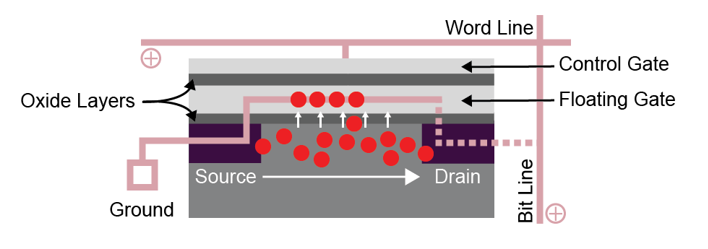
| How does NAND flash memory cells work? | |
| How do blocks of flash memory cells work? | An electron trapped inside the middle layer reads as a 1, outside the middle is read as a 0 Data must be read, deleted or written in blocks Data cannot be overwritten without being erased first |
Want to create your own Flashcards for free with GoConqr? Learn more.