
13128969
Description

Flashcards by Maxime PANS, updated more than 1 year ago

|
Created by Maxime PANS
almost 8 years ago
|
|
| Question | Answer |
| Longitudinal Waves | A wave that vibrates in the direction of energy release.E.g Sound Waves |
| Transverse Waves | A wave that the Vibration is at a right angle to the direction. |
| What is Frequency | How many waves are in a certain time period (usually 1 second) |
| What is Amphlitude | how big the wave is (determines the volume of the sound) |
| What is a Wavelength | is the length of a full wave from one point of the wave to the same point of the following wave. |
| Wave Speed = | Frequency x Wavelength f x λ |
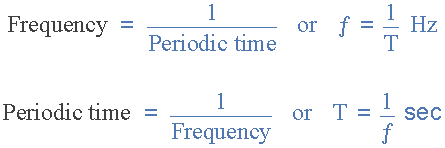
| How Frequency relates with time period |
Image:
Tim2 (binary/octet-stream)
|
| The Colours in Visible Light | Red Orange Green Yellow Blue Indigo Violet |
| Electromagnetic Colour Rule | All electromagnetic waves travel at the same speed in free space. The higher the frequency, the higher energy |
| Electromagnetic Spectrum | Radio waves Microwaves Infra-Red Radiation Visible Light Ultra Violet X Rays Gamma Rays |
| Radio Waves Uses | Broadcasting and communications |
| Microwaves Uses and Dangers | Cooking and satellite transmissions Internal heating of body tissue |
| Infra-Red Radiation Uses and Dangers | Heaters and night vision equipment Skin burns |
| Ultra Violet Uses and Dangers | Fluorescent lamps Damage to surface cells and blindness |
| X- Rays uses | Observing the internal structure of objects and materials and medical applications |
| Gamma Rays Uses and Dangers | Sterilising food and medical equipment Cancer, mutation |
| Wavefronts | A wavefront is an imaginary surface representing corresponding points of a wave that vibrate in unison. When viewed from above it can be seen as like a peak of the wave |
| The Doppler Effect | As the ambulance travels towards you the emitting of the sound stays constant. However since it’s moving towards you and its travelling slightly closer to the speed of sound it emits the sound closer to the previous sound wave. This means when that there is a higher frequency which therefore means a higher pitch. When the ambulance passes you the frequency decreases along with the pitch because the ambulance is travelling away from you so the wavelengths increase. This is because the sound source is moving away from you meaning the ambulance emits the sound wave further from the last. |
| Reflection | - Know that Light Waves are Transverse and Sound Waves are Longitudinal but both can be reflected and refracted. Light moves in STRAIGHT LINES that’s why we can’t see around the corner. - Sound waves produce echoes which are reflections of waves. This also tells us that sound travels slower than light as echoes take a significant time to reach us. - The angle of incidence is equal to the angle of reflection, - I = r |
| Refraction | Refraction is when a wave hits a denser object causing it to decrease in speed and change direction. However it depends on the angle of incidence. When it hits the block the density increases making the speed decrease along with the wavelength. The light always bends towards the normal. The number of how optically dense an object is the refractive index. It is a number that tells us how much light slows down (compared to light travelling through a vacuum).If the refractive index was 2, it would mean that light travels 2 times faster in a vacuum. Refractive index = sin i / sin r |
| The Critical Angle | - The critical angle is the last angle that refraction happens at which light is refracted at 90 degrees along the surface edge. c= sin^-1 (1/n) - Diamond has a very large refractive index, meaning light will reflect more often- this is what causes it to sparkle. |
| Total Internal Reflection | - It can only happen when it goes from a higher reflective index to a lower reflective index. - Only happen if angle > than the critical angle. An example is fibre optic cables. |
| Hearing Sound | - Longitudinal Sound Waves are travelling through the air as vibrations of air molecules and those vibrations are being detected by your ears. Range of Human hearing is 20 - 20,000 Hz Infrasound is below 20Hz Ultrasound is above 20,000Hz Speed of sound is 330m/s |
| Seeing Sound | The X axis on the oscillation machine shows the time period, one box = 1 time period. The Y axis shows the voltage reading which shows the sound. The sound gets displayed by sound being converted into voltage and displayed then on the screen. If we change the divisions the wave will look different on the screen however will be the same value. |
Want to create your own Flashcards for free with GoConqr? Learn more.