
13385925
Description

Flashcards by Hyper Molecular, updated more than 1 year ago

|
Created by Hyper Molecular
over 8 years ago
|
|
| Question | Answer |
| What is the equation for speed (scalar quantity)? | Speed = Distance / Time OR V = S / T |
| On a Distance-Time graph, what does a horizontal line mean? | It means that the object is stationary |
| On a Distance-Time graph, what does a straight, sloping line mean? | It means that the object is travelling at a constant speed |
| What does the gradient represent on a Distance-Time graph? | It represents the object's speed |
| What are the other rearrangements of the formula for speed? | Time = Distance / Speed (T = S / V) AND Distance = Speed x Time (S = V x T) |
| What does the letter 's' represent in the formula for speed? | Distance |
| What is a vector quantity? | Vector quantities (e.g. 3 m/s as a velocity) have a magnitude (size) and a direction |
| What is a scalar quantity? | Scalar quantities (e.g. 3 m/s as a speed) only have a magnitude, not a direction |
| What is velocity? | Velocity is a speed given, but in a certain direction |
| What is the formula for acceleration? | Acceleration = Δv -------- t |
| In the formula for acceleration, what does 'Δv' mean? | The change in velocity |
| In the formula for acceleration, what does 't' mean? | The time taken |
| Give ONE/ANOTHER equation involving acceleration. (If you already did one of these before, do a different formula) | a = Δv / t OR v² - u² = 2as OR a = (v - u) / t |
| Give ONE/ANOTHER equation involving acceleration. (If you already did one of these before, do a different formula) | a = Δv / t OR v² - u² = 2as OR a = (v - u) / t |
| Give ONE/ANOTHER equation involving acceleration. (If you already did one of these before, do a different formula) | a = Δv / t OR v² - u² = 2as OR a = (v - u) / t |
| Give an example of how you can measure acceleration in real life. | Use a motion sensor connected to a computer (which can measure velocity changes), which will automatically create a velocity-time graph for you |
| In a Velocity-Time graph, what does a horizontal line mean? | It means that the acceleration is zero (travelling at a constant speed) |
| In a Velocity-Time graph, what does a positive gradient mean? | It means that there is a positive acceleration |
| In a Velocity-Time graph, what does a negative gradient mean? | It means that there is a negative acceleration (deceleration) |
| How do you work out the distance travelled on a Velocity-Time graph? | You can work out the distance on a Velocity-Time graph by calculating the area under the line |
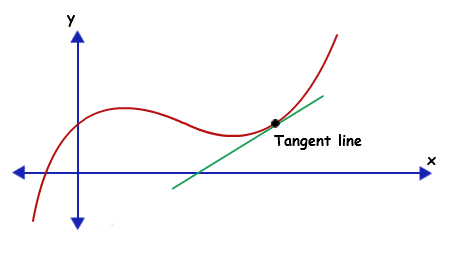
| Explain what the tangent of a curved line looks like. | Pick any point on a curved line, and draw a straight line that touches that point on the curved line only. This straight line is the tangent |
| How do you work out the speed at a particular point on a graph line that is curved? | Create a tangent of that point, and use the formula: gradient = change in x / change in y to work out the gradient/speed of the tangent (straight) line. The gradient is equal to the speed. |
Want to create your own Flashcards for free with GoConqr? Learn more.