
16310451
Description

Flashcards by Erin Vales, updated more than 1 year ago

|
Created by Erin Vales
about 7 years ago
|
|
| Question | Answer |
| Goal of Statistical Inference | to use data collected in a sample and statistics computed from this data to make statements about some parameter of the population |
| Statistical Hypothesis | a statement about a population parameter (population mean, population standard deviation, population proportion, etc.) |
| Null Hypothesis | a conjecture about a population parameter that is presumed to be true usually a statement of no effect or no change |
| Alternative Hypothesis | a conjecture about the population parameter that the researcher hopes is true |
| Test Statistic | some quantity calculated from the sample data that we use to assess the strength of the evidence against the null hypothesis |
| P value | the probability, assuming that the null hypothesis is true, that the test statistic takes a value as extreme or more extreme that the value actually observed small p value provides evidence against the null hypothesis |
| Significant | a test that rejects the null hypothesis |
| Insignificant | a test that fails to reject the null hypothesis |
| Significance level | the probability of rejecting the null hypothesis when it is actually true that a researcher is willing to risk denoted by the alpha symbol |
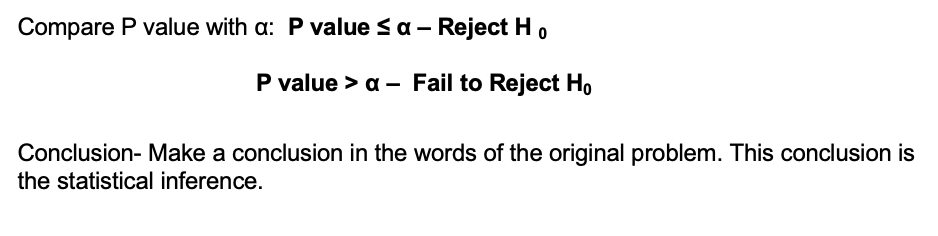
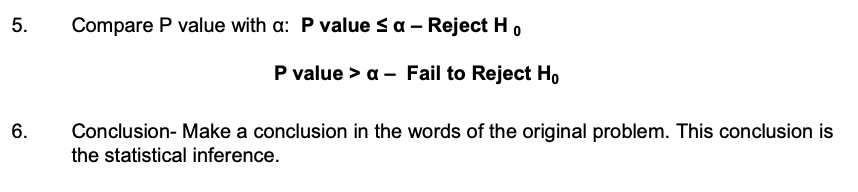
| Comparing p value to significance level | |
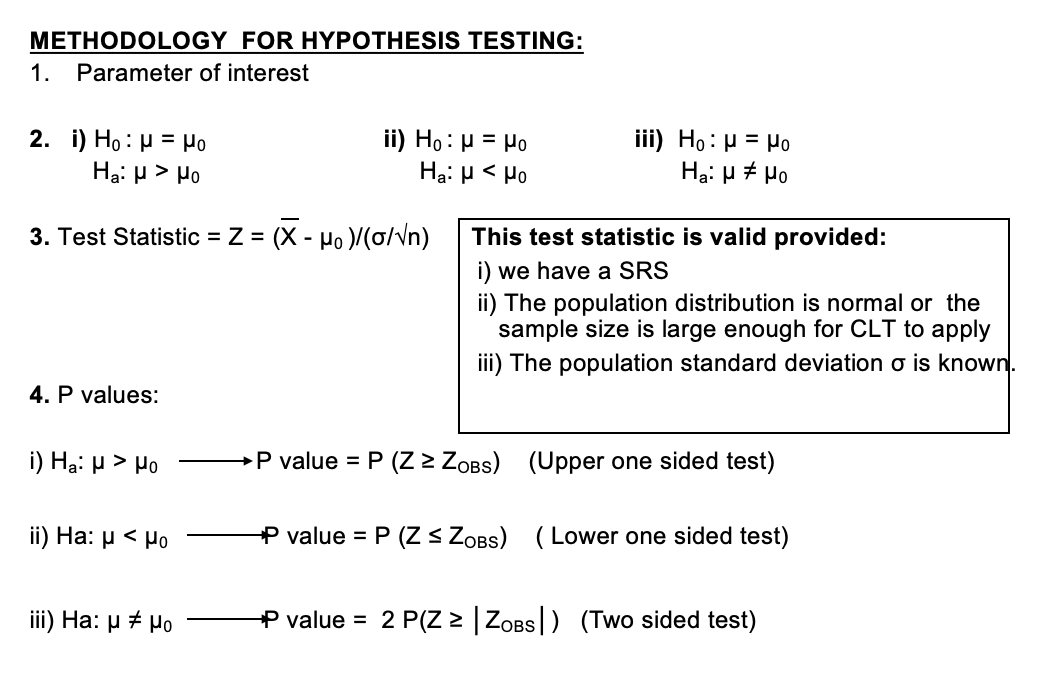
| Significance test for Population Mean **when population standard deviation** | |
| Significance test for Population Mean (cont.) **when population standard deviation is KNOWN** | |
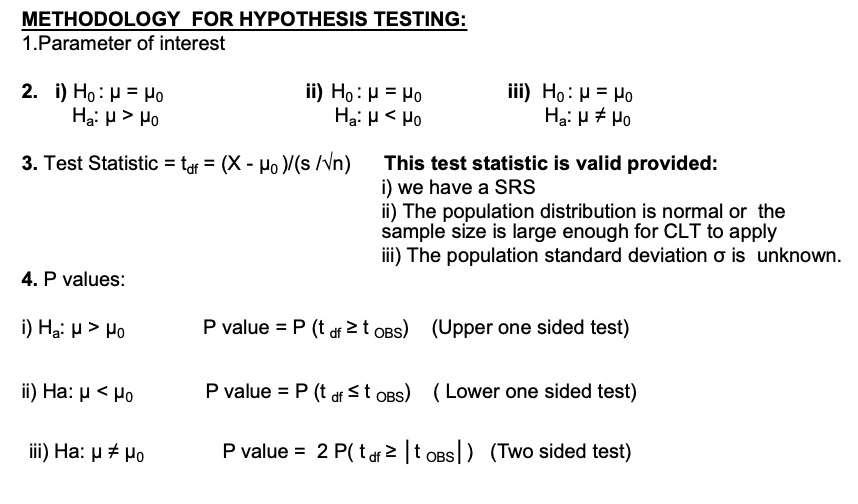
| Significance test for Population Mean **when population standard deviation is UNKNOWN** | |
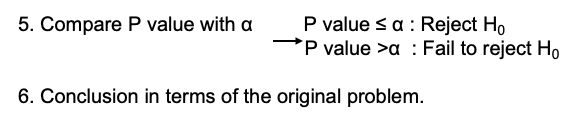
| Significance test for Population Mean (cont.) **when population standard deviation is UNKNOWN** | |
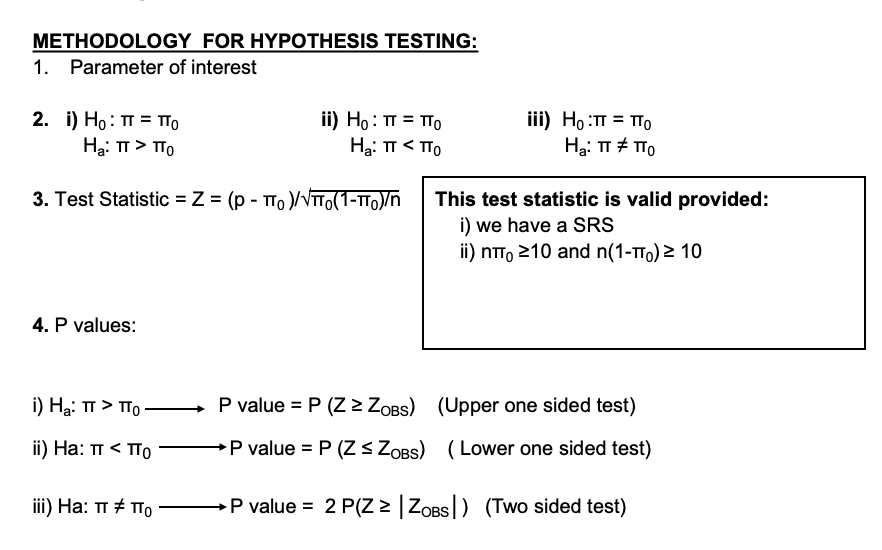
| Significance test for Population Proportion (pi) | |
| Significance test for Population Proportion (pi) (cont.) |



Want to create your own Flashcards for free with GoConqr? Learn more.