
16753847


| Question | Answer |
| Define a wave | Periodic disturbance in a material (medium) or space |
| Each particle of the medium.... | Oscillates (or vibrates) about a fixed position |
| Due to this oscillation, the wave transfers.... | Energy without any material being transferred |
| Mechanical waves are.... | Motion of matter through vibrations of particles (e.g. sound waves and water waves) |
| Electromagnetic waves are.... | Vibrating electric and magnetic fields that can travel through a vacuum (also the fields are oscillating) |
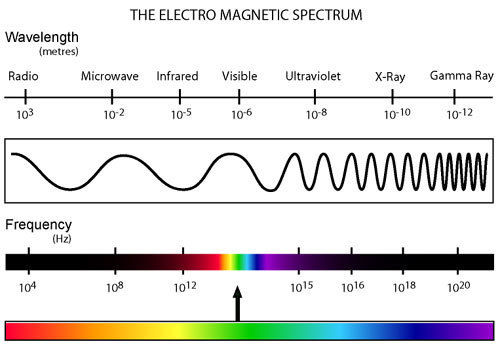
| Electromagnetic spectrum: | |
| X-rays come from.... | Electrons |
| Gamma rays come from.... | A nucleus |
| The wavelength of red light is.... | 7 x 10^-7 m (1sf) 700nm |
| The wavelength of blue light is.... | 4 x 10^-7m (1sf) 400nm |
| We should know that the EM Spectrum is.... | Continuous |
| Progressive waves are waves that.... | Move outwards from the source |
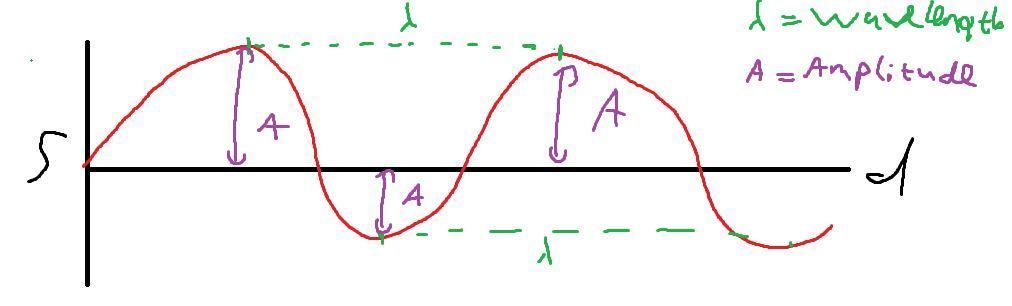
| Displacement-distance wave graph: | |
| Define Amplitude | Maximum displacement from equilibrium position |
| Define Wavelength | Horizontal distance between either: 2 crests 2 troughs Any 2 corresponding parts of same wave |
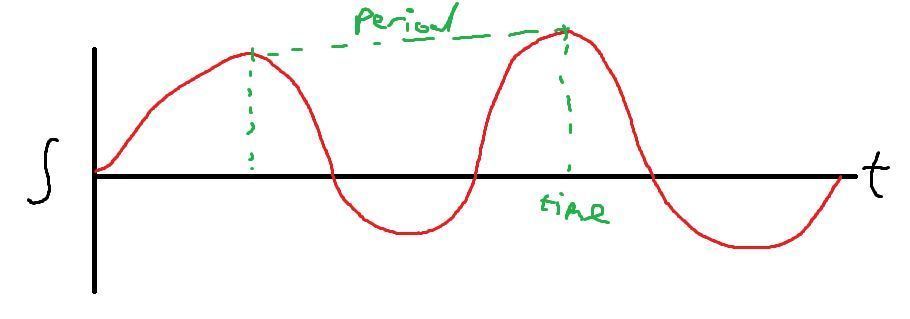
| Displacement-time wave graph: | |
| Time period (T) is.... | The time in seconds for a wave to travel a distance of 1 wavelength |
| What is the formula for period? | Frequency = 1/period |
| Define frequency | Number of waves passing a point per unit time (usually per second) (1Hz = 1 per second) |
| What are the 2 units for frequency? | Hz or s^-1 |
| What is the wave equation? | V = fλ (Speed ms-1 = frequency hz x wavelength m) Note V may also be wrote as a C |
| What is the equation similar to speed distance time but used for waves? | V = λ / T (speed = wavelength x time period) |
| Define a radian: | When the length of an arc equals the radius the angle is 1 radian (2π = 360 degrees) |
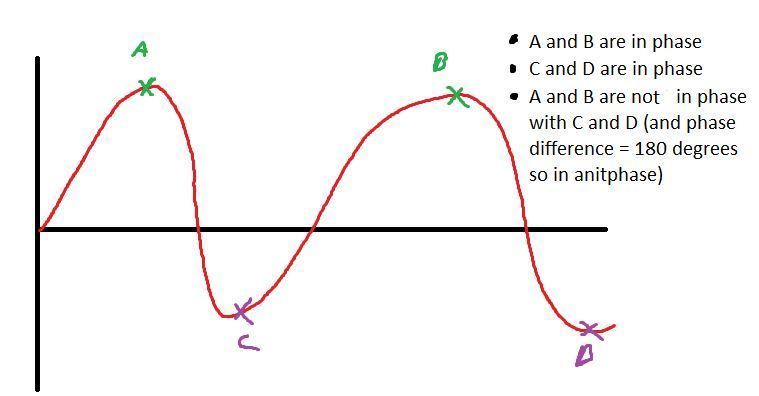
| Define phase | Exactly the same pattern of oscillation |
| When in phase, the phase difference is.... | 360 degrees |
| Antiphase is a specific circumstance where.... | When out of phase, the phase difference is 180 degrees |
| Diagram to illustrate phase: | |
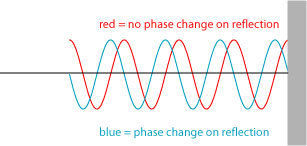
| Reflection is when.... | Waves hit a boundary they can't pass so are reflected back |
| When reflected, waves undergo a phase change of.... | 180 degrees or (π rad) |
| Reflection diagram of phase change | |
| 2 equations for working out phase difference: | 2π x (t/T) , (time difference / time period) 2π x (d/λ) , (distance / wavelength) |
| If points on a wave are in phase, the radian value of their phase difference is.... | 2π |
| What does the word propagation mean? | Movement |
| For transverse waves, the direction of wave propagation is..... | Perpendicular to oscillations |
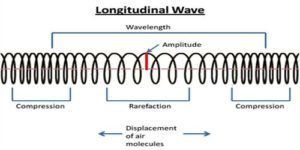
| For longitudinal waves, the direction of wave propagation is.... | Parallel to oscillations |
| Compression and rarefaction diagram: | |
| On a model of longitudinal wave, what do the peaks and troughs represent? | Peaks = compression Troughs = rarefactions |
| Examples of transverse waves: | EM waves, water waves , waves on string, S-waves (secondary , seismic) |
| Examples of longitudinal waves: | Sound waves , P-Waves (seismic) |
| In the wave equation , v=fλ , what value is usually constant? | v |
Want to create your own Flashcards for free with GoConqr? Learn more.