
17003664


| Question | Answer |
| Standing waves are also referred to as..... | Stationary Waves |
| Essentially, a standing wave is..... | The superposition of 2 progressive waves travelling in opposite directions producing a standing wave |
| The 2 progressive waves in superposition should have the same..... | Amplitude and frequency |
| How is a standing wave formed (exam answer) ? | Incident wave send down string It's then reflected at the fixed end This reflected wave and another incident wave superpose The incident and reflected waves have the same amplitude and frequency Producing pattern of nodes and anti-nodes AKA standing waves |
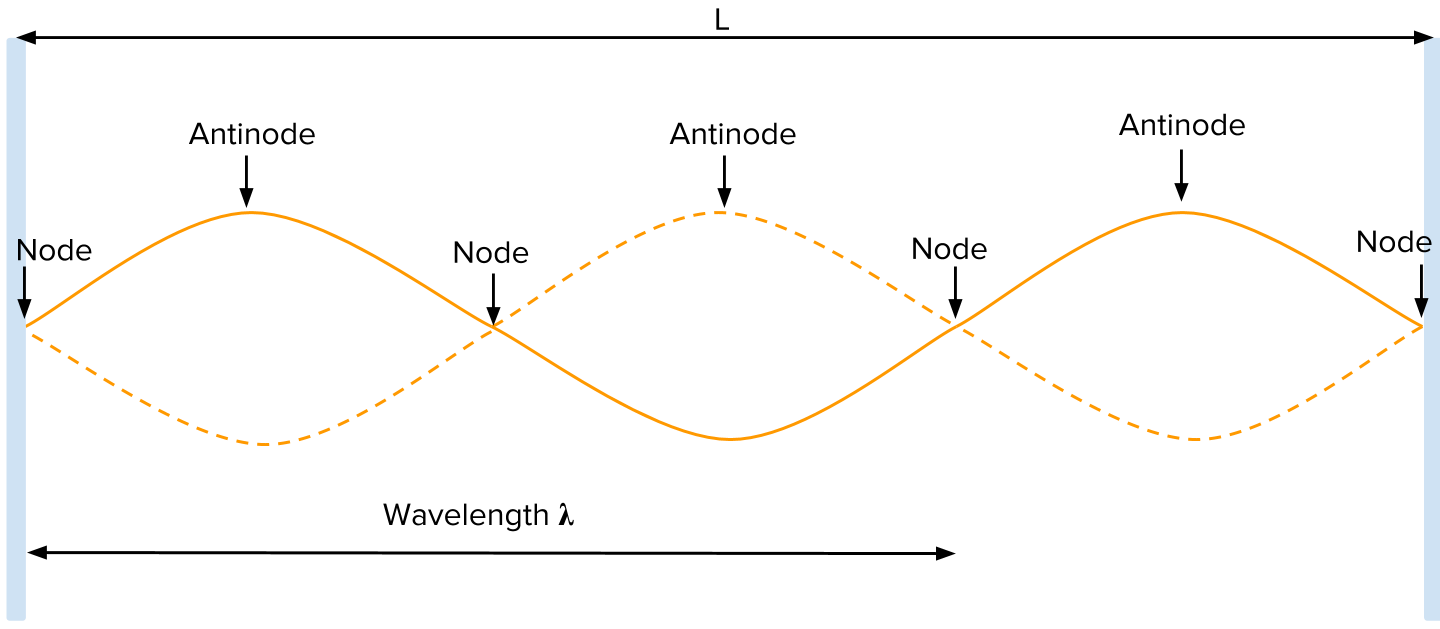
| What are the properties of a node on a standing wave? | It has 0 amplitude (is always stationary) |
| What are the properties of an anti-node on a standing wave? | It has maximum amplitude (is always oscillating) |
| Standing wave diagram: | |
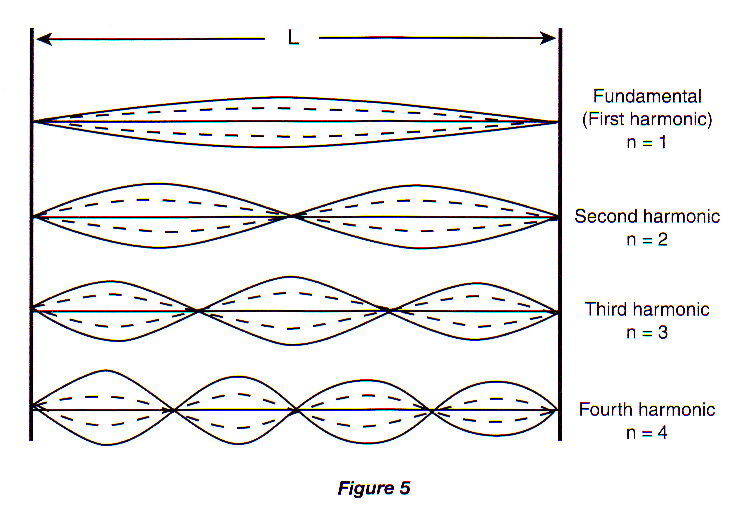
| The first harmonic (fundamental frequency) standing wave has what wavelength? | λ / 2 |
| The second harmonic standing wave has what wavelength? | λ |
| The third harmonic standing wave has what wavelength? | 1.5 λ (this pattern continues) |
| Harmonic standing wave diagram: | |
| For standing waves, which value of the wave equation (v=fλ) is fixed? | v (wave speed) |
| What is the equation for finding the first harmonic frequency (fundamental frequency) ? | f = 1/2l x root(T/μ) f = fundamental frequency Hz l = length of string m T = tension in string N μ = mass per unit length kgm-1 |
| How do we work out tension? | T = mass (on string) x gravity |
| How do we work out mass per unit length? | μ = M / L M = mass of string L = length of string Note m and M are not the same!!!!! |
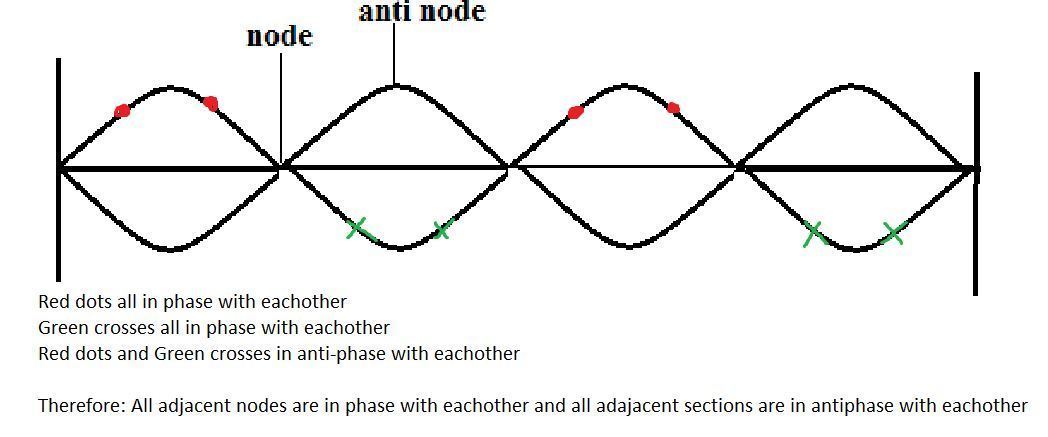
| Diagram for phase of standing wave: | |
| Amplitude on progressive wave is..... | A constant value equal to amplitude |
| Amplitude on a standing wave..... | Varies from 0 to max amplitude |
| Phase on a progressive wave..... | Constantly varies |
| Phase on a standing wave: | In phase with adjacent nodes In anti-phase with adjacent sections |
| Energy on progressive waves: | Transferred in direction of travel |
| Energy on standing waves: | Stored in wave |
Want to create your own Flashcards for free with GoConqr? Learn more.